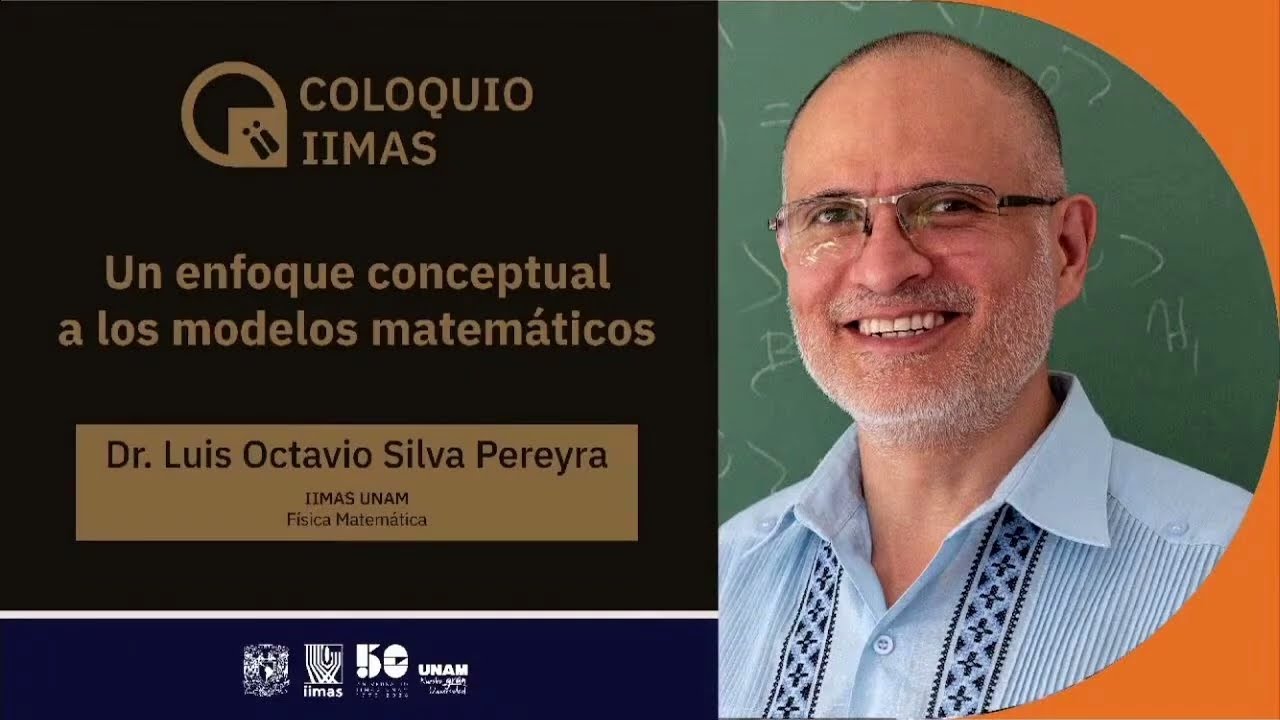
Un enfoque conceptual a los modelos matemáticos. 26 marzo 2026
Keywords
Summary
293 words
Critical Evaluation
Value of the Information & Strength of the Argument
The talk provides a valuable conceptual framework for understanding mathematical models, emphasizing their role as autonomous mental constructs that can be manipulated to predict and explain phenomena. The speaker effectively illustrates the evolution of models from Ptolemaic to modern quantum mechanics, highlighting both their power and limitations. He argues that mathematical models are not just tools but are intimately connected to the theories they represent, as seen in the case of von Neumann’s axiomatization of quantum mechanics, where functional analysis becomes the theory itself. The argumentation is solid, drawing on historical examples and personal research, though it is more of an expert opinion than a systematic review. The speaker also raises important philosophical questions about the nature of randomness and the relationship between models and reality, which adds depth to the discussion.
Scientific Rigor, Source Quality, Title Accuracy
The speaker demonstrates scientific rigor by accurately describing historical models and mathematical concepts. He references specific works, such as the Almagest, and mentions the Aharonov-Bohm effect, which was experimentally confirmed. However, he does not provide explicit citations or references during the talk, relying on his expertise. The title accurately reflects the content, which is a conceptual exploration of mathematical models. The talk is well-structured and technically sound, though it assumes some familiarity with advanced mathematics and physics. The speaker also acknowledges the limitations of models, such as the difficulty in determining parameters in epidemiological models, which shows critical thinking.
246 words
Title / Content Match
The title accurately reflects the content, which focuses on a conceptual approach to mathematical models.
Quality & Reliability
8/10
The speaker is a researcher at IIMAS-UNAM in mathematical physics, providing a rigorous conceptual overview of mathematical models. The content is well-structured and technically accurate, though it is a colloquium talk rather than a peer-reviewed publication.
Key Moments
Markers derived by PSI from the transcript: the creator did not define chapters.
- Introduction to calendars as early mathematical models and the role of astronomers in ancient civilizations.
- Discussion of the Ptolemaic model and its mathematical description in the Almagest, including the construction of physical machines.
- Explanation of analytic geometry and the concept of point mass, leading to differential equations as models.
- Limitations of Newtonian dynamics with three bodies, and mention of exact solutions like choreographies.
- Overview of general relativity as a geometric model of motion.
- Axiomatic formulation of non-relativistic quantum mechanics using Hilbert spaces and self-adjoint operators.
- Discussion of the Aharonov-Bohm effect and the importance of mathematical proof in quantum mechanics.
- Introduction to functional models and their role in extending the spectral theorem.
- Comparison of deterministic and probabilistic models, and the philosophical issue of randomness.
- Derived models such as the wave equation and homogenization, and phenomenological models like SIR and simulations like Game of Life.
Cited Sources
- Almagest — Mentioned as the book where Ptolemy described his geocentric model mathematically.
- Aharonov-Bohm effect — Discussed as a quantum phenomenon that was later experimentally confirmed.
Concurring Sources
- Mathematical model - Wikipedia — General reference on mathematical models, consistent with the talk's conceptual framework.
- Aharonov-Bohm effect - Wikipedia — Provides background on the effect discussed in the talk.
Contribution & Novelties
The talk offers a unique conceptual perspective on mathematical models, emphasizing their autonomy and their role as bridges between theory and reality. It also highlights the speaker’s own research on functional models, which provides an alternative viewpoint on quantum mechanics. The discussion of models derived from models, such as homogenization and fractional derivatives, adds depth to the understanding of how mathematical frameworks evolve.
Pour aller plus loin :
- Mathematical model — Provides a general overview of mathematical models and their types.
- Ptolemy’s Almagest — Background on the ancient astronomical treatise.
- Aharonov-Bohm effect — Detailed explanation of the quantum phenomenon.
- Von Neumann axioms — Overview of the axiomatic formulation of quantum mechanics.
- Homogenization (mathematics) — Technique for deriving effective models.
119 words
Radar Profile
The radar profile shows high scores in quantity and quality of information, with a strong technical level, indicating a dense and rigorous presentation. The overall reliability is also high, reflecting the speaker's expertise. The profile suggests a talk that is rich in content but may be challenging for a general audience.
💬 Sur les 0 commentaires analysés, aucune tendance n'est disponible.