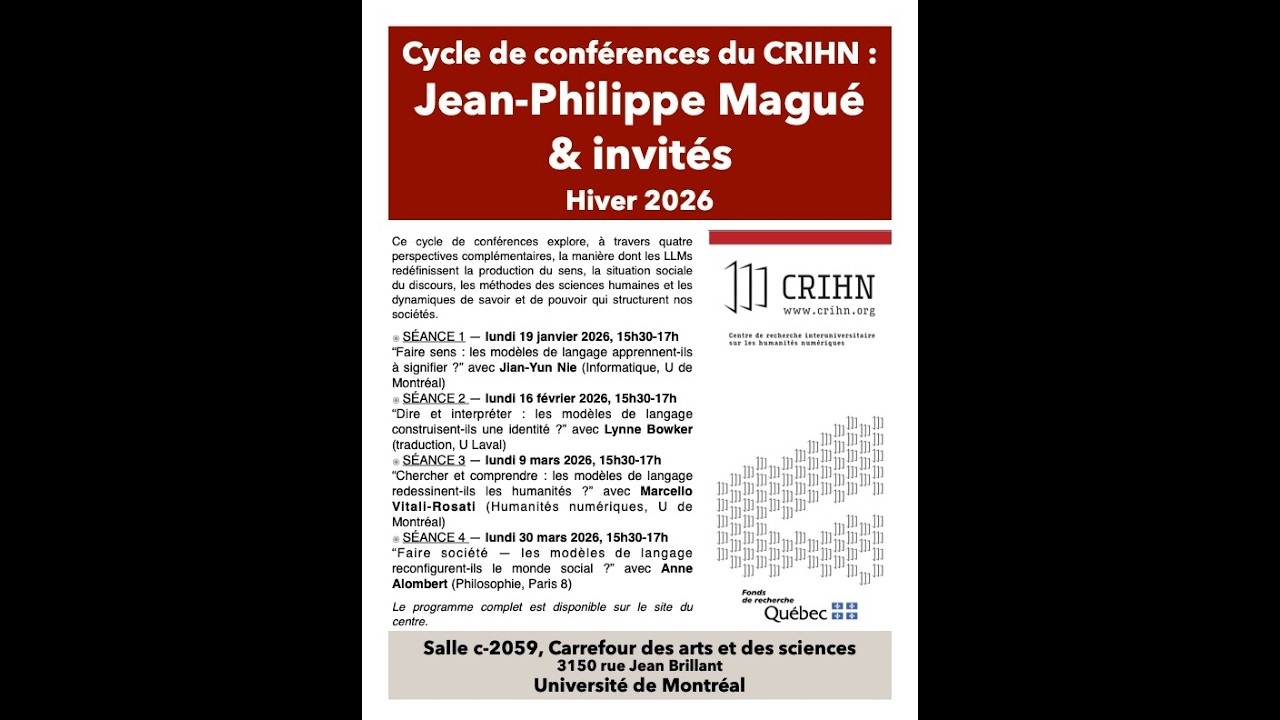
Vidéo de la conférence de Jean-Philippe Magué (ENS Lyon) & Lynne Bowker (U Laval)
Keywords
Summary
151 words
Critical Evaluation
Value of the Information & Strength of the Argument
The talk provides a valuable conceptual framework for understanding LLM identity from a linguistic perspective. The argument is well-structured, moving from the observation of ‘who’ in Anthropic’s constitution to the inherent social situatedness of language, and then to empirical evidence of LLM traits. The speaker effectively uses examples and analogies, such as comparing LLM identity to human role-playing. However, the argumentation could be strengthened by more concrete citations and a deeper engagement with counterarguments. The discussion of empirical studies is brief and lacks critical evaluation.
Scientific Rigor, Source Quality, Title Accuracy
The talk references Anthropic’s blog and mentions empirical studies on political positioning and personality traits, but does not provide specific citations or URLs. The title accurately reflects the content. The speaker’s expertise in linguistics lends credibility, but the lack of detailed sourcing limits the scientific rigor. No comments were provided for analysis.
152 words
Title / Content Match
The title accurately reflects the content, which explores whether language models construct an identity.
Quality & Reliability
7/10
The talk is an expert opinion based on linguistic theory and some empirical studies, but lacks detailed citations and rigorous methodology. The argument is coherent but relies on anecdotal examples and general references.
Key Moments
Markers derived by PSI from the transcript: the creator did not define chapters.
- Introduction by Michel Sénatra, presentation of the seminar series and guest Lynne Bowker.
- Jean-Philippe Magué introduces the topic: do LLMs construct an identity? He cites Anthropic's constitution using 'who'.
- Discussion on the first-person pronoun in LLM responses and the who/what distinction.
- Argument that all utterances are socially situated, expressing identity through content and style.
- Explanation that interpretation is also socially situated, leading to inevitable identity projection onto LLMs.
- Contrast between human identity formation through social trajectory and LLM identity through training data.
- Presentation of empirical studies showing LLMs have political and personality traits, but are manipulable via prompts.
- Rebuttal of the manipulability argument, comparing to human role-playing and fiction.
- Conclusion: LLMs occupy a liminal space between subject and object, and identity is a necessary byproduct of linguistic interaction.
Cited Sources
- Anthropic's constitution blog post — Referenced as the source of the quote about Claude's constitution defining 'who Claude is'.
Concurring Sources
- Anthropic's constitution blog post — Supports the claim that LLM developers frame models in terms of identity.
Contribution & Novelties
The talk offers a novel perspective by applying sociolinguistic theories of identity to LLMs, arguing that identity is an inherent aspect of linguistic interaction. It challenges the view that LLM identity is merely a superficial artifact of prompts.
Pour aller plus loin :
- Sociolinguistics — Provides background on how language varies with social identity.
- Theory of enunciation — Relevant to the concept of socially situated utterances.
- Big Five personality traits — The framework used in the cited study on personality manipulation.
81 words
Radar Profile
The radar profile shows balanced scores across information quantity, quality, technical level, and reliability, indicating a well-rounded but not exceptional presentation. The talk is strong in conceptual depth but could benefit from more rigorous sourcing.