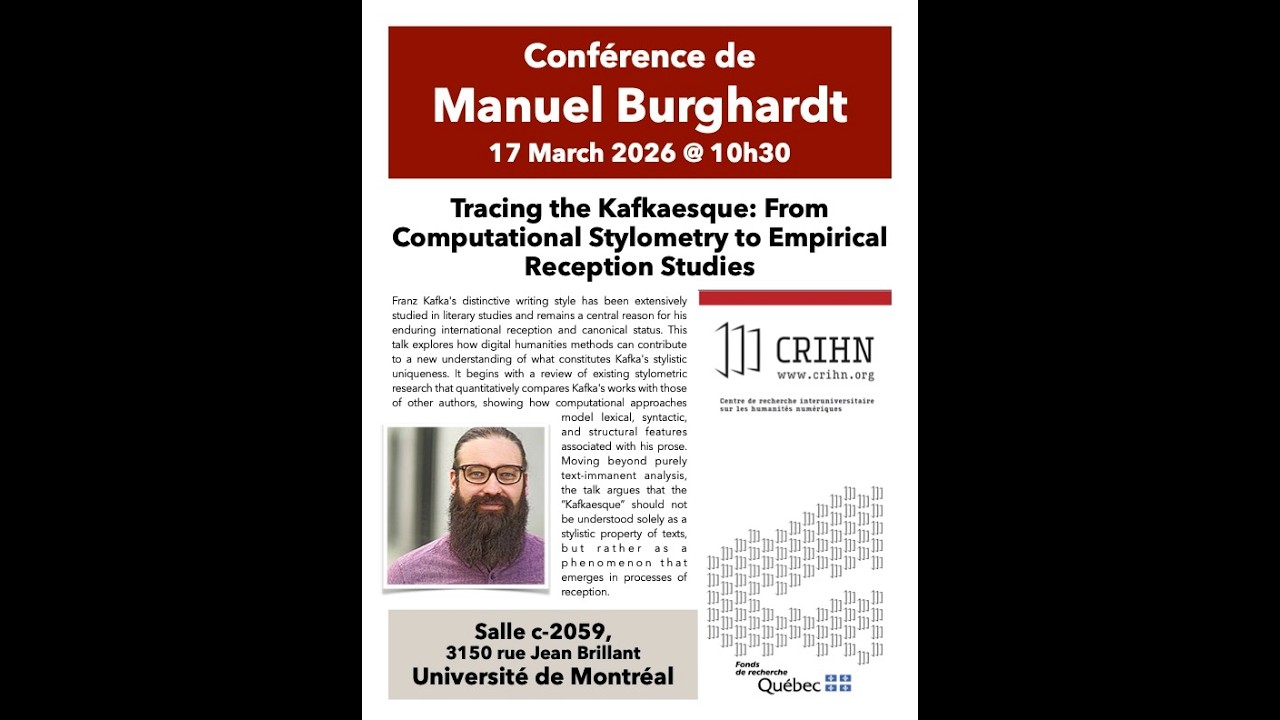
CRIHN conference: Manuel Burghardt (Universität Leipzig) on « Tracing the Kafkaesque » (17/03/26)
Keywords
Summary
196 words
Critical Evaluation
Value of the Information & Strength of the Argument
The value of the information lies in its innovative combination of computational text mining with reception theory, offering a novel perspective on literary studies. The argumentation is solid: Burghardt systematically builds a case for using Goodreads reviews as a proxy for reader reception, addressing potential biases and methodological challenges. He supports his claims with concrete examples and data from his corpus, and he is transparent about the limitations of his initial analyses. However, the talk is more of a research proposal than a fully validated study, and some conclusions are tentative.
Scientific Rigor, Source Quality, Title Accuracy
The talk demonstrates scientific rigor through its careful methodology and use of established concepts like stylometry and reception theory. Burghardt cites relevant literature, including Frieda Krauss’s dissertation and other stylometric studies, and he references the work of Roman Ingarden and Wolfgang Iser. The sources are appropriate and credible, though the talk does not provide a full bibliography. The title accurately reflects the content, which traces the Kafkaesque through computational and empirical reception studies. The talk is well-structured and the argumentation is clear, though it would benefit from more detailed discussion of the methodological limitations.
200 words
Title / Content Match
The title accurately reflects the content, which traces the concept of the Kafkaesque through computational and empirical reception studies.
Quality & Reliability
8/10
The talk presents a well-structured methodological approach, combining computational methods with reception theory, and grounds its claims in a large corpus of Goodreads reviews. The speaker is a professor in computational humanities, and the presentation includes references to existing studies and theoretical frameworks. However, the talk is a conference presentation, not a peer-reviewed study, and some conclusions are preliminary.
Key Moments
Markers derived by PSI from the transcript: the creator did not define chapters.
- Introduction to the talk and the goal of using digital humanities to understand Kafka's unique style.
- Overview of stylometry and its application to Kafka, with examples of clustering.
- Discussion of existing stylometric studies on Kafka and their limitations.
- Introduction to reception theory and Frieda Krauss's argument that the Kafkaesque is a reception phenomenon.
- Proposal to use Goodreads reviews as a source for empirical reception studies.
- Presentation of the corpus and initial keyword analysis, revealing emotional and evaluative language.
- Topic modeling of reviews for The Metamorphosis, highlighting family dynamics and economic themes.
- Analysis of the usage of the word 'Kafka' in reviews, showing patterns of understanding and application.
- Conclusion and outlook for future research, including ecological considerations.
Cited Sources
- Frieda Krauss's dissertation on the Kafkaesque — Cited as a key influence for the reception-based approach.
- Stylometric study comparing Kafka and Thomas Mann (2025) — Referenced as an example of recent computational research on Kafka.
Concurring Sources
- Goodreads reviews of Kafka works — The primary data source for the empirical analysis.
Contribution & Novelties
The talk contributes a novel methodological framework that combines computational text mining with empirical reception studies, using Goodreads reviews as a large-scale data source. This approach moves beyond traditional stylometry to capture the subjective reading experience, which is central to the Kafkaesque. The initial findings on interpretive labor and the usage of the term ‘Kafka’ offer new insights into how readers engage with Kafka’s texts.
Pour aller plus loin :
- Reception theory — Provides background on the theoretical framework used in the talk.
- Stylometry — Explains the computational method used in earlier studies.
- Topic modeling — Details the technique used for analyzing review themes.
104 words
Radar Profile
The radar profile shows high scores in information quantity, quality, and reliability, with a slightly lower technical level, reflecting the talk's balance between computational methods and literary interpretation.