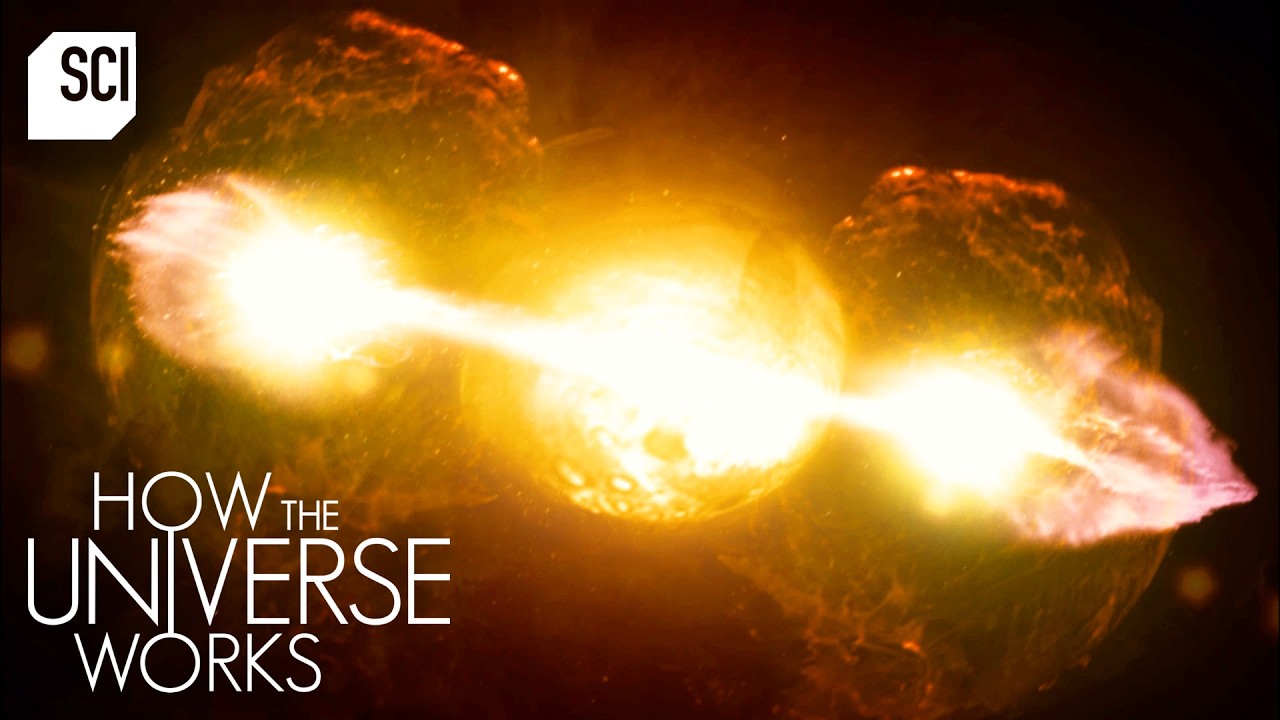
EXTREME HEAT! | How the Universe Works | Science Channel
Keywords
Summary
134 words
Critical Evaluation
The video is a well-produced science communication piece that effectively conveys the excitement and complexity of extreme astrophysical phenomena. It covers a range of topics, from supernova shock breakouts to the solar wind, with input from multiple experts, lending credibility. The explanations are generally accurate, though simplified for a general audience. For instance, the description of the supernova mechanism via a basketball analogy is intuitive but glosses over the ongoing research into neutrino-driven explosions. The segment on the Parker Solar Probe is particularly strong, highlighting the engineering challenges and the scientific value of the mission. However, the video lacks specific citations or references to scientific papers, which would enhance its reliability. The adéquation between title and content is good, as the focus is indeed on extreme heat and energy. The pacing is brisk, and the visual aids are engaging. Overall, it serves as an excellent introduction for curious viewers, but those seeking in-depth scientific detail may need to consult primary sources.
161 words
Title / Content Match
The title 'EXTREME HEAT!' accurately reflects the content, which focuses on extreme temperatures and energetic phenomena in the universe, from supernovas to the Sun's corona.
Quality & Reliability
7/10
The video presents complex astrophysical concepts with input from multiple experts and references to real missions (Parker Solar Probe) and events (SN 1987A). However, it lacks detailed citations and simplifies some mechanisms, which slightly reduces its reliability.
Key Moments
Markers derived by PSI from the transcript: the creator did not define chapters.
- Introduction to supernovas and the shock breakout phenomenon.
- Explanation of the basketball analogy for supernova shock waves.
- Discussion of neutrinos as the missing energy source in supernova explosions.
- Segment on the Sun and the solar wind mystery.
- Journey from the center of the Sun: how photons travel to the surface.
- Megaflares and their potential impact on Earth.
- Supernovas Part 2: the role of shock breakout and its rarity.
- Volcanoes and their connection to extreme heat on Earth.
Cited Sources
- Parker Solar Probe — Mentioned in the context of studying the solar wind and coronal holes.
- Supernova 1987A — Referenced as a key event for neutrino detection and supernova study.
Concurring Sources
- NASA Science: Supernovae — Supports the general explanation of supernova mechanisms.
- ESA: Solar Wind — Corroborates the description of solar wind acceleration.
Dissenting Sources
- Some researchers argue that the neutrino mechanism alone may not fully explain supernova explosions. — The video simplifies the supernova mechanism; ongoing research suggests additional processes may be involved.
Contribution & Novelties
The video provides a compelling synthesis of recent discoveries and ongoing mysteries in astrophysics, particularly the shock breakout observation and the Parker Solar Probe’s findings. It makes complex concepts accessible through analogies and expert interviews.
Pour aller plus loin :
- Neutrino astronomy — Relevant to the role of neutrinos in supernovae.
- Parker Solar Probe — Official mission page for further details.
- Shock breakout — Concept central to the supernova segment.
70 words
Radar Profile
The radar profile shows high scores in quantity of information and technical level, indicating a content-rich video with moderate depth. Quality and reliability are slightly lower due to lack of detailed citations, but overall it is a solid educational resource.
💬 Sur les 0 commentaires analysés, aucune tendance n'est disponible.