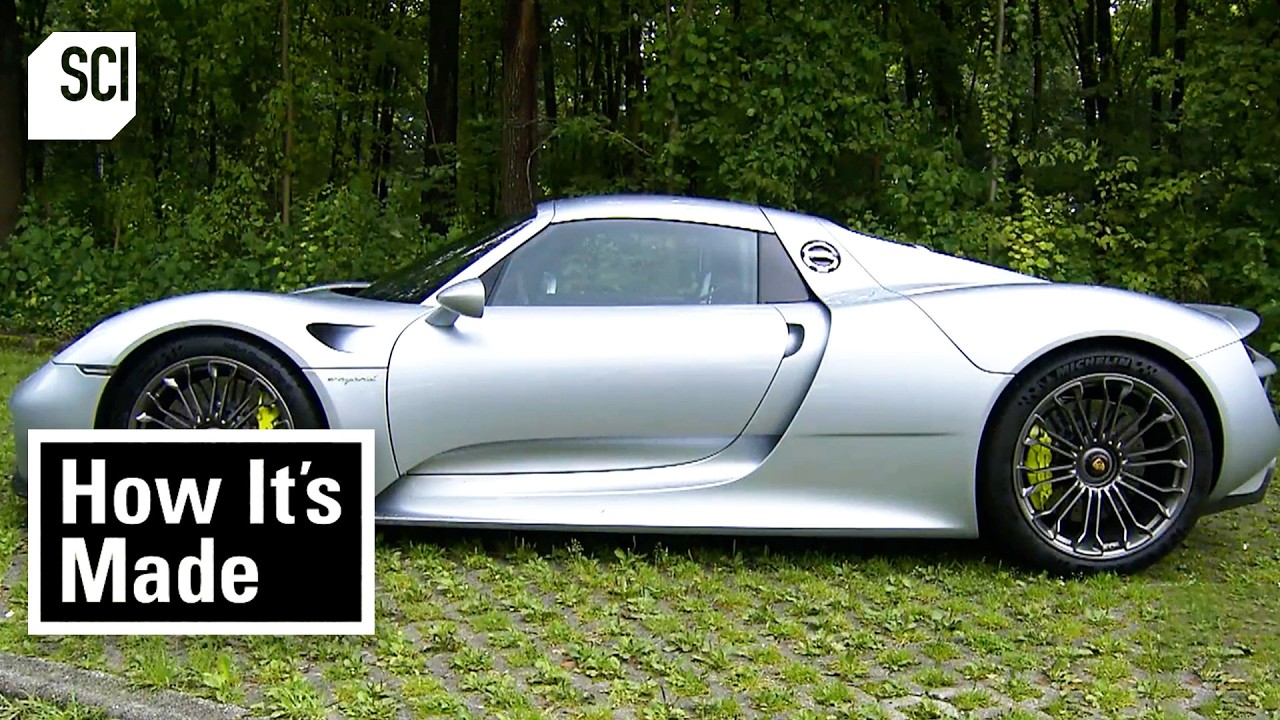
Dream Cars: Porsche 911 & Porsche 918 Spyder | How It’s Made | Science Channel
Keywords
Summary
143 words
Critical Evaluation
The documentary provides a fascinating and detailed look into the manufacturing processes of two high-performance Porsche vehicles. It excels in visual demonstration, showing the intricate steps of body assembly, painting, engine construction, and hybrid motor production. The information is presented in a clear, accessible manner, making it suitable for a general audience interested in automotive engineering. However, the scientific rigor is moderate: while the processes are accurately depicted, there is a lack of in-depth explanation of the underlying engineering principles. For instance, the video mentions the use of cathodic dip priming for corrosion resistance but does not elaborate on the electrochemical mechanisms. Similarly, the hybrid motor assembly is shown in detail, but the principles of AC synchronous motors are only briefly touched upon. The documentary does not cite any external sources, relying instead on the authority of the factory tour and the Science Channel brand. Some technical details may be oversimplified or slightly inaccurate; for example, the narrator refers to the 911’s engine as a ‘3.4 L V6’, but the 911 is known for its flat-six engine, and the displacement varies by model. This could be a transcription error or a simplification, but it undermines the precision expected from a science-focused program. The title accurately reflects the content, and the ad breaks are minimal and not intrusive. Overall, the documentary is informative and engaging, but viewers seeking deep technical or scientific analysis may be left wanting more. The lack of citations and the minor technical inaccuracies prevent it from achieving a perfect score, but it remains a valuable resource for understanding automotive manufacturing.
263 words
Title / Content Match
The title accurately reflects the content, which focuses on the manufacturing of the Porsche 911 and 918 Spyder.
Quality & Reliability
7/10
The documentary provides a detailed, step-by-step look at the manufacturing processes of the Porsche 911 and 918 Spyder, with clear explanations of techniques such as cathodic dip priming, seam sealing, and hybrid motor assembly. The information is presented in a straightforward manner, likely based on factory tours and expert commentary, but lacks citations to independent sources or scientific literature, and some technical details (e.g., engine displacement) may be imprecise.
Key Moments
Markers derived by PSI from the transcript: the creator did not define chapters.
- Introduction to the episode, featuring the Porsche 911 and 918 Spyder.
- Start of the Porsche 911 segment, showing body shell assembly.
- Start of the Porsche 918 Spyder segment, focusing on hybrid motor assembly.
- Detailed view of the painting process, including cathodic dip priming.
- Engine assembly: pistons, crankshaft, and timing chains.
- Cold testing of the engine and installation of intake/exhaust manifolds.
- Vehicle assembly line: dashboard, windows, and drivetrain installation.
- Final assembly: bumpers, nameplate, tires, and doors.
- Driving tests and quality checks, including dynamometer and water leak test.
- Porsche 918 Spyder hybrid motor assembly: stator winding and brazing.
Cited Sources
- How It's Made on discovery+ — The episode is part of the How It's Made series, available on discovery+.
- Video URL — Direct link to the YouTube video.
Concurring Sources
- Porsche 911 (Wikipedia) — Confirms the general manufacturing and design aspects of the Porsche 911.
- Porsche 918 Spyder (Wikipedia) — Provides details on the hybrid system and production of the 918 Spyder.
Contribution & Novelties
The documentary offers a rare, behind-the-scenes look at the manufacturing processes of two high-end Porsche models, highlighting the blend of traditional craftsmanship and modern automation. It provides visual insights into advanced techniques such as cathodic dip priming, seam sealing, and the assembly of a hybrid electric motor, which are not commonly seen in mainstream media. The focus on the 918 Spyder’s hybrid module is particularly valuable, as it demystifies the production of electric motors in a performance car context.
Pour aller plus loin :
- Porsche 911 (Wikipedia) — Provides historical and technical background on the Porsche 911.
- Porsche 918 Spyder (Wikipedia) — Details on the hybrid supercar’s specifications and development.
- Cathodic electrophoretic deposition (Wikipedia) — Explains the science behind the corrosion-resistant coating process shown in the video.
- AC motor (Wikipedia) — Offers an overview of AC synchronous motors, relevant to the 918’s electric motor assembly.
145 words
Radar Profile
The radar profile shows high scores in quantity of information and technical level, reflecting the detailed and specific content. Quality and reliability are slightly lower due to the lack of citations and minor inaccuracies, but the overall profile indicates a solid, informative documentary.