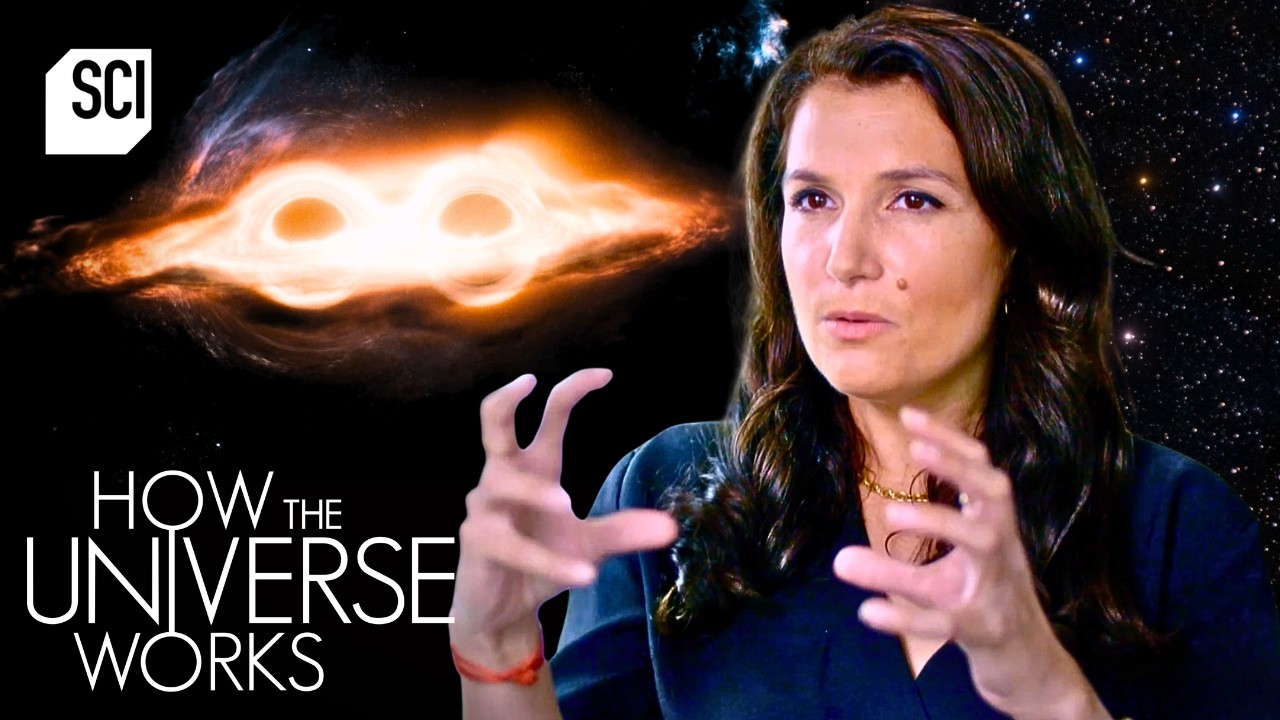
Chaos in Space 💥 | How the Universe Works | Science Channel
Keywords
Summary
168 words
Critical Evaluation
The documentary provides a visually stunning and engaging overview of extreme astrophysical phenomena, effectively communicating complex ideas to a general audience. The use of CGI and expert interviews lends credibility, and the scientific content is generally accurate, covering well-established concepts such as supernovae, pulsars, black holes, and galactic collisions. However, the presentation is heavily simplified, omitting the nuances of the underlying physics. For instance, the explanation of gravitational slingshots is oversimplified, and the discussion of black hole event horizons lacks depth. The documentary does not cite specific scientific studies or provide references, which limits its utility for viewers seeking to verify the information. The pacing is rapid, and the dramatic tone sometimes overshadows scientific precision. The title ‘Chaos in Space’ is apt, as the episode focuses on violent and chaotic events, but it does not delve into the broader implications of chaos theory in astrophysics. Overall, it is a high-quality popular science production that excels in visualization and accessibility, but it is not a rigorous scientific resource. The adéquation between title and content is strong, and the documentary successfully conveys the awe and complexity of the universe, though it could benefit from more explicit sourcing and technical detail.
198 words
Title / Content Match
The title 'Chaos in Space' accurately reflects the content, which focuses on violent cosmic events and extreme gravitational phenomena.
Quality & Reliability
7/10
The documentary presents established astrophysical concepts (supernovae, pulsars, black holes, galactic collisions) with expert commentary and CGI. It is scientifically accurate but lacks citations to specific studies or sources, and simplifies complex topics for a general audience.
Key Moments
Markers derived by PSI from the transcript: the creator did not define chapters.
- Introduction to supernovae as the most violent explosions in the universe.
- Explanation of HM Canree, a binary white dwarf system with extreme orbital dynamics.
- Description of pulsars, their properties, and the Black Widow pulsar destroying its companion.
- Discussion of the double pulsar system and its chaotic orbital evolution.
- Introduction to black holes, their formation, and properties.
- Example of a star orbiting a black hole and the X-ray emission from the accretion disk.
- Description of a tidal disruption event where a black hole tears apart a star.
- Explanation of gravitational slingshots and hypervelocity stars ejected from galaxies.
- Galactic collisions and mergers, including the creation of starburst galaxies.
- The cosmic web and the large-scale structure of the universe.
Cited Sources
- Chaos in Space | How the Universe Works | Science Channel — The video itself is the primary source, providing the documentary content.
Concurring Sources
- NASA - Supernovae — NASA's overview of supernovae corroborates the documentary's description of these events.
- NASA - Black Holes — NASA's black hole resources support the documentary's explanations of black hole properties and behavior.
Dissenting Sources
- No discordant sources identified — The documentary presents mainstream scientific consensus; no conflicting sources were found.
Contribution & Novelties
The documentary synthesizes known astrophysical concepts into a compelling narrative about the role of gravity and orbits in shaping the universe. It emphasizes the dual nature of gravity as both destructive and creative, a perspective that is not always highlighted in popular science. The use of specific examples like HM Canree and the Black Widow pulsar helps illustrate extreme orbital mechanics.
Pour aller plus loin :
- Supernova - Wikipedia — Provides a detailed overview of supernova types, mechanisms, and significance.
- Pulsar - Wikipedia — Explains the properties and discovery of pulsars, complementing the documentary’s description.
- Black hole - Wikipedia — Offers comprehensive information on black hole physics, including event horizons and accretion disks.
- Galaxy merger - Wikipedia — Discusses the process and outcomes of galactic collisions, relevant to the documentary’s segment on starbursts.
- Cosmic web - Wikipedia — Describes the large-scale structure of the universe, aligning with the documentary’s final section.
151 words
Radar Profile
The radar profile shows high scores in quantity of information and technical level, reflecting the dense and detailed content. Quality and reliability are moderate, indicating that while the information is accurate, it lacks explicit sourcing and depth. The overall balance suggests a well-produced educational piece suitable for general audiences.