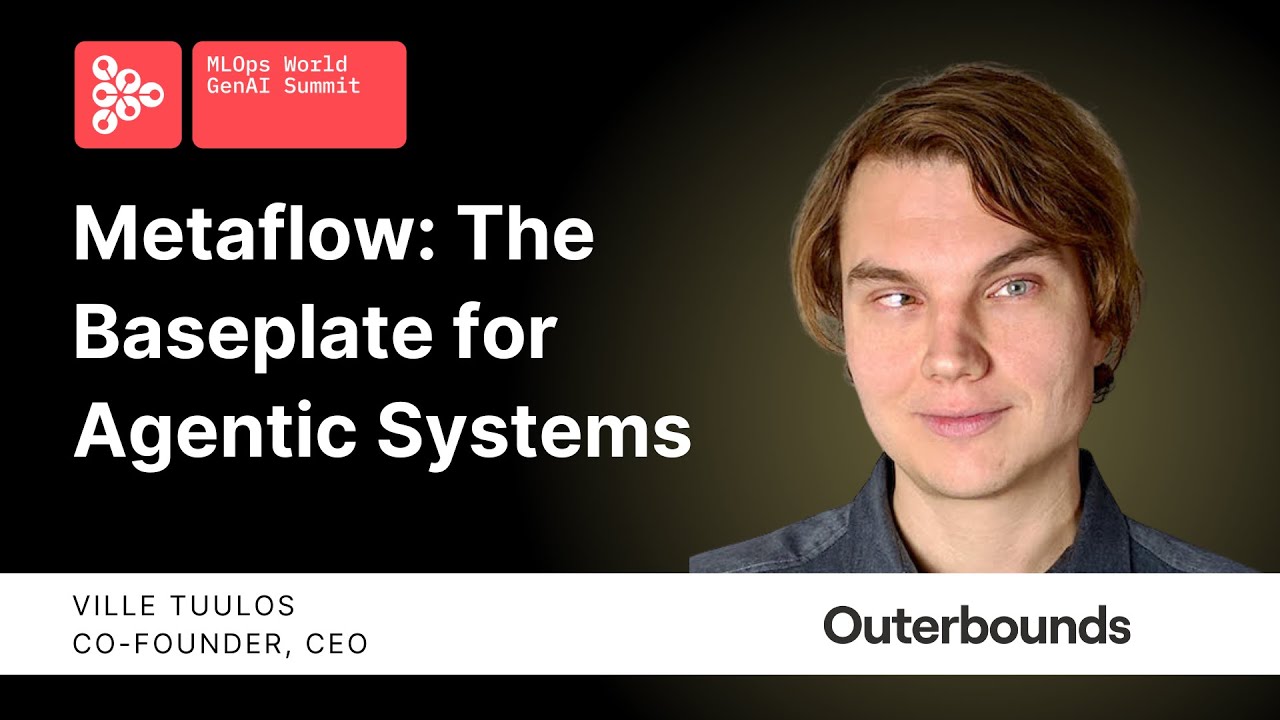
Metaflow: The Baseplate for Agentic Systems
Keywords
Summary
188 words
Critical Evaluation
Value of the Information & Strength of the Argument
The talk provides valuable insights into the practical challenges of deploying agentic systems in production, moving beyond the hype. Tuulos effectively argues that the main difficulty lies not in the agent loop itself but in the surrounding infrastructure: data freshness, tool security, state persistence, and model lifecycle management. He supports his claims with real-world examples and references to industry surveys (e.g., LangChain’s survey on agent difficulties). The argumentation is coherent and well-structured, building from the problem statement to the proposed solution. However, the presentation is inherently promotional for Metaflow, and the speaker’s perspective is that of a vendor, which may introduce bias. The value lies in the clear articulation of the ‘baseplate’ concept and the practical considerations for production AI.
Scientific Rigor, Source Quality, Title Accuracy
The talk demonstrates a good level of scientific rigor in its analysis of agentic systems, drawing on the speaker’s extensive experience and referencing industry observations. However, it lacks formal citations or references to academic literature. The primary source mentioned is the LangChain survey on agent challenges, but no specific URL is provided. The title accurately reflects the content, focusing on Metaflow as the foundational layer. The talk is well-structured and the arguments are logically presented. The lack of external sources and the promotional nature of the talk slightly reduce its overall rigor.
227 words
Title / Content Match
The title accurately reflects the content: the talk presents Metaflow as the foundational infrastructure ('baseplate') for production-grade agentic systems, detailing its role and capabilities.
Quality & Reliability
7/10
Talk by a recognized expert (co-founder of Outerbounds) based on extensive practical experience with Metaflow in production. Provides a clear, realistic assessment of challenges in deploying agentic systems, but lacks formal citations or empirical data. The presentation is opinionated and focuses on the speaker's own framework, which may introduce bias.
Key Moments
Markers derived by PSI from the transcript: the creator did not define chapters.
- Introduction: Ville Tuulos asks the audience about their familiarity with Metaflow and agents.
- Discussion of the hype vs. reality of agents, citing a LinkedIn post from the CEO of Box and a frustrated practitioner's experience.
- Overview of the typical agent architecture: LLM loop, tools, context, and state.
- Identification of key challenges: nondeterminism, quality, context management, tool integration, and infrastructure.
- Emphasis on the need for a 'baseplate' infrastructure, referencing the 'hidden technical depth' of ML.
- Introduction of Metaflow as the solution, explaining its origins and capabilities.
- Explanation of the balance between agent autonomy and deterministic control, mapping to Metaflow's features.
- Introduction of Metaflow 2.18 and its new support for agent workflows and MCP integration.
- Practical demonstration of deploying an agent with Metaflow, showing how it handles compute, data, and orchestration.
- Conclusion: Recap of the 'baseplate' concept and the importance of infrastructure in production AI.
Cited Sources
- MLOps World | GenAI Summit 2025 — Conference website where the talk was recorded.
Concurring Sources
- LangChain Blog: What We Learned from Surveying 1000 Agents — Survey cited in the talk, supporting the claim that quality and performance are the top challenges in building agents.
Contribution & Novelties
The talk provides a clear framework for thinking about the infrastructure needed for production agentic systems, coining the term ‘baseplate’ to describe the foundational layer. It offers a practical perspective from a vendor who has built and deployed such systems, highlighting the importance of data management, compute provisioning, and workflow orchestration. The introduction of Metaflow 2.18 with MCP support is a concrete contribution to the MLOps ecosystem.
Pour aller plus loin :
- Model Context Protocol (MCP) — Official site for the MCP standard, directly relevant to the talk’s discussion of tool integration.
- LangChain Survey on Agent Challenges — Reference to the survey mentioned in the talk, providing data on common difficulties in building agents.
- Metaflow Documentation — Official documentation for Metaflow, useful for understanding its features and capabilities.
128 words
Radar Profile
The radar profile shows high scores in information quality and technical level, reflecting the speaker's expertise and the depth of the content. The quantity of information is moderate, as the talk is focused and does not cover all aspects exhaustively. The overall reliability is good, but the promotional nature of the talk slightly lowers the score.
💬 No comments were provided for analysis.