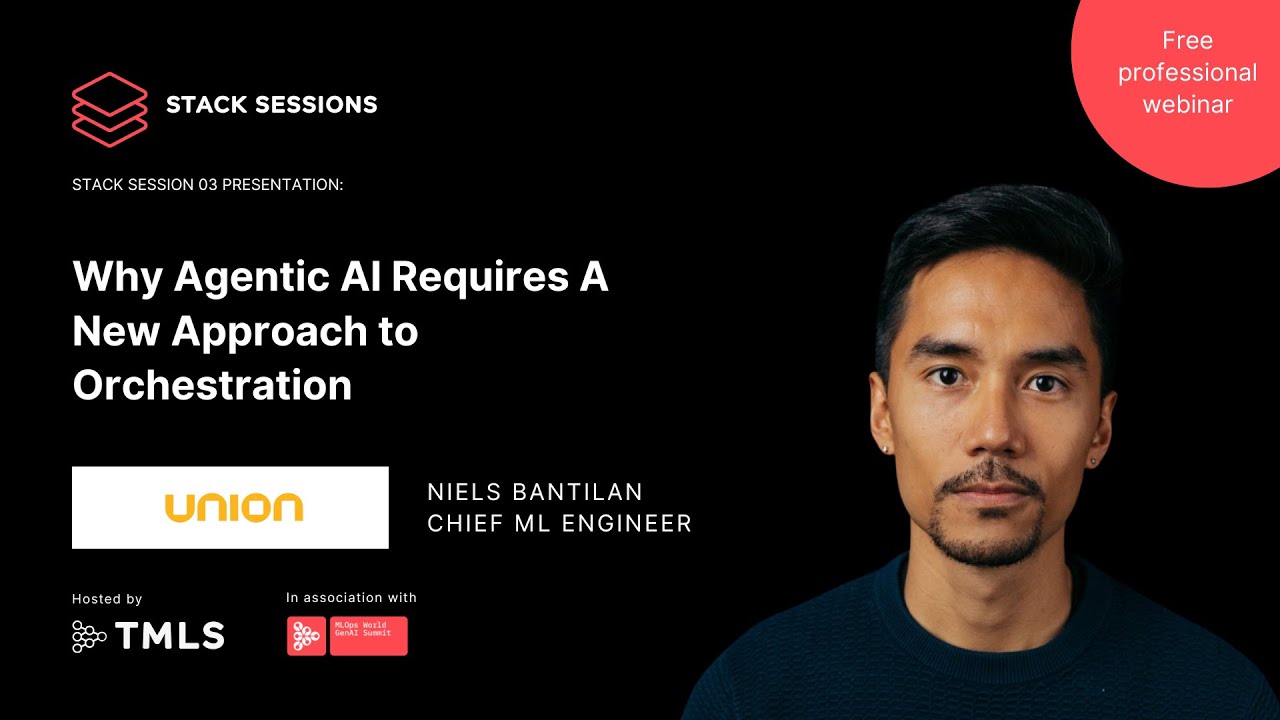
Why Agentic AI Requires a New Approach to Orchestration | Niels Bantilan, Union.ai
Keywords
Summary
159 words
Critical Evaluation
Value of the Information & Strength of the Argument
The talk provides valuable insights into the limitations of existing orchestration tools for agentic AI, backed by practical examples from real-world deployments. The argumentation is coherent and grounded in the speaker’s experience, but it is primarily a product pitch for Flyte 2.0, which limits its objectivity. The speaker effectively demonstrates the need for dynamic, fault-tolerant orchestration and presents a plausible solution, but the claims are not independently verified.
Scientific Rigor, Source Quality, Title Accuracy
The talk is an expert opinion rather than a peer-reviewed study, so scientific rigor is moderate. The speaker references his own open-source projects (Pandera, Flyte) and industry trends, but does not cite external research. The title accurately reflects the content, and the presentation is well-structured. No comments were provided for analysis.
134 words
Title / Content Match
The title accurately reflects the content: the talk argues that agentic AI requires new orchestration approaches and presents Flyte 2.0 as a solution.
Quality & Reliability
7/10
The talk presents expert opinion from a practitioner with deep experience in ML orchestration, backed by concrete demos of the Flyte 2.0 platform. Claims are not formally verified but are plausible and grounded in practical experience. The presentation is transparent about limitations and future roadmap.
Key Moments
Markers derived by PSI from the transcript: the creator did not define chapters.
- Introduction and speaker background
- Agenda and historical context of orchestration
- Six common pain points for builders
- Announcement of Flyte 2.0 and its key features
- Demo: Pythonic authoring and parallel execution
- Demo: Handling out-of-memory errors and retries
- Demo: Dynamic workflows with peanut butter and jelly example
- Demo: Crash recovery and fault tolerance
- Roadmap and Q&A session
Cited Sources
- MLOps World — Event website for the GenAI World session where this talk was recorded.
Concurring Sources
- Flyte — The open-source project that Flyte 2.0 is based on, supporting the claims about its capabilities.
- LangGraph — A framework for building agentic AI applications, illustrating the need for dynamic orchestration.
- AutoGen — A framework for multi-agent AI systems, illustrating the need for dynamic orchestration.
Contribution & Novelties
The talk presents Flyte 2.0 as a novel orchestration platform designed for agentic AI, emphasizing dynamic workflows, fault tolerance, and resource awareness. It contributes to the discourse on AI infrastructure by arguing that traditional static orchestration is insufficient for modern AI agents. The speaker provides concrete examples and demos, making the concepts tangible.
Pour aller plus loin :
98 words
Radar Profile
The radar profile shows a balanced performance across all dimensions, with slightly lower scores in technical depth and information quality, reflecting the talk's focus on product demonstration rather than deep technical analysis. The overall reliability is moderate, consistent with an expert opinion presentation.