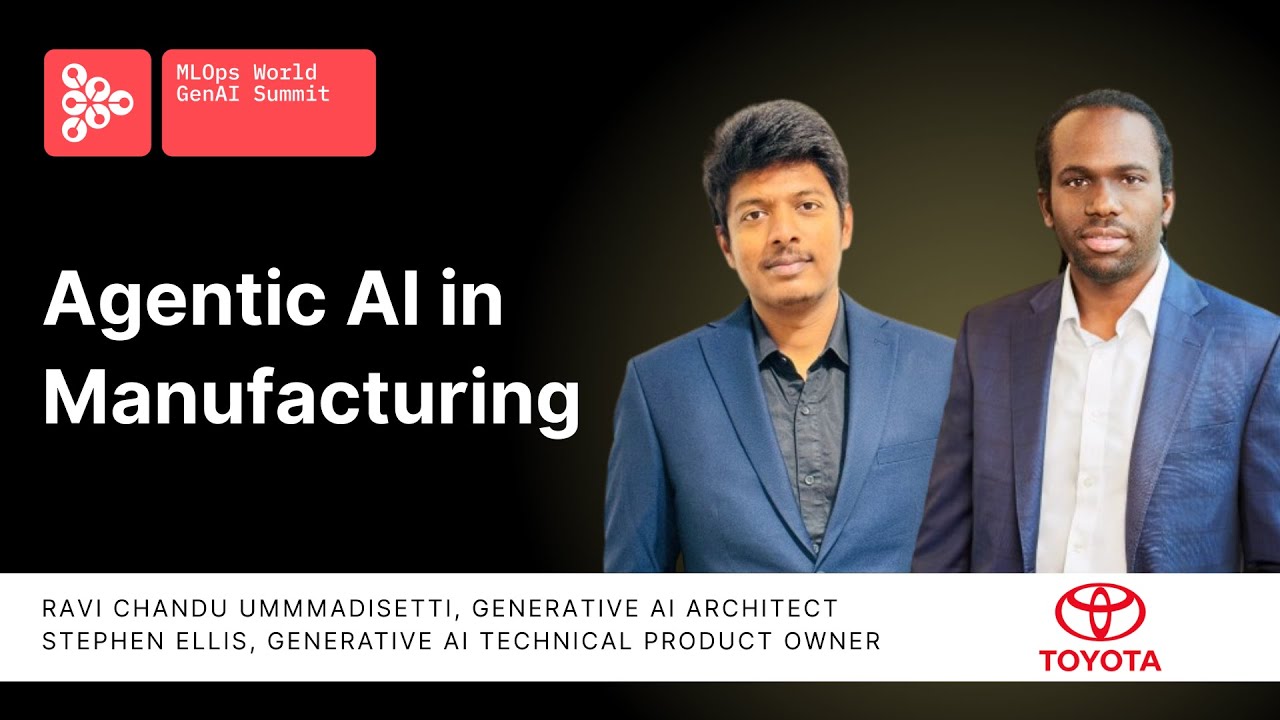
Agentic AI in Manufacturing | Ravi Chandu & Stephen Ellis, Toyota
Keywords
Summary
155 words
Critical Evaluation
Value of the Information & Strength of the Argument
The talk offers valuable insights into real-world applications of agentic AI in a large manufacturing enterprise. The speakers provide concrete examples of projects that have delivered measurable benefits, such as a 70% reduction in machine downtime and $22 million annual savings on printing. They also discuss the strategic importance of building a unified platform to scale AI across the organization. The argumentation is coherent, emphasizing the need for interoperability, rapid deployment, and user feedback. However, the presentation is largely anecdotal, with limited technical depth and no quantitative evaluation of the systems’ performance. The speakers acknowledge challenges but do not provide detailed solutions or comparative analyses.
Scientific Rigor, Source Quality, Title Accuracy
The talk is based on the speakers’ professional experience at Toyota, which lends credibility but also introduces potential bias. They mention using specific technologies like LangGraph, CrewAI, and various vector databases, but do not provide citations or references to external sources. The title accurately reflects the content, focusing on agentic AI in manufacturing. The session is part of a conference, suggesting a certain level of peer review, but the lack of detailed technical documentation limits the scientific rigor. The speakers do not provide any sources for their claims, and the only link in the description is to the conference website, which does not contain additional technical details.
227 words
Title / Content Match
The title accurately reflects the content, focusing on agentic AI applications in manufacturing as presented by Toyota representatives.
Quality & Reliability
7/10
The talk provides practical insights from industry practitioners with hands-on experience, but lacks detailed technical depth and verifiable data. Claims are plausible but not independently verified.
Key Moments
Markers derived by PSI from the transcript: the creator did not define chapters.
- Introduction by Stephen Ellis and Ravi Chandu, setting the context for Toyota's AI initiatives.
- Discussion of Toyota's enterprise AI team structure and its engineering-heavy approach.
- Presentation of specific projects: Battery Brain, Gear Pal, and Material GPT.
- Introduction of Toyota GPT as a unified platform for integrating multiple AI models and bots.
- Technical deep dive into RAG architecture, including ingestion pipeline and embedding fine-tuning.
- Discussion of challenges with document extraction, multilingual support, and security.
- Evaluation methods, including golden datasets and feedback loops.
- Conclusion and future outlook on scaling agentic AI across Toyota.
Cited Sources
- MLOps World — Conference website where the talk was recorded.
Concurring Sources
- MLOps World — Conference website confirming the event and session.
Contribution & Novelties
The talk provides a practical perspective on deploying agentic AI in a large manufacturing enterprise, highlighting specific use cases and lessons learned. It emphasizes the importance of building a unified platform and interoperability framework to scale AI initiatives. The speakers share insights into technical challenges such as document ingestion, embedding fine-tuning, and evaluation, which are valuable for practitioners.
Pour aller plus loin :
- Retrieval-Augmented Generation (RAG) — Overview of RAG, a key technique discussed.
- LangGraph — Framework used for orchestration.
- CrewAI — Multi-agent framework mentioned.
- Pinecone — Vector database used.
- Neo4j — Graph database used.
95 words
Radar Profile
The radar chart shows a balanced profile with moderate scores across all dimensions, indicating a solid but not exceptional presentation. The talk provides useful practical insights but lacks deep technical rigor and comprehensive sourcing.
💬 No comments were provided for analysis.