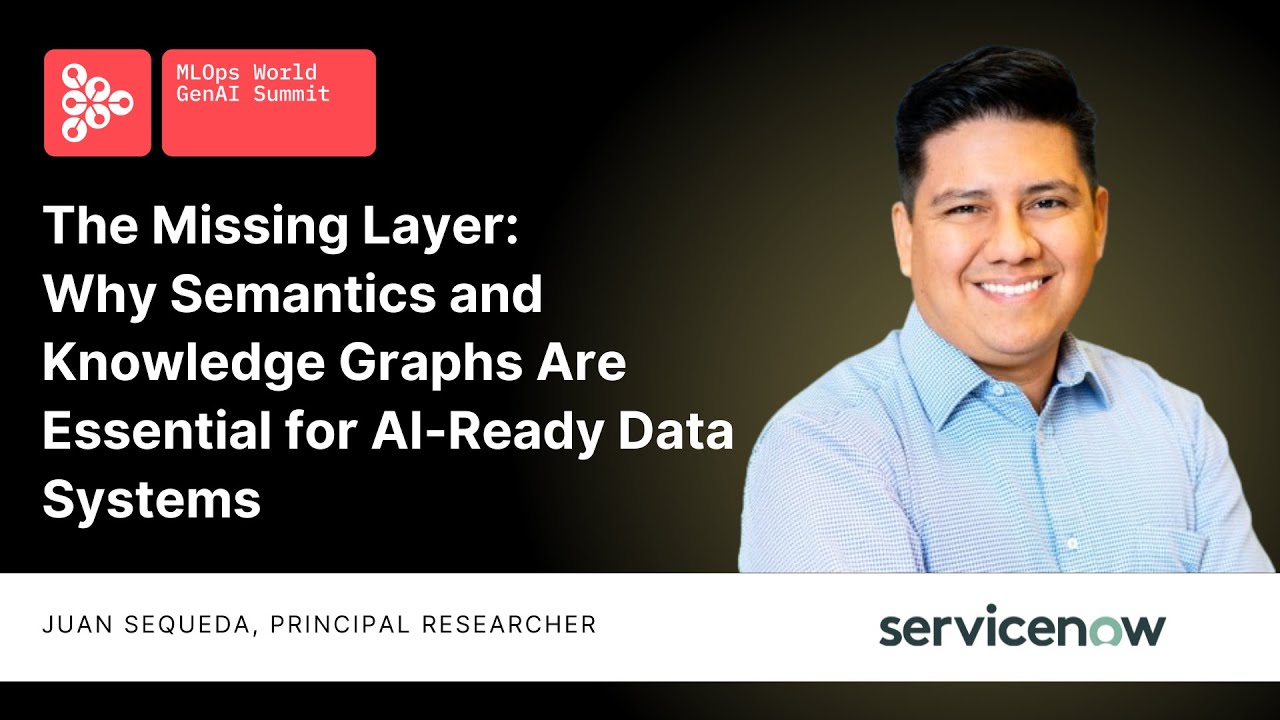
Why Semantics & Knowledge Graphs Are Essential for AI-Ready Data Systems | Juan Sequeda, ServiceNow
Keywords
Summary
135 words
Critical Evaluation
Value of the Information & Strength of the Argument
The talk provides valuable insights into the practical importance of semantics and knowledge graphs for AI systems. Sequeda presents a clear, actionable definition of semantics as governed metadata, and supports his claims with a benchmark study and independent replication. His argument for a crawl-walk-run progression and the reuse of metadata is compelling. However, the argumentation is largely anecdotal and opinion-based, with limited discussion of potential drawbacks or alternative approaches. The speaker’s position is clear and well-articulated, but it would benefit from more empirical evidence and a more balanced perspective.
Scientific Rigor, Source Quality, Title Accuracy
The talk demonstrates scientific rigor through references to a peer-reviewed benchmark paper and independent validation by dbt Labs. The speaker also cites historical context and standards (RDF, OWL, SKOS). However, the talk is primarily an opinion piece, and the sources cited are not always explicitly named or linked. The title accurately reflects the content, and the talk is well-structured. The speaker’s expertise is evident, but the lack of critical discussion of limitations slightly reduces the overall rigor.
181 words
Title / Content Match
The title accurately reflects the content, which focuses on the importance of semantics and knowledge graphs for AI-ready data systems.
Quality & Reliability
8/10
The speaker is a recognized expert in knowledge graphs and semantics, with over 20 years of experience. The talk references a peer-reviewed benchmark paper and independent replication by dbt Labs. However, it is largely an opinion piece advocating for a specific approach, with limited critical discussion of limitations or alternative perspectives.
Key Moments
Markers derived by PSI from the transcript: the creator did not define chapters.
- Introduction: Knowledge graphs are not new; the speaker urges the audience to learn from history.
- Discussion of the benchmark paper showing 3x accuracy improvement with knowledge graphs.
- Definition of semantic layer: business metadata + mapping metadata + technical metadata.
- Explanation of the progression: glossary, taxonomy, ontology, knowledge graph.
- Example of building a metadata knowledge graph using RDF triples.
- Emphasis on reusability and the 'enterprise brain' concept.
- Conclusion: Semantics enable scalable AI systems; without them, organizations will fail.
Cited Sources
- MLOps World — Conference website where the talk was recorded.
Concurring Sources
- dbt Labs replication of benchmark — Independent validation of the speaker's benchmark results, mentioned in the talk.
Contribution & Novelties
The talk provides a clear, practical definition of semantics as governed metadata and emphasizes the importance of a metadata knowledge graph as a foundation for AI-ready systems. It offers a concrete progression from glossaries to ontologies and highlights the reusability of semantic definitions. The speaker’s vision of an ’enterprise brain’ is a compelling metaphor for integrating knowledge across an organization.
Pour aller plus loin :
- Knowledge Graph — Provides background on knowledge graphs and their applications.
- Semantic Web — Explains the vision of the semantic web and related standards.
- RDF — Details the RDF standard for representing graph data.
99 words
Radar Profile
The radar profile shows high scores in quantity and quality of information, with moderate technical depth and high reliability. This indicates a well-informed and credible talk, though it may require some background knowledge to fully appreciate.
💬 Sur les 0 commentaires analysés, aucune tendance n'est disponible.