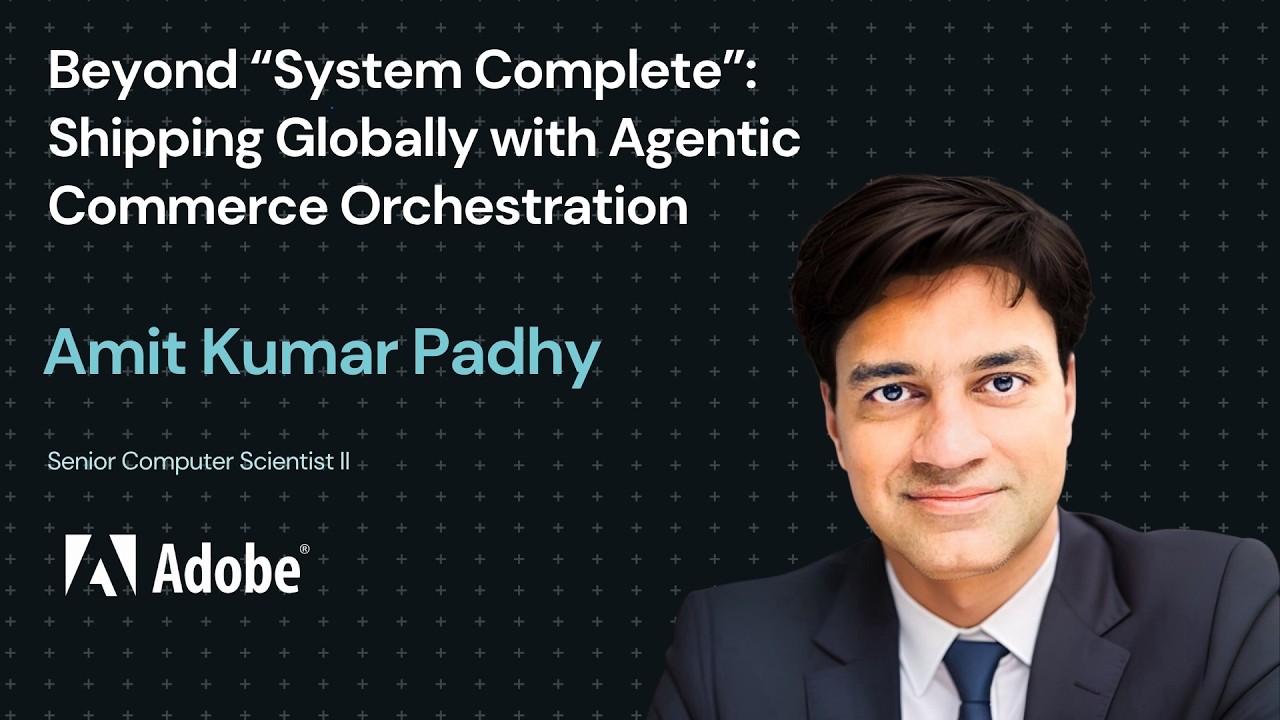
Beyond “System Complete”: Shipping Globally with Agentic Commerce Orchestration
Keywords
Summary
188 words
Critical Evaluation
Value of the Information & Strength of the Argument
The talk provides valuable insights from a real-world implementation, offering a concrete blueprint for agentic orchestration in e-commerce. The argumentation is solid, based on practical experience and lessons learned. The speaker clearly explains the architecture and the rationale behind design choices, such as scoping LLM usage and using deterministic validators for compliance. The impact data, while approximate, supports the effectiveness of the approach. The discussion on model agnosticism and latency trade-offs adds practical value.
Scientific Rigor, Source Quality, Title Accuracy
The talk is based on the speaker’s professional experience at Adobe, but no specific sources or references are cited. The title accurately reflects the content, focusing on the transition from system completion to global shipping. The presentation is coherent and well-structured, though it lacks formal citations or references to external research. The speaker’s credentials lend credibility, but the absence of verifiable sources limits the scientific rigor.
155 words
Title / Content Match
The title accurately reflects the content, focusing on moving beyond system completion to global shipping via agentic orchestration.
Quality & Reliability
7/10
The talk presents a production-tested architecture from a senior practitioner at Adobe, with concrete patterns and lessons learned. However, it lacks formal evaluation, detailed metrics, and external references, relying on anecdotal evidence and approximate impact data.
Key Moments
Markers derived by PSI from the transcript: the creator did not define chapters.
Contribution & Novelties
The talk offers a practical, production-tested architecture for agentic commerce orchestration, detailing patterns for event-driven coordination, selective LLM invocation, and saga-based compensation. It provides valuable lessons on avoiding common pitfalls such as over-reliance on LLMs and centralized bottlenecks.
Pour aller plus loin :
- ReAct: Synergizing Reasoning and Acting in Language Models — The ReAct pattern is central to the planner agents described.
- Saga pattern — The compensation mechanism for agent failures aligns with the saga pattern.
- Blackboard pattern — The shared-state memory layer uses a blackboard-style approach.
87 words
Radar Profile
The radar profile shows high scores in technical level and information quality, reflecting the advanced nature of the content. The lower score in reliability is due to the lack of formal sources and reliance on anecdotal evidence.
💬 No comments were provided for analysis.