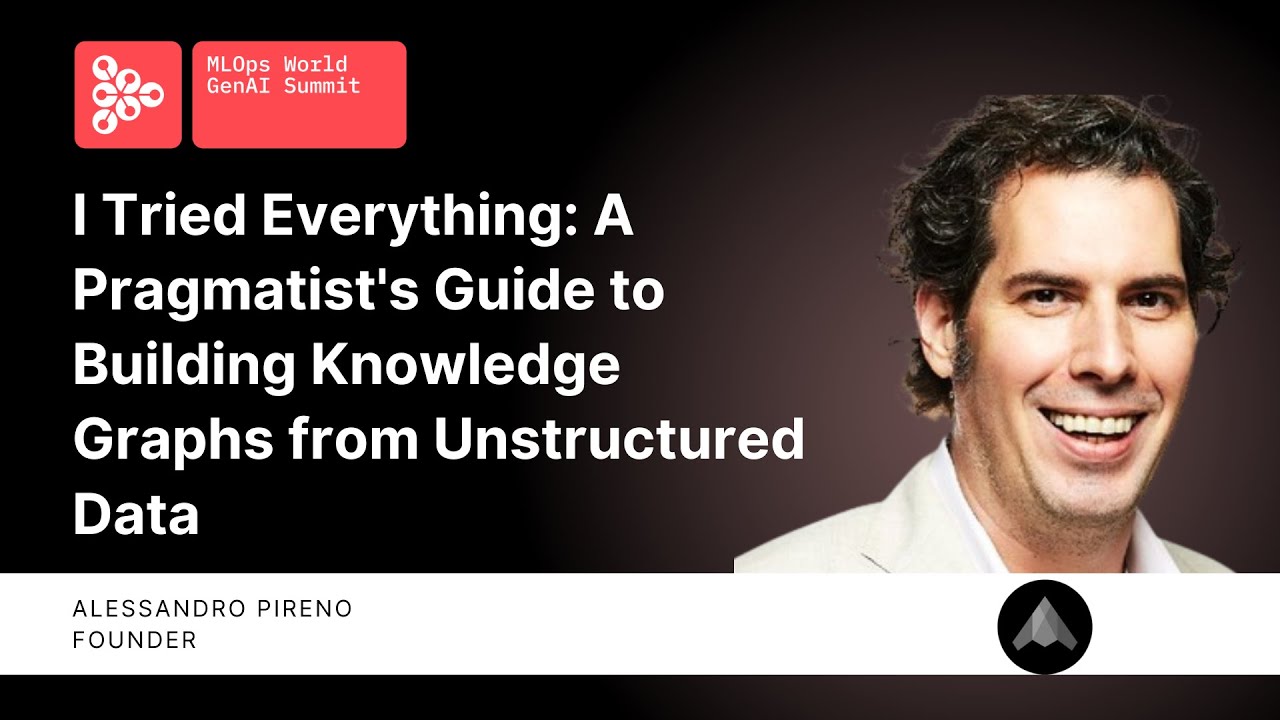
A Pragmatist’s Guide to Building Knowledge Graphs from Unstructured Data
Keywords
Summary
182 words
Critical Evaluation
Value of the Information & Strength of the Argument
The talk provides valuable practical insights into building knowledge graphs, especially the comparison of LLM vs. NLP approaches and the novel use of FastText embeddings for entity resolution. The argumentation is based on personal experience and logical reasoning, but lacks quantitative benchmarks or formal evaluations. The speaker clearly explains trade-offs in cost, latency, and precision, and offers a decision framework that is useful for practitioners. However, the claims about scalability and performance are anecdotal and not backed by rigorous data.
Scientific Rigor, Source Quality, Title Accuracy
The talk is an expert opinion based on the speaker’s professional experience, but it does not cite specific sources or references. The only external link provided is to the MLOps World conference, which is not a source for the technical content. The title accurately reflects the content, which is a pragmatic guide. The lack of citations and empirical evidence limits the scientific rigor, but the practical insights are valuable for practitioners.
166 words
Title / Content Match
The title accurately reflects the content, which is a pragmatic guide based on the speaker's hands-on experience.
Quality & Reliability
7/10
The talk provides a practical, experience-based overview of knowledge graph construction from unstructured data, with clear comparisons of techniques and trade-offs. However, it lacks formal citations, empirical benchmarks, and detailed reproducibility, limiting its scientific rigor.
Key Moments
Markers derived by PSI from the transcript: the creator did not define chapters.
- Introduction and background on the speaker's experience with multi-model databases.
- Explanation of why knowledge graphs are important for AI, including context compression and explicit nuance.
- Overview of three pillars for generating knowledge graphs: LLM, NLP, and hybrid approaches.
- Detailed discussion of NLP-based approach using spaCy, pattern matching, and scoring.
- Introduction of FastText embeddings for entity resolution, treating it as a classification problem.
- Comparison of NLP vs LLM in terms of speed, cost, and precision, with a concrete example.
- Discussion of using SLMs and LLMs for self-improvement, and decision framework for choosing between NLP and LLM.
Cited Sources
- MLOps World — Conference where the talk was presented, providing context for the talk.
Concurring Sources
- Knowledge graph — General concept of knowledge graphs.
- FastText — Library for the embedding technique mentioned.
- spaCy — NLP library used in the talk.
Contribution & Novelties
The talk offers a pragmatic, experience-based framework for building knowledge graphs from unstructured data, comparing LLM, NLP, and hybrid approaches. It introduces a novel technique using FastText embeddings for entity resolution, treating it as a classification problem rather than semantic search. The emphasis on using SLMs for refinement and LLMs for offline self-improvement is a practical contribution.
Pour aller plus loin :
- Knowledge graph — Foundational concept.
- FastText — Official library for the embedding technique mentioned.
- spaCy — NLP library used in the talk for pattern matching.
- Graph RAG — Related approach for using knowledge graphs with LLMs.
98 words
Radar Profile
The radar profile shows a balanced but moderate performance across all dimensions, with slightly higher scores in information quantity and quality, and lower in technical level and reliability. This reflects a talk that is informative and practical but lacks deep technical depth and rigorous sourcing.
💬 Sur les 0 commentaires analysés, aucune tendance n'est disponible.