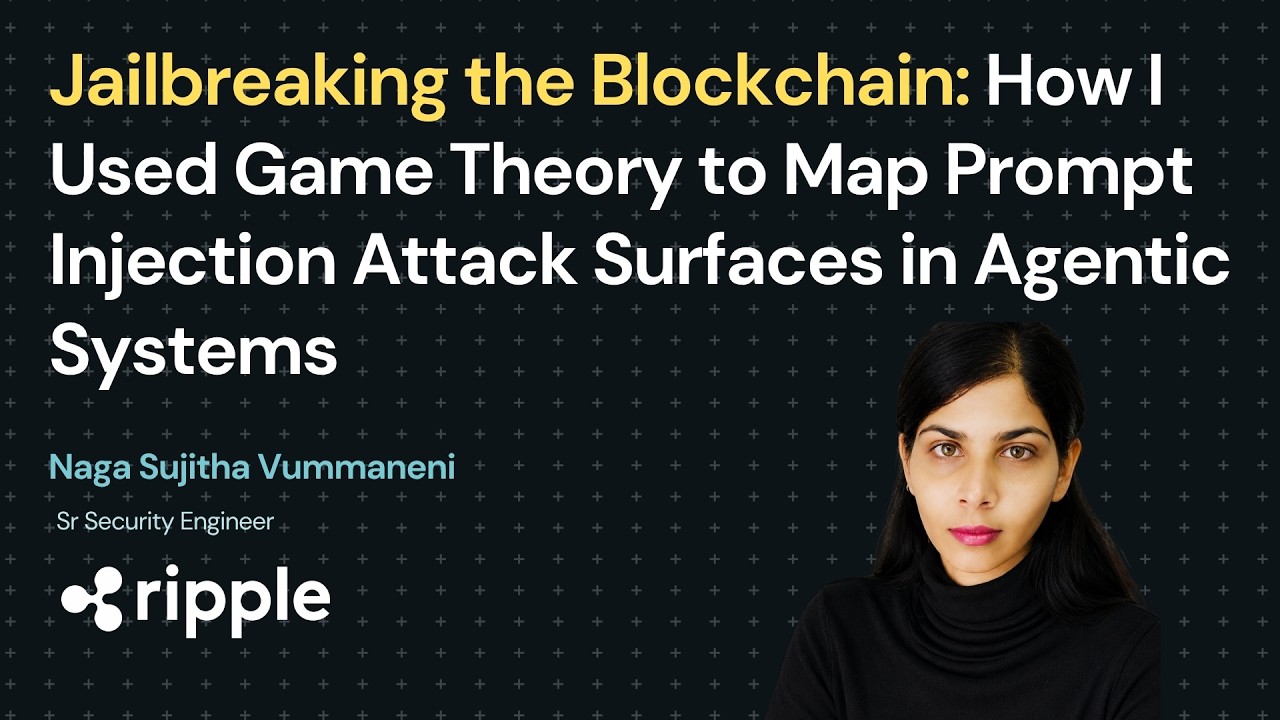
Jailbreaking the Blockchain: How I Used Game Theory to Map Prompt Injection Attack Surfaces
Keywords
Summary
155 words
Critical Evaluation
Value of the Information & Strength of the Argument
The talk provides valuable insights into AI agent security, particularly in high-stakes financial environments. The game-theoretic approach offers a structured way to analyze attack surfaces and prioritize defenses. The argumentation is persuasive, using concrete examples to illustrate abstract concepts. However, the lack of empirical data or formal proofs weakens the scientific rigor. The speaker’s practical experience lends credibility, but the claims are not backed by published research.
Scientific Rigor, Source Quality, Title Accuracy
The talk does not cite specific sources or references. The speaker mentions research on game-theoretic prompt injection frameworks and zero-knowledge ML systems, but no details are provided. The title accurately reflects the content, focusing on game theory and prompt injection in blockchain. The talk is well-structured and logically presented, but the absence of citations limits its scientific value.
140 words
Title / Content Match
The title accurately reflects the content, focusing on game theory applied to prompt injection attack surfaces in blockchain contexts.
Quality & Reliability
7/10
The talk presents a coherent methodology based on practical experience in blockchain security, but lacks formal citations or empirical data. The game-theoretic framework is illustrative rather than rigorously derived.
Key Moments
Markers derived by PSI from the transcript: the creator did not define chapters.
- Introduction: The speaker sets the stage, emphasizing that the architecture, not the model, is the vulnerability.
- Game theory framework: Two players, two strategies, and the Nash equilibrium shift with boundary validation.
- Use case 1: DEX trading agent compromised via token metadata injection.
- Use case 2: Liquidation bot manipulated through poisoned memory and cumulative attack.
- Use case 3: Bridge relayer agent exploited via forged events and internal trust.
- Use case 4: DAO treasury agent attacked via hidden instructions in proposals.
- Defenses summary: Treat all inputs as hostile, enforce least privilege, make injection observable, design for equilibrium.
- Conclusion: Map, game, and guard the system, not just the model.
Contribution & Novelties
The talk offers a novel application of game theory to prompt injection attack surfaces in blockchain-based AI agents. It provides a practical methodology for mapping attack surfaces and designing defenses that shift attacker incentives. The emphasis on architecture over model alignment is a valuable perspective.
Pour aller plus loin :
- Prompt injection attacks on LLMs — Overview of prompt injection attacks and mitigations.
- Nash equilibrium — Foundational concept in game theory used in the talk.
- Zero-knowledge proofs — Cryptographic technique mentioned in the speaker’s background, relevant for secure ML systems.
90 words
Radar Profile
The radar profile shows balanced scores across information quantity, quality, technical level, and reliability, with a slight dip in reliability due to lack of citations. This suggests a technically informative talk that would benefit from more rigorous sourcing.
💬 No comments were provided for analysis.