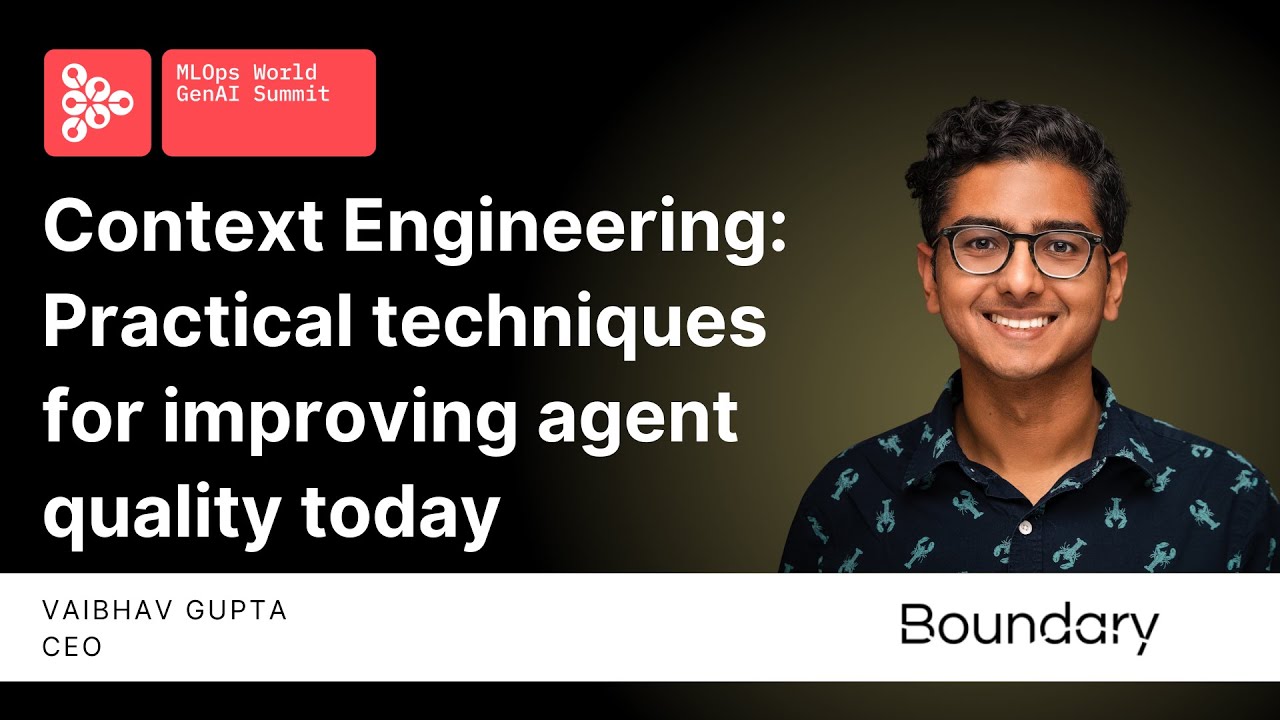
Context Engineering Practical Techniques for Improving Agent Quality Today | Vaibhav Gupta, Boundary
Keywords
Summary
191 words
Critical Evaluation
Value of the Information & Strength of the Argument
The talk provides high practical value by offering a clear framework for thinking about LLM agents as software constructs, which can be engineered with existing tools and patterns. The argumentation is solid, grounded in the speaker’s experience with probabilistic systems and software engineering. He effectively uses analogies (e.g., React, Jupyter notebooks) to illustrate how better abstractions can improve developer productivity and system reliability. The emphasis on reading prompts, writing tests, and using type systems is actionable and supported by examples. However, some claims, such as the benefits of his company’s programming language, are promotional and not independently verified.
Scientific Rigor, Source Quality, Title Accuracy
The talk is rigorous in its use of software engineering principles, though it lacks formal citations. The speaker references his own experience and industry practices but does not cite specific research papers or external sources. The title accurately reflects the content, focusing on practical context engineering techniques. The talk is well-structured and coherent, with a clear thesis. The lack of citations is typical for industry talks, but the content aligns with known best practices in LLM application development.
191 words
Title / Content Match
The title accurately reflects the content: the speaker presents practical context engineering techniques to improve agent quality, with a focus on reliability and control.
Quality & Reliability
8/10
The talk is based on the speaker's extensive industry experience in probabilistic systems and AI engineering. It provides practical, actionable techniques grounded in software engineering principles. While not peer-reviewed, the content is coherent, well-argued, and aligns with current best practices in LLM application development.
Key Moments
Markers derived by PSI from the transcript: the creator did not define chapters.
- Introduction: Speaker asks audience about LLM usage and trust, setting the stage for improving reliability.
- Definition of LLM call as type system conversion, emphasizing function call abstraction.
- Tool calling as union of types, parallel tool calling as array of unions.
- Agent defined as while loop with state, with code example.
- Sub-agents and handoffs as function calls, avoiding new terminology.
- Comparison to React and Jupyter notebooks to illustrate better abstractions.
- Introduction of Boundary's programming language for agents, emphasizing type systems and error checking.
- Practical techniques: reading prompts, writing test cases, and using in-context reasoning.
- Example of extracting resume with function signature and reasoning, showing improved control.
- Discussion on JSON vs. alternative formats, and the importance of tooling for reliability.
Cited Sources
- MLOps World — Conference where the talk was recorded, providing context for the session.
Concurring Sources
- Chain-of-Thought Prompting Elicits Reasoning in Large Language Models — Supports the technique of in-context reasoning mentioned in the talk.
- ReAct: Synergizing Reasoning and Acting in Language Models — Aligns with the idea of agents as loops with reasoning and tool use.
Dissenting Sources
- No direct discordant sources found — The talk does not contradict established literature, but its promotional aspects are not independently verified.
Contribution & Novelties
The talk offers a fresh perspective by unifying various LLM techniques under the umbrella of context engineering, and by advocating for the application of traditional software engineering practices to AI systems. It introduces a concrete framework (type systems, while loops) that can help developers reason about and improve agent reliability. The emphasis on reading prompts and writing tests is a practical novelty for many practitioners.
Pour aller plus loin :
- Chain-of-Thought Prompting — The paper that introduced chain-of-thought reasoning, a key technique mentioned in the talk.
- ReAct: Synergizing Reasoning and Acting in Language Models — A framework combining reasoning and acting, relevant to agent design.
- Toolformer — A model that learns to use tools, illustrating the concept of tool calling.
- MLOps — A resource on MLOps practices, relevant to the production aspects discussed.
133 words
Radar Profile
The radar profile shows high scores in information quantity and quality, with a slightly lower technical depth, reflecting the practical, experience-based nature of the talk. The reliability score is strong, indicating a trustworthy presentation of industry practices.
💬 No comments were provided for analysis, so this field is left empty.