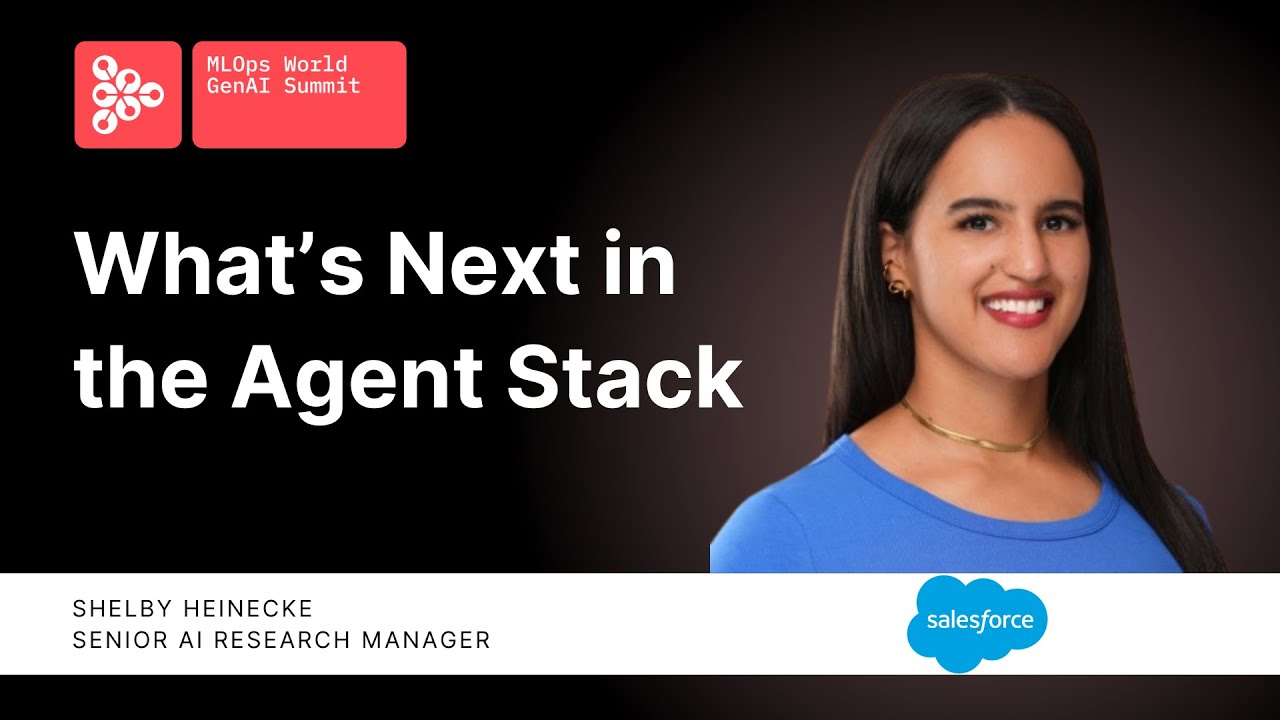
What’s Next in the Agent Stack | Shelby Heinecke, Salesforce
Keywords
Summary
88 words
Critical Evaluation
Value of the Information & Strength of the Argument
The talk provides valuable insights into practical challenges of deploying AI agents, such as latency, data quality, and evaluation. Heinecke argues for the use of small action models to reduce latency and cost, and presents synthetic data generation as a key to training effective models. The argumentation is coherent and supported by examples, but it is primarily based on Salesforce’s own research and tools, which may introduce bias. The presentation is persuasive but lacks independent validation of the claims.
Scientific Rigor, Source Quality, Title Accuracy
The talk references several open-source projects and technical reports, but specific URLs are not provided in the description. The only link given is to mlopsworld.com, which is the conference website. The title accurately reflects the content, focusing on the agent stack and production readiness. The scientific rigor is moderate; the talk is more of an expert opinion than a peer-reviewed presentation. No comments were provided for analysis.
161 words
Title / Content Match
The title accurately reflects the content, which focuses on the emerging agent stack and tools for production-ready AI agents.
Quality & Reliability
8/10
The talk is given by a senior AI research manager at Salesforce, presenting open-source tools and models developed by their team. The content is based on internal research and technical reports, but the presentation is largely promotional and lacks independent verification. The claims about model performance are plausible but not independently validated in the talk.
Key Moments
Markers derived by PSI from the transcript: the creator did not define chapters.
- Introduction and overview of Salesforce AI Research
- Discussion on the need for low latency in agents
- Introduction of small action models (xLAM) and their benefits
- Explanation of action data and APIgen pipeline
- Introduction of TACO, a multimodal action model
- Discussion on MCPEval for evaluating agents on MCP servers
- Introduction of Promptomatix for prompt optimization
- Conclusion and call to action
Cited Sources
- MLOps World Conference — Conference website where the talk was presented
Concurring Sources
- MLOps World Conference — Conference website
Contribution & Novelties
The talk presents several novel open-source tools and models developed by Salesforce AI Research, including xLAM, TACO, MCPEval, and Promptomatix. These tools aim to address key challenges in deploying AI agents, such as latency, multimodal reasoning, evaluation, and prompt optimization. The emphasis on small action models and synthetic data generation is a notable contribution to the field.
Pour aller plus loin :
- Model Context Protocol (MCP) — Official documentation for MCP, a standard for connecting AI models to external tools.
- Function Calling in LLMs — OpenAI’s guide on function calling, a related concept to action models.
- Chain-of-Thought Prompting — Research paper on chain-of-thought prompting, which is relevant to TACO’s training approach.
111 words
Radar Profile
The radar profile shows high scores in information quantity and quality, with moderate technical depth and reliability. This indicates a talk that is informative and well-structured but may lack deep technical detail and independent verification.