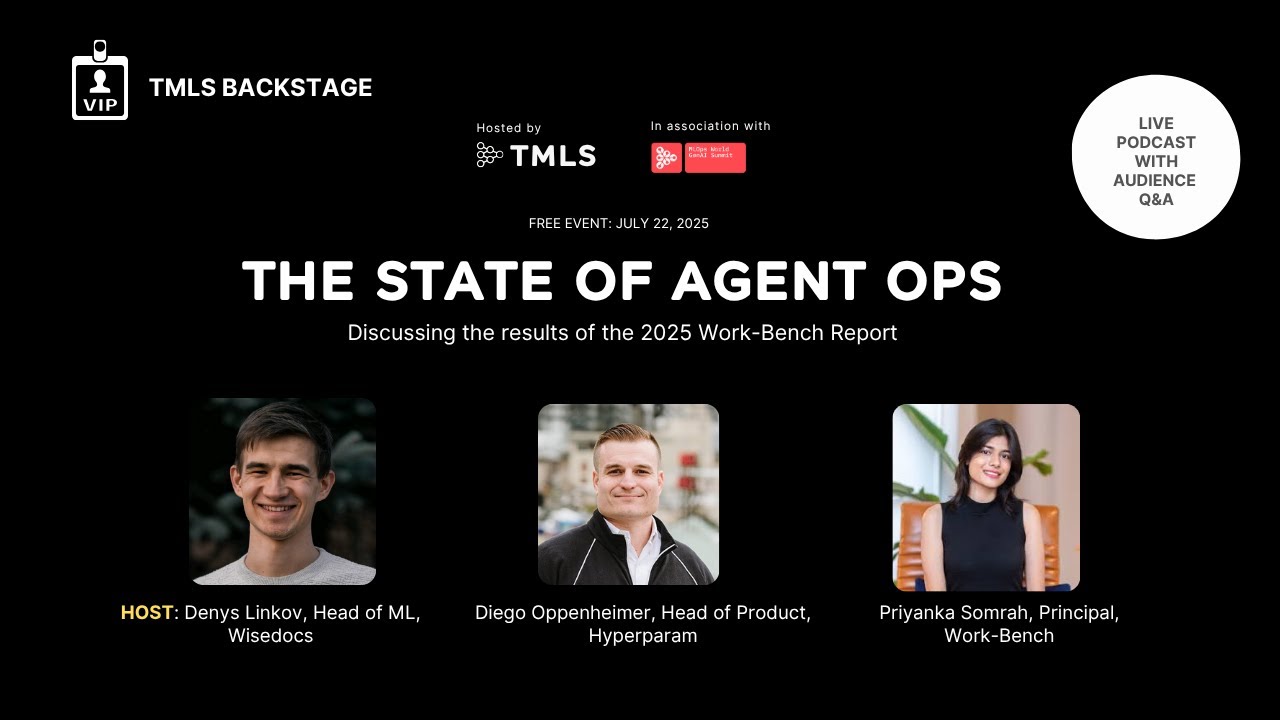
TMLS Backstage 01: The State of Agents OPS
Keywords
Summary
138 words
Critical Evaluation
Value of the Information & Strength of the Argument
The discussion provides valuable insights from practitioners with hands-on experience in AI infrastructure and enterprise software. The panelists offer a balanced view, acknowledging both the potential and the limitations of agentic systems. They argue convincingly that agentic workflows are not a replacement for all automation but are suited for tasks requiring adaptability and context awareness. The argumentation is solid, grounded in real-world examples like Excel rollouts and McDonald’s processes, and they critically examine the challenges of security, debugging, and tooling. However, some points are based on anecdotal evidence rather than rigorous data, and the discussion occasionally lacks depth on technical specifics.
Scientific Rigor, Source Quality, Title Accuracy
The panelists reference a ‘Benchmark Report on Agentic Ops’ but do not provide specific citations or data points from it. The discussion is largely based on personal experience and industry observations, which adds practical value but limits scientific rigor. The title accurately reflects the content, as it is a backstage conversation about the state of agentic operations. The sources cited are minimal, with only a link to the episode post in the description. No external sources are explicitly mentioned in the video, and the panelists do not cite specific studies or papers. The lack of formal references reduces the overall scientific credibility, but the practical insights from experienced professionals are still valuable.
228 words
Title / Content Match
Title accurately reflects the content: a backstage discussion on the state of agentic operations.
Quality & Reliability
7/10
Panel of experienced practitioners (ML lead, product head, VC principal) discussing agentic ops based on industry experience and a benchmark report. No formal citations, but practical insights and balanced perspectives. Some claims lack empirical backing, but overall credible.
Key Moments
Markers derived by PSI from the transcript: the creator did not define chapters.
- Introduction of panelists and topic.
- Discussion on the need for agentic workflows vs RPA.
- Examples of use cases for agentic systems.
- Debate on determinism vs non-determinism in automation.
- Enterprise adoption challenges and security concerns.
- Weakest parts of the stack: security, logging, debugging.
- Tool use and MCP discussion.
- Tracing and monitoring in agentic systems.
- Q&A session with audience.
Cited Sources
- Episode post with full descriptions and links — Referenced as the source for the benchmark report and additional resources.
Concurring Sources
- Anthropic's blog on building effective agents — Aligns with the panel's discussion on when to use agents and the importance of tool use.
Contribution & Novelties
The video offers a practitioner’s perspective on the current state of agentic operations, highlighting the practical challenges and opportunities. It provides a nuanced view on where agentic workflows are beneficial versus traditional automation, and emphasizes the importance of security and observability. The discussion on the non-deterministic nature of agent systems and its implications for debugging is particularly insightful.
Pour aller plus loin :
- Model Context Protocol (MCP) — Official documentation for MCP, a standard for connecting AI models to tools and data.
- Anthropic’s blog on AI agents — Discusses effective agent design and use cases.
- Observability in AI systems — OpenTelemetry provides tools for tracing and monitoring, relevant to the debugging challenges discussed.
113 words
Radar Profile
The radar profile shows balanced scores across information quantity, quality, technical level, and reliability, indicating a well-rounded discussion. The high scores in information quality and reliability reflect the practical expertise of the panelists, while the moderate technical level suggests the content is accessible to a broad audience.
💬 No comments provided.