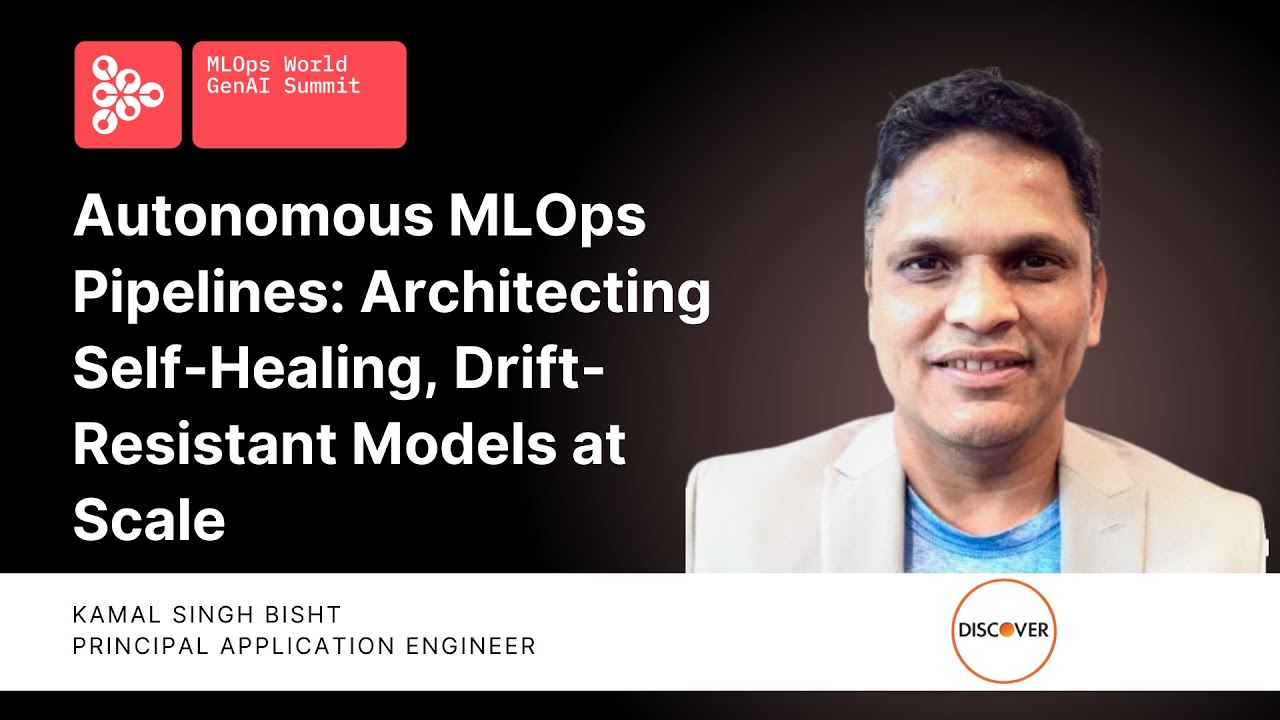
Autonomous MLOps Pipelines: Architecting Self-Healing, Drift Resistant Models
Keywords
Summary
162 words
Critical Evaluation
Value of the Information & Strength of the Argument
The talk provides a comprehensive and structured overview of autonomous MLOps, offering a clear framework that is actionable for practitioners. The argumentation is logical, building from the problem of drift to a detailed architecture and decision-making process. The speaker’s practical experience adds credibility, and the inclusion of specific detection methods and safety checks strengthens the value. However, the presentation lacks concrete case studies or empirical evidence, and some concepts are presented at a high level without deep technical detail.
Scientific Rigor, Source Quality, Title Accuracy
The talk is based on the speaker’s professional experience and does not cite external sources. The only link provided in the description is to the MLOps World conference, which is not a scientific reference. The title accurately reflects the content, and the talk is well-structured. The lack of citations limits the scientific rigor, but the practical nature of the content is appropriate for a conference talk.
160 words
Title / Content Match
The title accurately reflects the content, which focuses on architecting self-healing, drift-resistant MLOps pipelines.
Quality & Reliability
7/10
The talk provides a coherent framework for autonomous MLOps, grounded in practical experience from a principal engineer at Discover Financial Services. It covers key concepts like drift types, detection methods, and a decision engine architecture. However, it lacks specific empirical data, case studies, or references to external sources, and the presentation is largely conceptual.
Key Moments
Markers derived by PSI from the transcript: the creator did not define chapters.
- Introduction and overview of the talk's objectives.
- Challenges of ML systems: adaptive behavior, evolving data, and monitoring needs.
- Four pillars of autonomous MLOps: self-monitoring, self-diagnosing, self-healing, self-optimizing.
- Business benefits: reduced MTTR, improved performance, cost optimization, risk mitigation.
- Types of drift: data drift, concept drift, label drift with examples.
- Cascade effect of drift across models.
- Reference architecture: data sources, monitoring, drift detection, alerting, decision engine.
- Components of real-time monitoring and drift detection methods.
- Autonomous decision engine: inputs, decision pipeline, safety checks, actions.
- Future directions: explainable drift, multimodal monitoring, human-in-the-loop.
Cited Sources
- MLOps World Conference — The talk was recorded at this conference, and the link is provided in the video description.
Concurring Sources
- MLOps World Conference — The talk was presented at this event, aligning with industry trends in MLOps.
Contribution & Novelties
The talk offers a practical framework for autonomous MLOps, synthesizing existing concepts into a coherent architecture. It emphasizes the importance of a decision engine with safety checks and continuous learning, which is a valuable contribution for practitioners. The discussion of drift types and detection methods is well-organized, and the future directions highlight emerging areas.
Pour aller plus loin :
- Data Drift Detection — Overview of data drift and its implications.
- Concept Drift — Definition and methods for handling concept drift.
- MLOps — General overview of MLOps practices and challenges.
89 words
Radar Profile
The radar profile shows balanced scores across all dimensions, with slightly lower technical depth compared to information quantity and quality. This reflects a talk that is informative and well-structured but not highly technical or research-oriented.