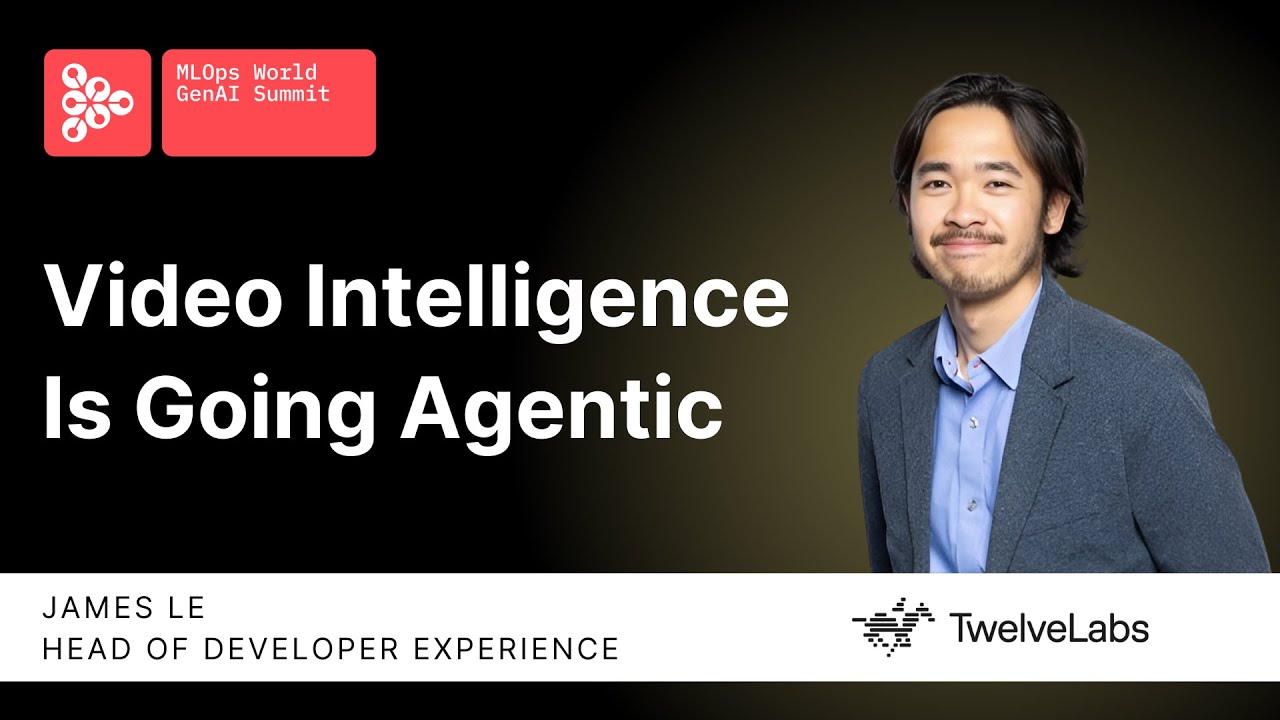
Video Intelligence Is Going Agentic | James Le, TwelveLabs
Keywords
Summary
168 words
Critical Evaluation
Value of the Information & Strength of the Argument
The talk provides valuable insights into the practical application of agentic AI to video understanding, a relatively nascent field. James Le presents a clear argument for why traditional methods fail and how their approach addresses these limitations. The argumentation is supported by a concrete case study (MLSE) and references to academic work, though these references are not detailed. The speaker’s expertise and the technical depth of the discussion add credibility, but the lack of independent validation and the promotional nature of the talk slightly weaken the overall argumentation.
Scientific Rigor, Source Quality, Title Accuracy
The talk demonstrates a reasonable level of scientific rigor, with references to academic papers and a real-world deployment. However, the sources are not formally cited, and the claims about model performance are not backed by published benchmarks. The title accurately reflects the content, and the talk is well-structured. The description provides a link to the conference website, but no additional sources are listed. Overall, the rigor is adequate for an industry talk but not at the level of a peer-reviewed publication.
184 words
Title / Content Match
The title accurately reflects the content, which focuses on the shift towards agentic video intelligence and its applications.
Quality & Reliability
7/10
The talk is an expert opinion from a practitioner at TwelveLabs, presenting their proprietary video understanding models and agentic framework. It includes specific technical details and a real-world case study (MLSE), but lacks independent verification and peer-reviewed sources. The claims about model performance and industry impact are not backed by published benchmarks or external validation.
Key Moments
Markers derived by PSI from the transcript: the creator did not define chapters.
- Introduction and context about video data explosion
- Limitations of traditional video understanding approaches
- Introduction to TwelveLabs' video foundation models (Marango and Pegasus)
- Rise of agentic frameworks and design patterns
- Challenges of video as a modality and academic inspirations
- Introduction to Jockey, TwelveLabs' video agent framework
- Engineering challenges: asynchronous processing and transparent reasoning
- UI design principles for multimodal interfaces
- Real-world case study: MLSE's 98% efficiency boost
- Future roadmap: flow-aware editing, contextual meta-learning, multimodal orchestration
- Introduction to MCP server and Q&A session
Cited Sources
- MLOps World | GenAI Summit 2025 — Conference where the talk was recorded
Concurring Sources
- MLOps World | GenAI Summit 2025 — Conference website, supporting the event context
Contribution & Novelties
The talk provides a practitioner’s perspective on building agentic video intelligence systems, highlighting the shift from static analysis to autonomous agents. It introduces TwelveLabs’ proprietary models and the Jockey framework, offering insights into architectural patterns and engineering challenges. The real-world case study with MLSE demonstrates tangible productivity gains. The talk also discusses the integration of video intelligence with MCP servers, a relatively new development.
Pour aller plus loin :
- Video Understanding — Overview of the field.
- Multimodal learning — Background on multimodal AI.
- Agent-based model — General concept of agents.
- Model Context Protocol — Official site for MCP.
98 words
Radar Profile
The radar profile shows a balanced performance across all dimensions, with slightly lower scores in reliability and technical depth. This suggests a talk that is informative and practical but could benefit from more rigorous sourcing and deeper technical explanations.