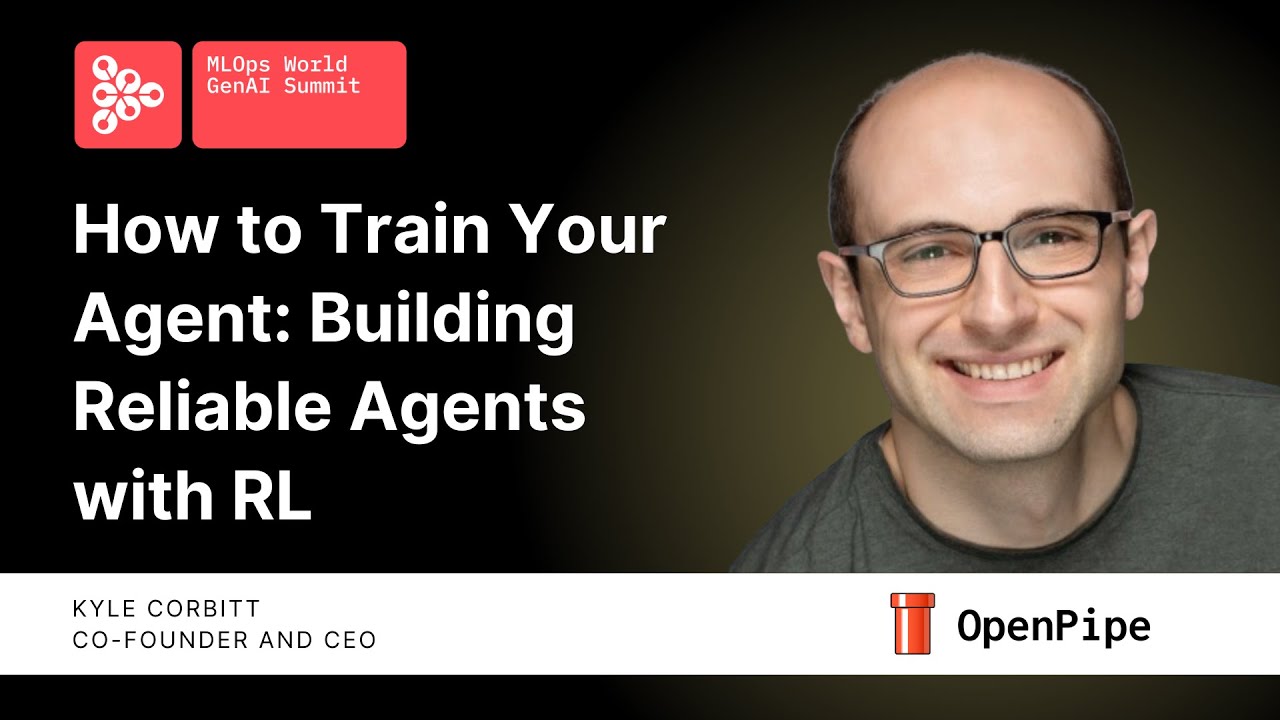
How to Train Your Agent: Building Reliable Agents with RL
Keywords
Summary
183 words
Critical Evaluation
Value of the Information & Strength of the Argument
The talk provides valuable, actionable insights for practitioners looking to deploy RL in production. The speaker’s experience with real-world deployments (DoorDash, Vanguard) lends credibility. He clearly explains the benefits of RL (accuracy, cost, latency) and the practical steps involved, using a concrete case study. The argumentation is logical and well-structured, moving from problem definition to solution. However, the talk is largely anecdotal and lacks rigorous experimental details or comparisons with alternative methods. The speaker’s enthusiasm for RL is evident, but he does not deeply explore potential drawbacks or failure modes beyond the initial setup challenges.
Scientific Rigor, Source Quality, Title Accuracy
The talk is based on the speaker’s professional experience and an open-source project, but it does not cite academic papers or external sources. The only link provided is to the MLOps World conference. The title accurately reflects the content. The speaker mentions GRPO but does not provide a detailed explanation or reference. The lack of citations limits the scientific rigor, but the practical nature of the talk compensates somewhat. The title is appropriate and not misleading.
186 words
Title / Content Match
The title accurately reflects the content, which focuses on applying reinforcement learning to improve agent reliability.
Quality & Reliability
7/10
The speaker is a practitioner with direct experience, and the talk includes concrete case studies and open-source tools. However, it is an opinion-based presentation without peer-reviewed sources or detailed methodological transparency.
Key Moments
Markers derived by PSI from the transcript: the creator did not define chapters.
- Introduction: Kyle Corbitt introduces himself and the topic of building reliable agents with RL.
- Definition of RL as 'on-the-job training' for agents.
- Case study introduction: Art E, an email assistant.
- Importance of building a prompted agent first before using RL.
- Benefits of RL: higher accuracy, lower cost, lower latency.
- Challenges: building a realistic environment and reward function.
- Using the Enron email dataset for the environment.
- Creating a reward function with synthetic data and LLM evaluation.
- Training loop and results: accuracy improvement from 40% to 96%.
- Ancillary rewards for efficiency and final thoughts on cost and effort.
Cited Sources
- MLOps World — Conference where the talk was recorded.
Concurring Sources
- GRPO paper — The algorithm used in the talk.
Contribution & Novelties
The talk provides a practical, step-by-step guide to applying RL to agent reliability, with a concrete open-source example. It highlights the importance of environment realism and reward function design, and demonstrates significant improvements in accuracy, cost, and latency. The speaker shares real-world lessons from deployments at DoorDash and other companies.
Pour aller plus loin :
- Group Relative Preference Optimization (GRPO) — The RL algorithm mentioned in the talk.
- Reinforcement Learning from Human Feedback (RLHF) — A related technique for training language models.
- Enron Email Dataset — The dataset used for the environment.
92 words
Radar Profile
The radar profile shows high scores in information quantity and quality, with moderate technical depth and reliability. This indicates a talk that is informative and practical, but not deeply technical or rigorously sourced.