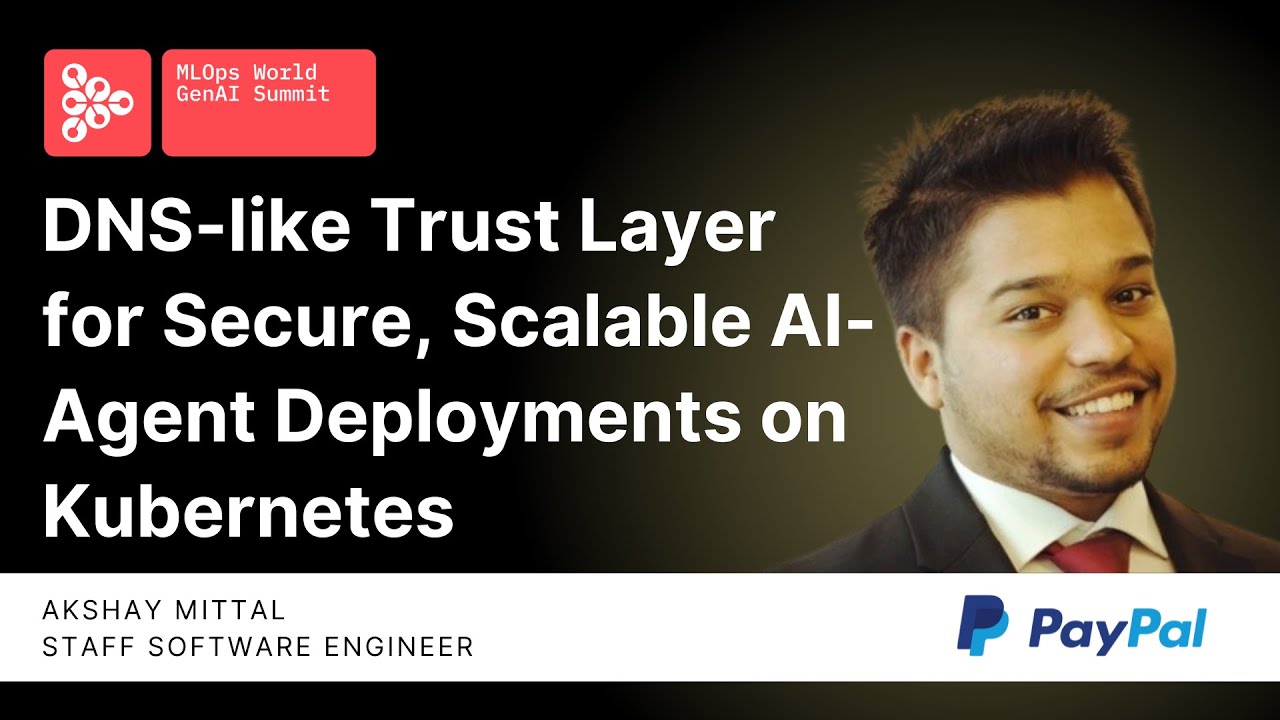
DNS-like Trust Layer for Secure, Scalable AI-Agent Deployments on Kubernetes | Akshay Mittal, PayPal
Keywords
Summary
165 words
Critical Evaluation
Value of the Information & Strength of the Argument
The talk provides a valuable overview of a practical solution to a real problem in agentic AI: trust and governance. The speaker demonstrates a working proof-of-concept with performance metrics, which adds credibility. However, the argumentation is largely based on the speaker’s own design and implementation, with limited external validation. The claims about scalability and security are plausible but not rigorously proven. The speaker acknowledges the early stage of the project and outlines future work, which is honest but also indicates the lack of mature evidence.
Scientific Rigor, Source Quality, Title Accuracy
The talk is based on the speaker’s own research and implementation, with references to industry protocols like A2A, MCP, and ACP. The description provides a link to the MLOps World conference, but no direct sources are cited in the talk. The title accurately reflects the content. The speaker mentions using AI for documentation, but this is not a source. Overall, the scientific rigor is moderate, with a clear proof-of-concept but lacking peer-reviewed validation.
173 words
Title / Content Match
The title accurately reflects the content: a DNS-like trust layer for AI agents on Kubernetes, presented by Akshay Mittal from PayPal.
Quality & Reliability
6/10
The talk presents a proof-of-concept for a DNS-like trust layer for AI agents, with live demos and performance metrics. However, it lacks peer-reviewed validation, detailed security analysis, and independent verification. The speaker is a staff engineer at PayPal, lending practical credibility, but the claims are largely anecdotal and based on a small-scale pilot.
Key Moments
Markers derived by PSI from the transcript: the creator did not define chapters.
- Introduction to the AI landscape and shift to autonomous agents
- Trust problems in agent communication
- Introduction to ANS as DNS-like trust layer
- ANS naming convention and protocol support
- Cryptographic trust chain and capability proofs
- Kubernetes integration and lifecycle
- Live demo: ANS core library testing
- Live demo: service connectivity and monitoring
- Performance results and implementation roadmap
- Q&A session
Cited Sources
- MLOps World Conference — Conference where the talk was presented
Concurring Sources
- MLOps World Conference — Conference where the talk was presented
Contribution & Novelties
The talk introduces the Agent Name Service (ANS), a novel protocol for trust and governance in AI-agent deployments. It provides a concrete implementation on Kubernetes with performance benchmarks, which is a practical contribution to the field. The approach of combining DNS-like naming with cryptographic identity and capability verification is innovative.
Pour aller plus loin :
- Agent Name Service GitHub repository — Note: The speaker mentioned a GitHub link, but it is not provided in the description. This is a placeholder; the actual repository is not verified.
- Open Policy Agent (OPA) — Policy enforcement tool used in the talk.
- Sigstore — Software signing and verification, mentioned for supply chain security.
- A2A protocol — Agent-to-agent protocol by Google, referenced in the talk.
- MCP protocol — Model Context Protocol by Anthropic, referenced in the talk.
132 words
Radar Profile
The radar profile shows a balanced distribution across quantity, quality, and technical level, with a slightly lower reliability score. This indicates a technically informative talk with practical demonstrations, but with limited external validation and scientific rigor.