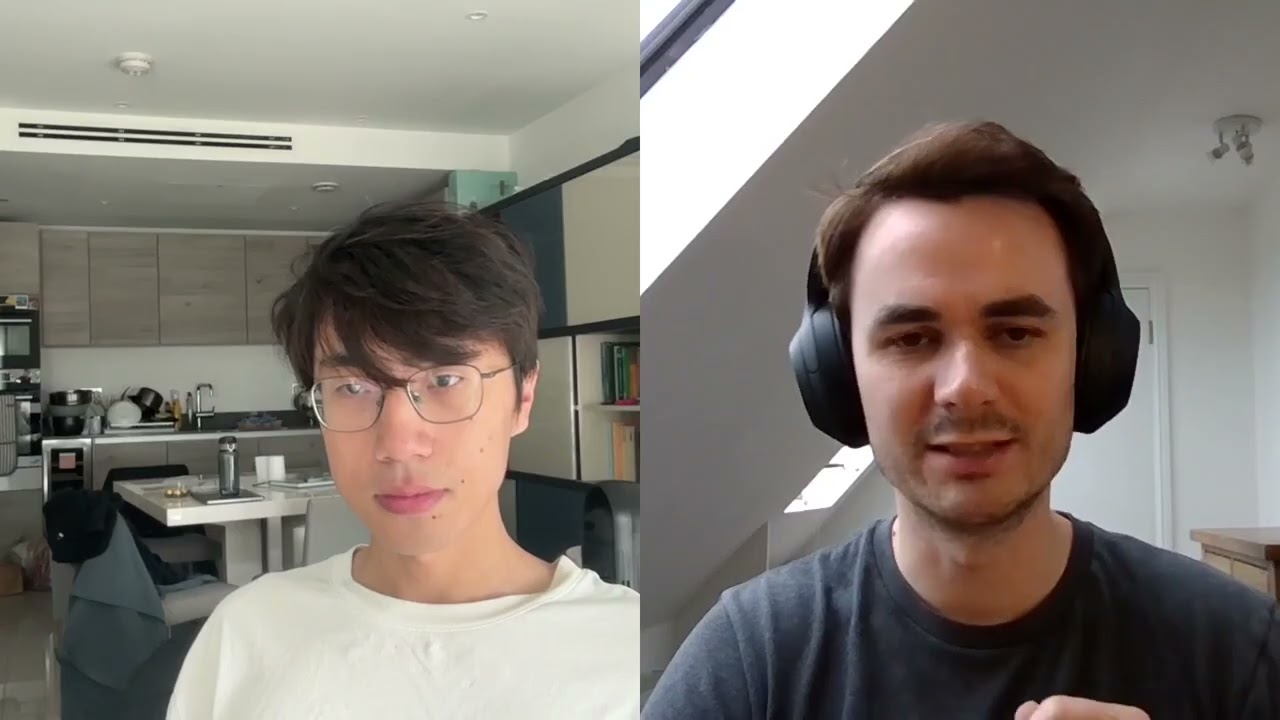
Changmin Yu on what the hippocampus can teach us about RL | FAI CDT
Keywords
Summary
146 words
Critical Evaluation
Value of the Information & Strength of the Argument
The value of the information is high, as it provides a first-hand account of cutting-edge research at the intersection of neuroscience and AI. The argumentation is coherent and well-supported by references to specific neural phenomena (place cells, grid cells, sharp-wave ripples) and their computational counterparts. The speaker clearly explains the rationale behind his approaches and provides evidence of their effectiveness through comparisons with baselines. The discussion is nuanced, acknowledging the conjectural nature of many neuroscience findings.
Scientific Rigor, Source Quality, Title Accuracy
The scientific rigor is strong: the speaker is an expert in the field, and his claims are based on his own published research and established literature. He mentions specific collaborators (e.g., Manish Sahani) and institutions (Gatsby, Harvard, Microsoft, Meta). The title is accurate and not sensationalized. The content is well-structured and avoids overgeneralization. The interview format allows for clarification and depth.
152 words
Title / Content Match
The title accurately reflects the content: an interview about how hippocampal mechanisms, particularly replay, can inform reinforcement learning.
Quality & Reliability
8/10
The speaker is a PhD graduate in computational neuroscience, and the content is based on his own research, published in peer-reviewed venues. The discussion is technical and grounded in established neuroscience and RL concepts, though it is an interview and not a formal presentation.
Key Moments
Markers derived by PSI from the transcript: the creator did not define chapters.
- Introduction of Changmin Yu and his thesis topic.
- Overview of thesis: modeling hippocampus and using replay for RL.
- Explanation of place cells and grid cells.
- Description of hippocampal replay and sharp-wave ripples.
- Translation of replay into model-based RL with forward and backward predictions.
- Intrinsic motivation model based on forward and backward information.
- Comparison with standard experience replay and results on continuous control tasks.
- Discussion of internships: Microsoft Research, Meta, Huawei.
- Work on protein language models at Microsoft.
- Work on diffusion models for EMG signal augmentation at Meta.
Cited Sources
- UCL Centre for Artificial Intelligence — The channel and institution hosting the interview.
Concurring Sources
- Hippocampal replay in the awake state: a potential substrate for memory consolidation and retrieval — Supports the role of replay in memory consolidation.
- Model-based reinforcement learning: a survey — Provides an overview of model-based RL, relevant to the discussed methods.
Dissenting Sources
- Challenges in translating neuroscience to AI — Some researchers argue that direct analogies from neuroscience may not always lead to practical AI improvements, and that the complexity of biological systems may not be fully captured by simplified models.
Contribution & Novelties
The interview provides a unique perspective on how hippocampal replay can be directly translated into RL algorithms, specifically by training world models with both forward and backward predictions. This approach improves sample efficiency and generalization, as demonstrated in continuous control tasks. The speaker also highlights the importance of intrinsic motivation based on forward and backward information. This work bridges neuroscience and AI, offering novel insights for both fields.
Pour aller plus loin :
- Hippocampus — Background on the brain region.
- Reinforcement learning — Core concepts.
- World model — Related AI concept.
- Place cell — Neural basis of spatial representation.
- Sharp wave ripple — Neural oscillation associated with replay.
108 words
Radar Profile
The radar profile shows high scores in information quantity, quality, and reliability, with a slightly lower technical level, reflecting the accessible yet expert nature of the interview. The overall balance indicates a highly informative and credible discussion.
💬 Sur les 0 commentaires analysés, aucune tendance n'est disponible.