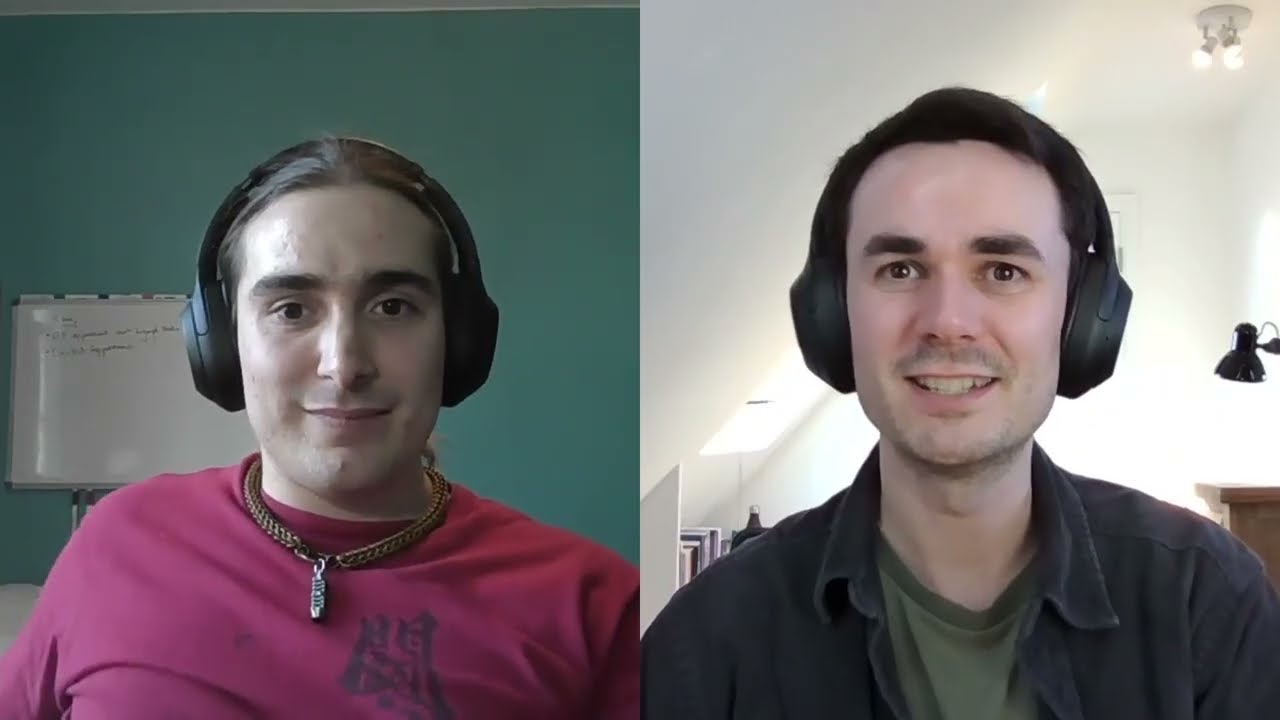
Riverside Neural Operators | Emilio McAllister Fognini, FAI CDT
Keywords
Summary
129 words
Critical Evaluation
Value of the Information & Strength of the Argument
The video provides a clear and insightful overview of neural operators, explaining their motivation and advantages over traditional solvers. The argumentation is coherent, with the speaker using analogies and concrete examples to illustrate abstract concepts. He effectively contrasts neural operators with finite element methods, emphasizing flexibility and speed. The discussion on inverse problems adds depth, showing real-world relevance. However, the presentation is conversational and lacks rigorous mathematical detail, which may limit its value for experts. The speaker’s expertise is evident, but the informal format means some claims are not fully substantiated.
Scientific Rigor, Source Quality, Title Accuracy
The scientific rigor is moderate: the speaker is a PhD student, and the content is technically sound, but no formal sources are cited. The title accurately reflects the content. The description mentions potential applications in healthcare and industry, which are discussed. No external references are provided, so the quality of sources cannot be assessed. The adéquation between title and content is good, as the video is indeed about neural operators.
176 words
Title / Content Match
The title accurately reflects the content, which is a discussion about neural operators with Emilio McAllister Fognini.
Quality & Reliability
8/10
The speaker is a PhD student in foundational AI, and the discussion is technically accurate and well-structured. However, it is an informal interview without formal citations or peer review, and some claims are presented without rigorous backing.
Key Moments
Markers derived by PSI from the transcript: the creator did not define chapters.
- Introduction and overview of neural operators.
- Explanation of the original motivation for neural operators.
- Discussion of applications in medical imaging and inverse problems.
- Comparison with traditional numerical methods like FEM.
- Explanation of how neural operators represent functions.
- Discussion of forward vs inverse problems.
- Challenges and limitations of neural operators.
- Potential for accelerating scientific simulations.
Contribution & Novelties
The video offers a clear conceptual explanation of neural operators, bridging the gap between traditional PDE solvers and modern machine learning. It highlights the potential for resolution independence and parameter generalization, which are key advantages. The discussion on inverse problems in medical imaging provides a concrete application. However, the content is largely introductory and does not present novel research findings.
Pour aller plus loin :
- Neural Operator — Wikipedia overview of neural operators.
- Finite element method — Traditional numerical method discussed.
- Inverse problem — Mathematical concept relevant to the discussion.
90 words
Radar Profile
The radar profile shows balanced scores across all dimensions, with slightly higher quality of information and technical level, indicating a solid but not exceptional presentation. The moderate scores on quantity and reliability suggest the content is informative but lacks depth and formal sourcing.