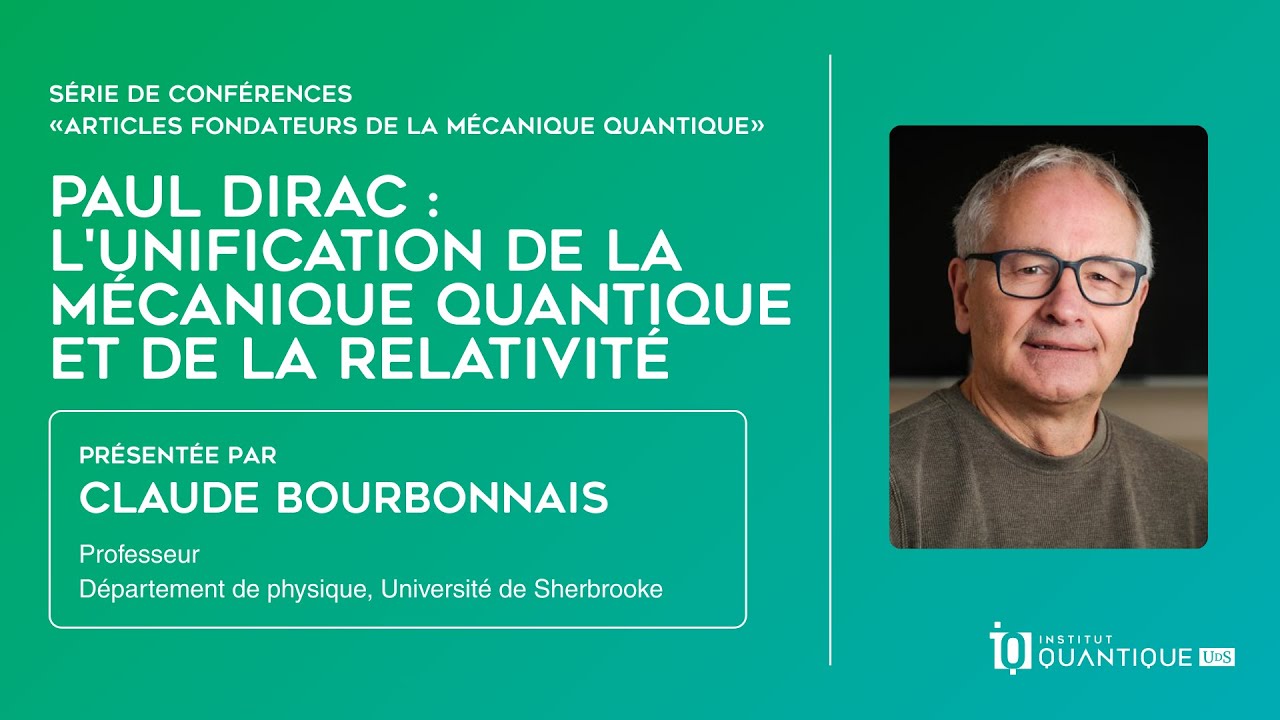
Paul Dirac : l'unification de la mécanique quantique et de la relativité
Keywords
Summary
157 words
Critical Evaluation
Value of the Information & Strength of the Argument
The lecture provides a valuable historical and conceptual overview of the development of relativistic quantum mechanics, emphasizing the key experimental and theoretical steps leading to Dirac’s equation. The argumentation is solid, tracing the logical progression from the anomalous Zeeman effect to the need for a relativistic equation, and demonstrating how Dirac’s approach naturally yielded spin and the correct fine structure. The speaker effectively explains complex concepts with clarity, using analogies and historical context to support the narrative.
Scientific Rigor, Source Quality, Title Accuracy
The scientific rigor is high, as the speaker is a physicist and the content aligns with established historical and scientific facts. The lecture references original works and key figures, though it does not provide formal citations. The title accurately reflects the content, focusing on Dirac’s unification. The presentation is well-structured and technically accurate, with appropriate caveats about approximations and historical context.
153 words
Title / Content Match
The title accurately reflects the content, which focuses on Dirac's unification of quantum mechanics and relativity.
Quality & Reliability
8/10
The lecture is given by a physicist from the Université de Sherbrooke, providing a historically and scientifically accurate account of Dirac's equation. It includes precise technical details and references to original works, though it is a popularized presentation without formal citations.
Key Moments
Markers derived by PSI from the transcript: the creator did not define chapters.
- Introduction to early relativistic effects in atomic spectra, including Michelson-Morley doublet.
- Discussion of Sommerfeld's relativistic correction to Bohr's model and the fine structure constant.
- Explanation of the anomalous Zeeman effect and Pauli's fourth quantum number.
- Introduction of electron spin by Uhlenbeck and Goudsmit, and the spin-orbit interaction.
- Biographical background of Paul Dirac, including his education and family life.
- Derivation of the Dirac equation using 4x4 matrices and its implications for spin and g-factor.
- Application to hydrogen atom, including fine structure and the Darwin term, and reactions from contemporaries.
Cited Sources
- The Quantum Theory of the Electron — Dirac's original 1928 paper presenting the Dirac equation.
Concurring Sources
- The Quantum Theory of the Electron — Dirac's original paper, which the lecture is based on.
Contribution & Novelties
The lecture provides a comprehensive historical and conceptual account of Dirac’s unification, emphasizing the role of linearity and the emergence of spin. It clarifies the limitations of the Klein-Gordon equation and the necessity of 4x4 matrices. The presentation also highlights the personal and scientific context, making it accessible while retaining technical depth.
Pour aller plus loin :
- Dirac equation — Overview of the equation and its implications.
- Spin (physics) — Detailed explanation of intrinsic angular momentum.
- Fine structure — Relativistic corrections to atomic energy levels.
85 words
Radar Profile
The radar profile shows high scores in quantity and quality of information, with a strong technical level, indicating a well-balanced and informative lecture. The reliability is also high, reflecting the speaker's expertise and accurate historical content.
💬 No comments were provided for analysis.