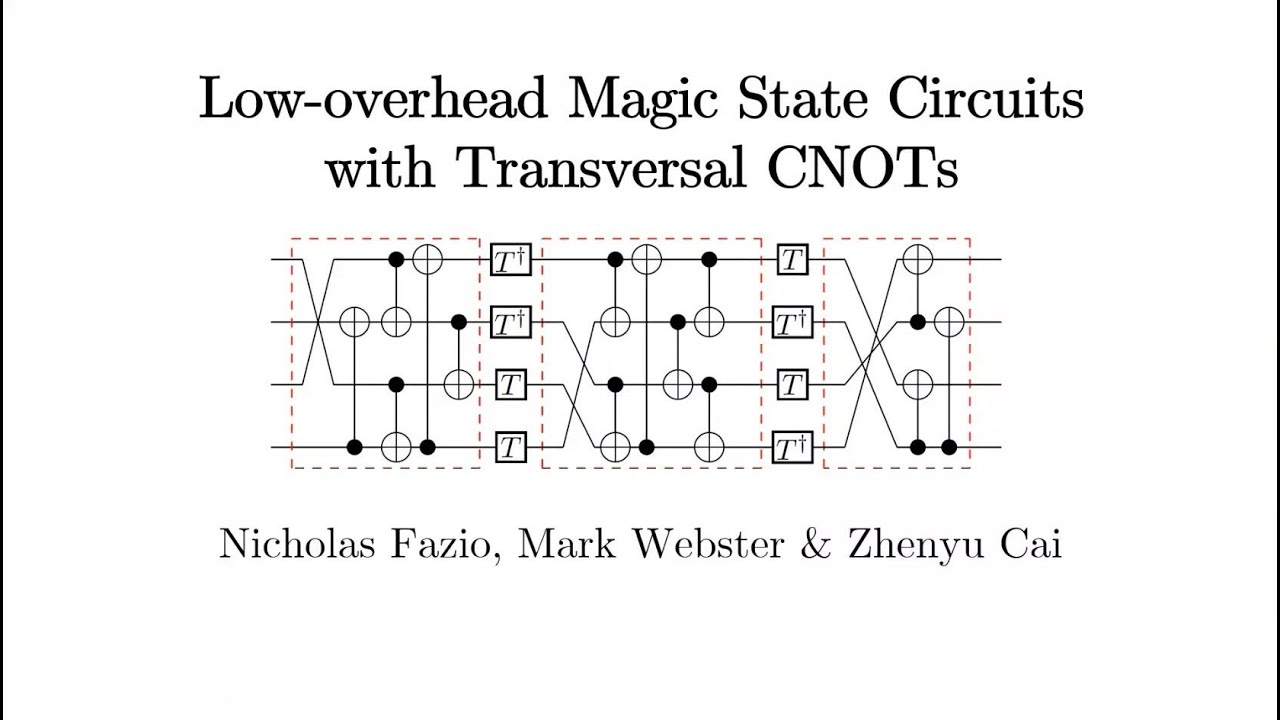
Low overhead Magic State Circuits with Transversal CNOTs
Keywords
Summary
141 words
Critical Evaluation
Value of the Information & Strength of the Argument
The talk presents a novel algorithm for optimizing magic state circuits, which is a critical component of fault-tolerant quantum computing. The argumentation is clear and logical, building from basic concepts to the specific contributions. The speaker provides concrete examples and walks through the compilation steps, making the method understandable. The value lies in the potential to reduce overheads in architectures where transversal CNOTs are available, which is a timely contribution given recent experimental demonstrations. The speaker acknowledges limitations, such as the assumption of ideal CNOTs in some contexts, and discusses trade-offs. Overall, the argumentation is solid and well-supported by examples.
Scientific Rigor, Source Quality, Title Accuracy
The talk is based on original research, likely to be published in a peer-reviewed venue. The speaker references prior work, such as Cody Jones’s 8-to-2 scheme and the Eastin-Knill theorem, but does not provide explicit citations during the talk. The title accurately reflects the content, focusing on low-overhead magic state circuits with transversal CNOTs. The presentation is rigorous, with clear definitions and a step-by-step explanation of the algorithm. However, the lack of formal citations in the talk may limit immediate verification. The speaker’s affiliation with University of Sydney and collaboration with Oxford and UCL researchers adds credibility.
212 words
Title / Content Match
The title accurately reflects the content, focusing on low-overhead magic state circuits using transversal CNOTs.
Quality & Reliability
8/10
Presentation of original research by a PhD candidate, with clear methodology and references to prior work, but limited peer-review context and no external verification.
Key Moments
Markers derived by PSI from the transcript: the creator did not define chapters.
- Introduction and motivation for magic states in quantum computation.
- Explanation of the Eastin-Knill theorem and the need for magic state injection.
- Introduction to phase polynomials and their role in representing magic state circuits.
- Example of 15-to-1 magic state distillation using phase polynomials.
- Discussion of the algorithm for compiling CNOT blocks and reducing depth.
- Walkthrough of the 8-to-2 CCZ factory example.
- Results for CS and T state circuits, showing reduced overheads.
- Discussion of implications for architectures with transversal CNOTs.
- Conclusion and potential future work.
Cited Sources
- Cody Jones, 'Low-overhead constructions for the fault-tolerant Toffoli gate' — Referenced as the source of the 8-to-2 CCZ scheme.
- Earl Campbell, 'The smallest 3D color code' — Referenced as a blog post describing the 8-to-2 scheme.
Concurring Sources
- Cody Jones, 'Low-overhead constructions for the fault-tolerant Toffoli gate' — Provides the 8-to-2 scheme that the talk builds upon.
- Earl Campbell, 'The smallest 3D color code' — Describes the 8-to-2 scheme in an accessible manner.
Contribution & Novelties
The talk presents a new algorithm for compiling magic state circuits with reduced T-depth and CNOT-depth, assuming transversal CNOTs. This is a significant contribution as it addresses a key bottleneck in fault-tolerant quantum computing. The method leverages phase polynomials and a greedy compilation strategy to minimize overheads. The examples demonstrate substantial improvements over existing schemes. The work is likely to be published in a peer-reviewed venue, adding to its credibility.
Pour aller plus loin :
- Magic state distillation — Background on the concept.
- Eastin–Knill theorem — Fundamental limitation on transversal gates.
- Clifford hierarchy — Context for T gates and magic states.
101 words
Radar Profile
The radar profile shows high scores in technical depth and information quality, with slightly lower scores in accessibility and novelty. This indicates a highly technical presentation with substantial content, but may be challenging for a general audience.
💬 No comments were provided for analysis.