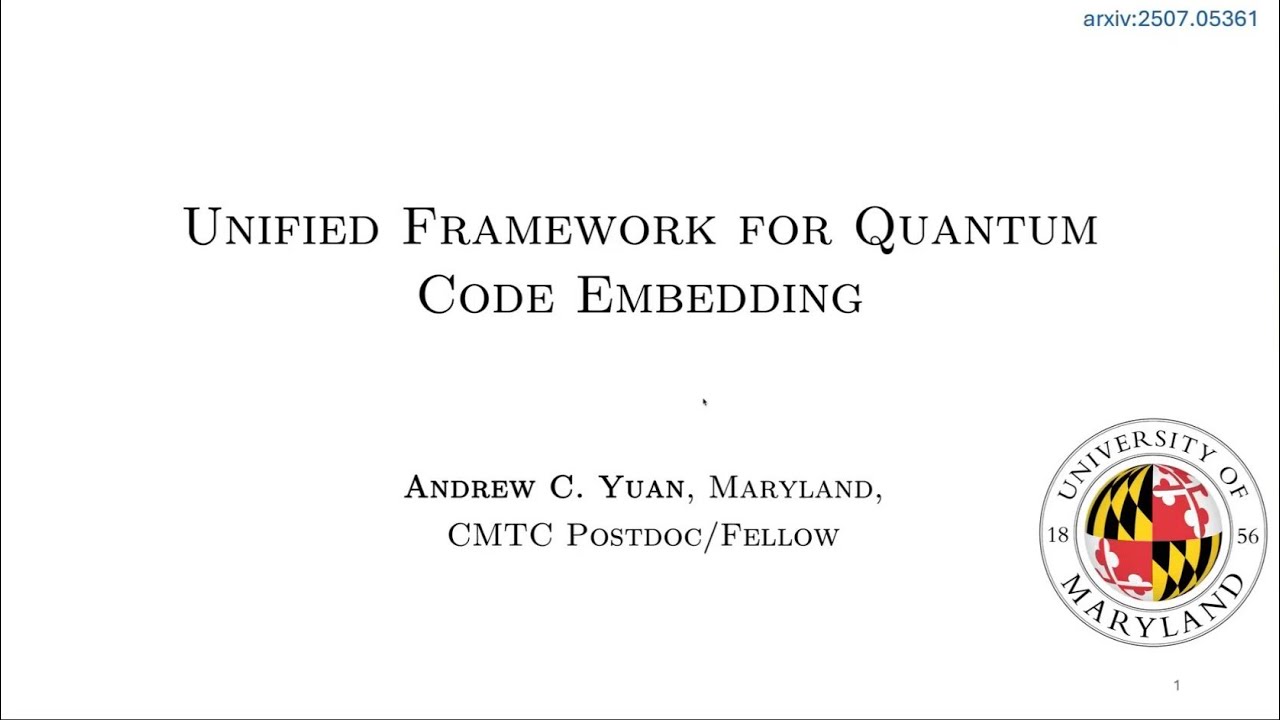
Unified Framework for Quantum Code Embedding
Keywords
Summary
110 words
Critical Evaluation
Value of the Information & Strength of the Argument
The talk provides a high-value contribution by unifying several known constructions under a single theoretical framework. The argumentation is rigorous, building from basic definitions of chain complexes to the main theorem. The speaker carefully explains the intuition behind each step, making the abstract concepts accessible. He also demonstrates the framework’s applicability through concrete examples, which strengthens the credibility of the claims. The presentation is well-structured, with clear logical flow from motivation to formal statement to examples.
Scientific Rigor, Source Quality, Title Accuracy
The scientific rigor is high: the speaker is a researcher at a reputable institution (JQI) and the work is based on established mathematical tools. The talk references prior work (e.g., layer code construction by Williamson and Baspin, weight reduction by Hastings and Shu) and places the framework in context. The title accurately reflects the content. No sources are explicitly cited in the video, but the description mentions the arXiv reference in the top right corner, which is not visible in the transcript. The talk is a seminar presentation, so it is not peer-reviewed, but the mathematical nature of the content suggests high reliability.
194 words
Title / Content Match
The title accurately reflects the content: the talk presents a unified framework for embedding quantum codes, focusing on preserving logical qubits.
Quality & Reliability
8/10
Presentation of a novel mathematical framework with rigorous proofs, based on homological algebra. The speaker is a postdoc at JQI with relevant background. Claims are supported by references to prior work (e.g., layer code construction, weight reduction). No obvious errors or overstatements detected.
Key Moments
Markers derived by PSI from the transcript: the creator did not define chapters.
- Introduction by host and speaker background
- Motivation: modifying CSS codes by adding ancillas, examples of embedding and weight reduction
- Code concatenation as a simple case, operator-level description
- Introduction to chain complexes and their relation to CSS codes
- Generalization to independent CSS codes and the main framework
- Example: layer code construction, embedding into 3D Euclidean space
- Formal statement of the framework and equivalence with direct sum decomposition
- Intuition for H2 and H0, cell complexes, and coning for weight reduction
- Cleaning lemma and bounding code distance
- Conclusion and summary
Cited Sources
- arXiv paper (referenced in video) — The speaker mentions an arXiv reference in the top right corner, but the exact URL is not provided in the transcript.
Concurring Sources
- Layer code construction (Williamson & Baspin) — Mentioned in the talk as a prior work that fits into the framework.
- Weight reduction (Hastings, Shu et al.) — Mentioned in the talk as related work on reducing check weights.
Contribution & Novelties
The talk presents a novel unified framework for embedding CSS codes, which generalizes previous constructions and provides rigorous conditions for preserving logical qubits. This is a significant theoretical contribution to quantum error correction.
Pour aller plus loin :
- Quantum LDPC codes — Overview of quantum LDPC codes, relevant to the motivation.
- Homological algebra — Mathematical background for the framework.
- Surface code — Example of a topological code used in the layer construction.
- Calderbank-Shor-Steane code — Definition and properties of CSS codes.
81 words
Radar Profile
The radar profile shows high scores in technical level and information quality, with slightly lower scores in quantity and reliability, reflecting the specialized nature of the talk and the lack of explicit citations in the video.