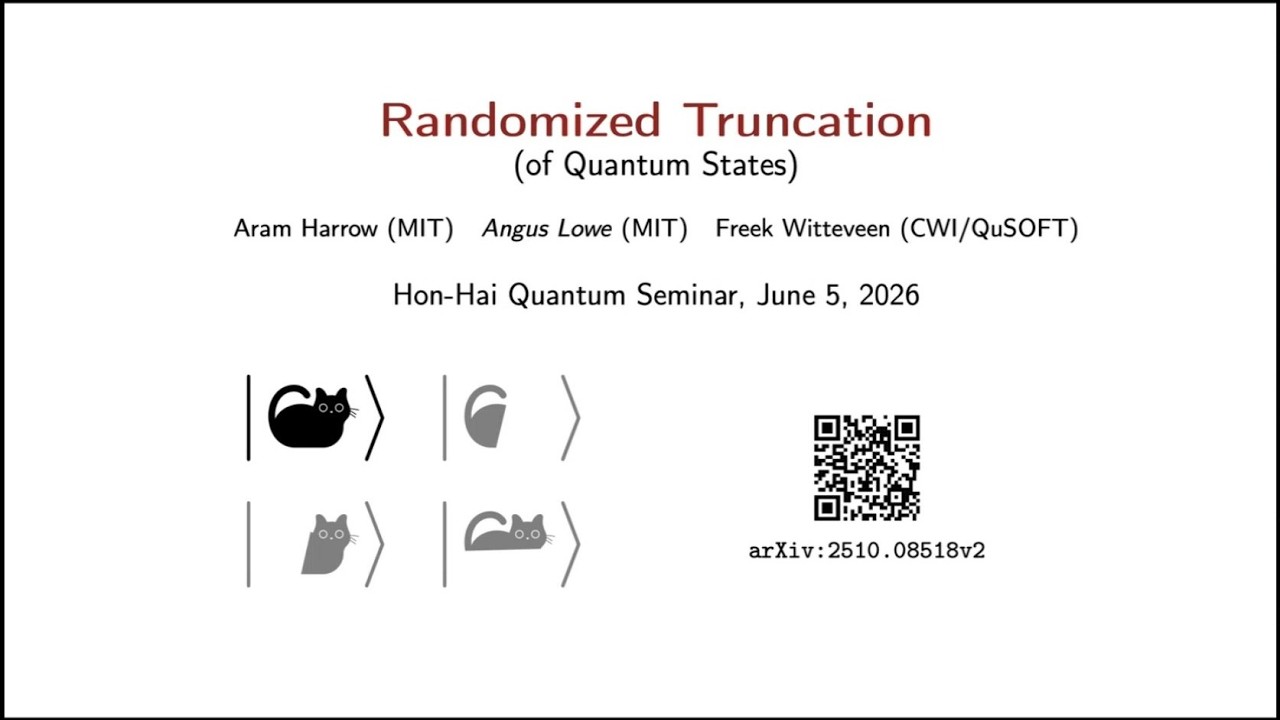
Randomized truncation of quantum states
Keywords
Summary
128 words
Critical Evaluation
Value of the Information & Strength of the Argument
The value of the information is high, as it addresses a fundamental problem in quantum information with practical implications for tensor network simulations. The argumentation is solid, building from the classical Eckart-Young theorem to the quantum setting, and clearly explaining why randomness helps for trace distance but not for fidelity. The speaker provides intuition via geometric and game-theoretic analogies, and supports the claims with rigorous proofs and numerical demonstrations. The presentation is well-structured, with clear statements of the main results and open questions.
Scientific Rigor, Source Quality, Title Accuracy
The scientific rigor is high: the work is based on formal proofs and includes references to standard results (Eckart-Young, Fuchs-van de Graaf inequalities) and related work (Gosset et al., QDrift). The sources are appropriate and the talk is self-contained. The title accurately reflects the content. No comments were provided, so no analysis of public reception is included.
155 words
Title / Content Match
The title accurately reflects the content, which focuses on randomized truncation of quantum states and its optimality.
Quality & Reliability
8/10
The talk presents original research with rigorous mathematical proofs, including convex optimization and zero-sum games, and includes numerical demonstrations. The speaker is a PhD student at MIT advised by Aram Harrow, and the work is joint with researchers at CWI and Q-Soft. The presentation is clear and technical, with appropriate caveats about open questions.
Key Moments
Markers derived by PSI from the transcript: the creator did not define chapters.
- Introduction and motivation: best low-rank approximation to a matrix (Eckart-Young theorem).
- Quantum version: best low Schmidt rank approximation, deterministic truncation, and why randomness doesn't help for fidelity.
- Example of quadratic advantage in trace distance for a single qubit.
- Discussion of why randomness helps for quantum processes (QDrift, T-gate optimization).
- Main result: efficient algorithms for optimal randomized truncation in trace distance.
- Description of the optimal truncation strategy: keep some coefficients, sample some, drop the rest.
- Proof techniques: convex optimization, zero-sum games, and NP-hardness for mixed states.
- Application to matrix product state simulations and numerical improvement.
- Open questions and conclusion.
Cited Sources
- Eckart-Young theorem — Mentioned as the classical result for optimal low-rank approximation.
- Fuchs-van de Graaf inequalities — Used to show the quadratic advantage is optimal.
- Gosset, Kothari, and Jiang result on T-gate optimization — Cited as an example where randomness helps in approximating quantum processes.
- QDrift algorithm — Mentioned as an example of randomized compilation in Hamiltonian simulation.
Concurring Sources
- Eckart-Young theorem — Supports the deterministic optimality for fidelity.
- Fuchs-van de Graaf inequalities — Supports the quadratic advantage bound.
Contribution & Novelties
The work provides the first efficient algorithms for optimal randomized truncation of quantum states, improving upon deterministic methods for trace distance. The key novelty is the characterization of the optimal ensemble and the efficient sampling procedure, which can be directly applied to tensor network simulations. The proof techniques, combining convex optimization and zero-sum games, are elegant and may have broader applicability.
Pour aller plus loin :
- Matrix product states — Background on the simulation method where truncation is used.
- Quantum state fidelity — The metric for which deterministic truncation is optimal.
- Convex optimization — The mathematical framework used in the proofs.
- Zero-sum game — The game-theoretic perspective for mixed strategies.
110 words
Radar Profile
The radar profile shows high scores in quality of information, technical level, and reliability, with slightly lower scores in quantity of information and overall score. This indicates a technically dense and reliable presentation, but with a narrow focus and limited breadth of topics covered.