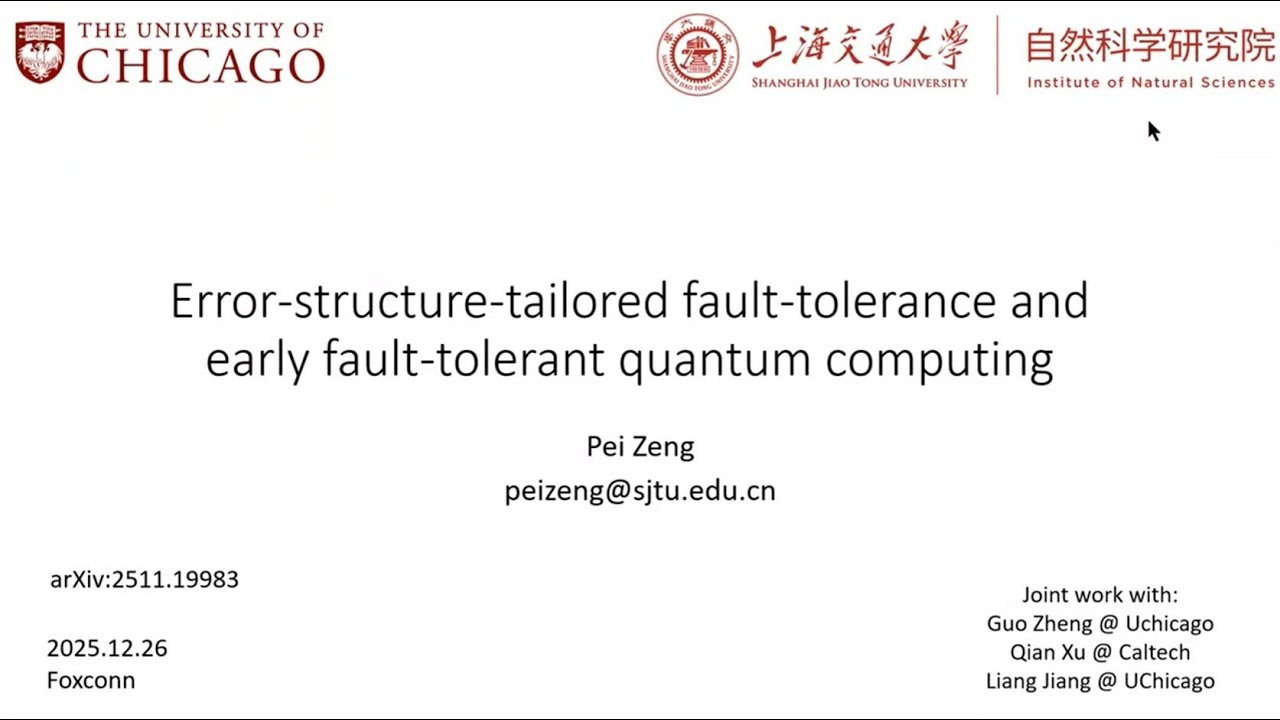
Error structure tailored early fault tolerant quantum computing
Keywords
Summary
184 words
Critical Evaluation
Value of the Information & Strength of the Argument
The talk presents a significant contribution to the field of fault-tolerant quantum computing by proposing a method to reduce the overhead of logical rotation gates. The argumentation is solid, building on established concepts like the Eastin-Knill theorem and magic state distillation, and then introducing a new framework that leverages the specific error structure of physical systems. The speaker provides quantitative resource estimates, comparing their method to existing approaches, which strengthens the value of the information. The presentation is technical and assumes familiarity with quantum error correction, but the core ideas are clearly explained.
Scientific Rigor, Source Quality, Title Accuracy
The talk demonstrates scientific rigor through the detailed theoretical analysis and the use of established concepts. However, the presentation is informal and does not explicitly cite sources during the talk, though the description mentions the work is by Pei Zeng from Shanghai Jiao Tong University. The title accurately reflects the content, focusing on error-structure-tailored fault tolerance for early fault-tolerant quantum computing. The talk does not include a formal bibliography, but the context suggests the work is based on peer-reviewed research.
188 words
Title / Content Match
The title accurately reflects the content: the talk focuses on tailoring fault tolerance to the error structure to enable early fault-tolerant quantum computing.
Quality & Reliability
8/10
The talk presents original research with a rigorous theoretical framework, including perturbative analysis and resource estimates. The speaker is a recognized researcher, and the work is likely peer-reviewed (as implied by the context). However, the presentation is informal and lacks detailed citations during the talk.
Key Moments
Markers derived by PSI from the transcript: the creator did not define chapters.
- Introduction and motivation: the need for fault tolerance and the high overhead of current approaches.
- Discussion of early fault-tolerant algorithms and the bottleneck of logical rotation gates.
- Review of the gadget-based fault-tolerance framework and the standard error model.
- Introduction of the error-structure-tailored fault-tolerance concept and the new gadget definitions.
- Design of 1-fault-tolerant continuous-angle rotation gates using dispersive-coupling Hamiltonians.
- Resource analysis and comparison with magic state distillation and cultivation.
- Conclusion and outlook for early fault-tolerant quantum computing.
Cited Sources
- Error structure tailored early fault tolerant quantum computing (paper) — The talk is based on this work, presented by Pei Zeng.
Concurring Sources
- Quantum error correction — General background on quantum error correction, which is the foundation of the talk.
Contribution & Novelties
The talk introduces a novel framework for fault-tolerant quantum computing that tailors the fault-tolerance conditions to the specific error structure of the physical system. This allows for the design of 1-fault-tolerant continuous-angle rotation gates without the need for T-gate compilation and magic state distillation, significantly reducing spacetime overhead. The approach is hardware-efficient and compatible with nearest-neighbor interactions, making it suitable for near-term devices.
Pour aller plus loin :
- Eastin-Knill theorem — This theorem is central to the motivation, as it prevents transversal implementation of logical rotation gates.
- Magic state distillation — The proposed method aims to circumvent this resource-intensive technique.
- Stabilizer codes — The framework relies on the structural properties of stabilizer codes.
113 words
Radar Profile
The radar profile shows high scores in technical level and information quality, indicating a specialized and rigorous presentation. The lower score in quantity of information reflects the focused scope of the talk, while the fiabilite_globale is high due to the speaker's expertise and the theoretical nature of the work.