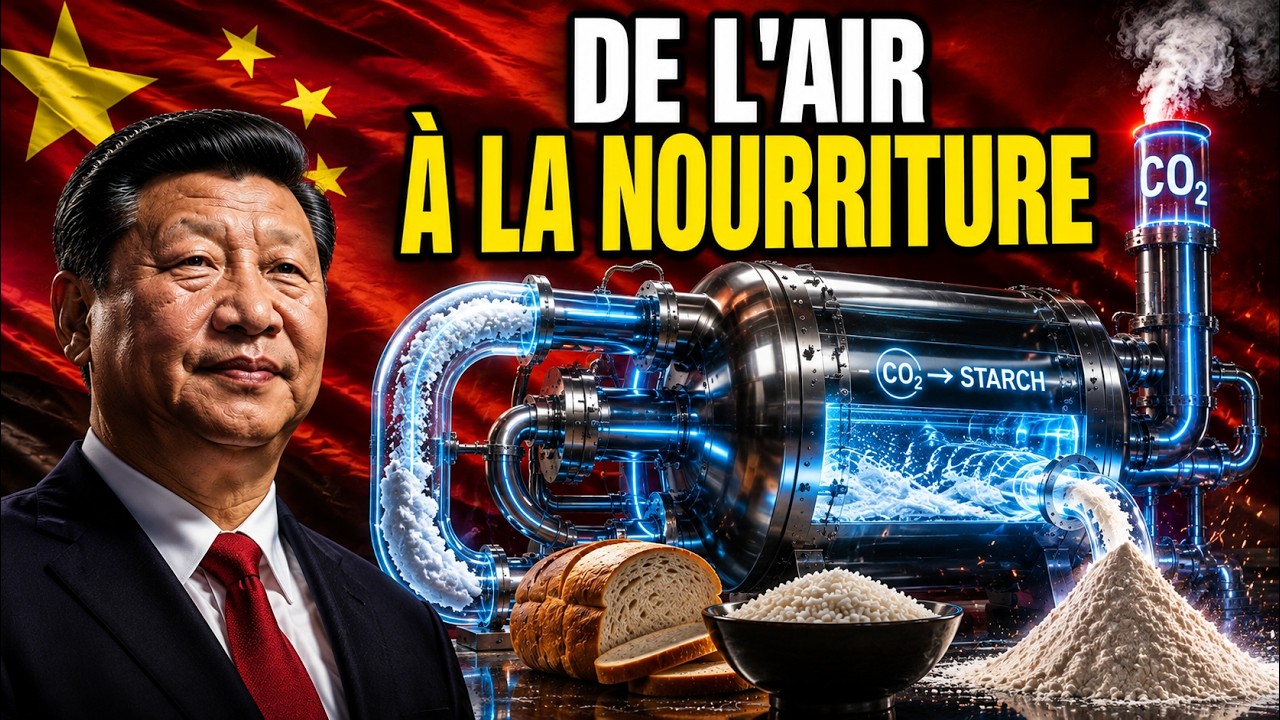
La Chine A Fabriqué De La Nourriture À Partir De L'Air, Sans Champ Ni Terre
China Has Made Food From Air, Without Fields or Soil
Keywords
Summary
169 words
Critical Evaluation
Value of the Information & Strength of the Argument
The video provides valuable insights into a cutting-edge scientific development and its potential implications. It correctly identifies the key technical aspects: the 11-step synthetic pathway, the use of enzymes from different organisms, and the energy intensity challenge. The argumentation is coherent and well-structured, moving from the scientific explanation to the strategic rationale. However, the video tends to overstate the geopolitical significance and presents a somewhat one-sided view, without discussing potential counterarguments or alternative perspectives. The claim that this could ‘break the link between food and land’ is presented as a near-certainty, while in reality it remains highly speculative. The video also simplifies the comparison between natural photosynthesis and the synthetic process, not fully accounting for the energy costs of the latter.
Scientific Rigor, Source Quality, Title Accuracy
The video mentions the publication of the study in a prestigious journal in 2021 and names the institute, but it does not provide specific citations or links. The description includes a disclaimer about the technology being a proof of concept, which adds credibility. The title is accurate but sensationalist. The video does not cite any external sources beyond the study itself, and it does not discuss any contradictory evidence or alternative viewpoints. The overall scientific rigor is moderate: the technical explanation is sound, but the geopolitical analysis is speculative and lacks supporting data.
229 words
Title / Content Match
The title accurately reflects the core content: the production of food (starch) from CO2 without traditional agriculture. It is somewhat sensationalist but not misleading.
Quality & Reliability
7/10
The video presents a plausible account of a real scientific breakthrough (synthetic starch production from CO2) and correctly identifies its limitations (energy intensity, lab-scale proof of concept). However, it lacks precise citations, overstates geopolitical implications, and uses rhetorical language that may oversimplify complex issues.
Key Moments
Markers derived by PSI from the transcript: the creator did not define chapters.
- Introduction: Chinese scientists produce starch from CO2 in a lab, breaking the link between food and land.
- Explanation of starch's importance and the inefficiency of natural photosynthesis (2% energy conversion).
- Description of the 11-step synthetic pathway, using enzymes from different organisms and computer simulation.
- Performance claims: 8.5 times faster than corn, and a 1 m³ bioreactor could replace 1/3 hectare of farmland.
- Honest assessment of limitations: energy-intensive, lab-scale, not economically competitive yet.
- Geopolitical context: China's food import dependency, especially soy, and the strategic vulnerability.
- Link to China's energy strategy: cheap renewable electricity could make the process viable.
- Potential adoption pathways: industrial starch, animal feed, and extreme environments (deserts, space).
- Comparison with Western approaches: private investors focus on short-term profitability, China on long-term security.
- Conclusion: The shift from land-based to energy-based food production could reshape global power.
Cited Sources
- Study on synthetic starch production (2021) — Mentioned as published in a prestigious journal, but no specific citation provided.
Concurring Sources
- Nature Catalysis (2021) - Cell-free synthesis of starch from CO2 — The original study referenced in the video.
Dissenting Sources
- Critiques of energy efficiency claims — Some experts argue that the energy input required for the process makes it impractical for large-scale food production in the near term.
Contribution & Novelties
The video’s original contribution lies in framing the synthetic starch breakthrough within a broader geopolitical and energy strategy narrative. It connects the scientific achievement to China’s investments in renewable energy and its food security concerns, offering a perspective that goes beyond the technical details. This adds value for viewers interested in the strategic implications of emerging technologies.
Pour aller plus loin :
- Synthetic starch production — Overview of starch and its synthetic production.
- Carbon capture and utilization — Context on using CO2 as a feedstock.
- China’s renewable energy policy — Background on China’s energy strategy.
95 words
Radar Profile
The radar profile shows a balanced performance across all dimensions, with slightly higher scores in information quantity and quality, reflecting the video's comprehensive coverage of the topic. The lower score in technical level indicates that while the video explains the science, it remains accessible to a general audience.
💬 Sur les 0 commentaires analysés, aucune tendance n'est disponible.