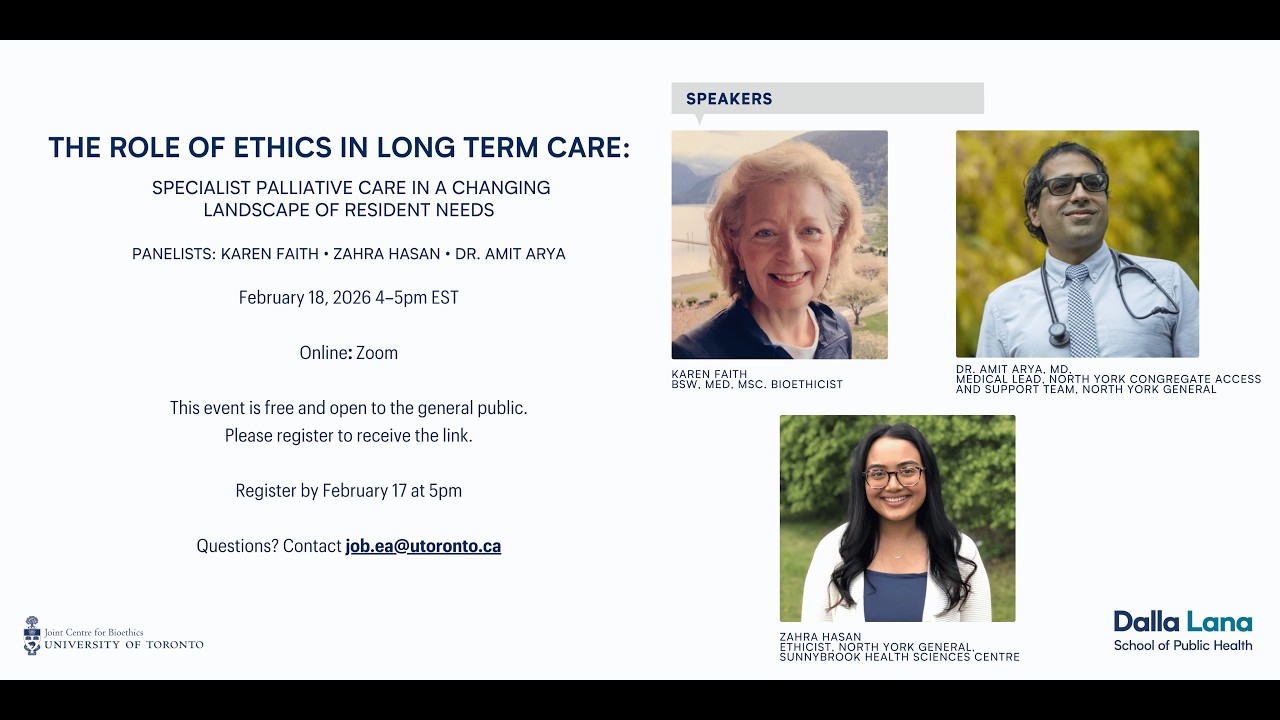
JCB Lecture | The Role of Ethics in Long-Term Specialist Palliative Care
Keywords
Summary
179 words
Critical Evaluation
Value of the Information & Strength of the Argument
The value of the information lies in its practical, case-based approach that bridges bioethics and palliative care in a specific healthcare setting. The speakers provide concrete examples of ethical dilemmas and emphasize the importance of trust, communication, and values-based decision-making. The argumentation is solid, grounded in clinical experience and supported by references to institutional data (e.g., CIHI statistics). However, the presentation is largely anecdotal and does not delve into systematic evidence or alternative viewpoints, which limits its scientific rigor.
Scientific Rigor, Source Quality, Title Accuracy
The lecture demonstrates scientific rigor through the speakers’ credentials and their clear articulation of ethical frameworks. They reference institutional data (CIHI) and mention educational initiatives (e.g., Pallium Canada), but do not provide specific citations or a literature review. The title accurately reflects the content, which is a focused discussion on ethics in specialist palliative care in LTC. The presentation is well-structured and the speakers maintain a high level of professionalism.
164 words
Title / Content Match
The title accurately reflects the content, which focuses on the role of ethics in specialist palliative care within long-term care settings.
Quality & Reliability
8/10
The lecture is delivered by recognized experts in bioethics and palliative care, with clear disclosures of potential conflicts of interest. The content is grounded in clinical experience and references to institutional data (e.g., CIHI). However, it is primarily an expert opinion presentation without systematic literature review or empirical data analysis.
Key Moments
Markers derived by PSI from the transcript: the creator did not define chapters.
- Introduction by Jennifer Gibson, land acknowledgment, and speaker introductions.
- Karen Faith reads her personal story 'Embracing Twilight and Dawn' about her father's death in LTC.
- Dr. Amit Arya introduces the case of Miss Chung, a 97-year-old with advanced dementia, highlighting ethical tensions.
- Discussion of palliative care principles and its relevance to LTC, including statistics on palliative care access.
- Zahra Hasan discusses the role of ethics consultation and collaboration with palliative care teams.
- Q&A session begins, addressing audience questions on ethical challenges and practical strategies.
Cited Sources
- CIHI (Canadian Institute for Health Information) - Palliative Care in Long-Term Care — Referenced for statistics on palliative care access in LTC (19% of residents received palliative care in last year of life).
- Pallium Canada — Mentioned as an organization supporting education in primary palliative care.
Concurring Sources
- CIHI - Palliative Care in Long-Term Care — Supports the claim that only 19% of LTC residents receive palliative care.
Contribution & Novelties
The seminar provides a unique perspective on integrating ethics consultation with specialist palliative care in long-term care settings, using a composite case to illustrate practical challenges. It highlights the emotional burden on substitute decision-makers and the importance of trust-building. The speakers offer actionable strategies for collaboration, such as joint ethics-palliative care rounds and trauma-informed approaches.
Pour aller plus loin :
- Advance care planning in long-term care — Relevant for understanding policy frameworks.
- Substitute decision-making in Ontario — Provides legal context for SDM roles.
- Palliative care for dementia patients — Discusses specific considerations for dementia.
- Ethics consultation in healthcare — University of Toronto JCB resources on clinical ethics.
107 words
Radar Profile
The radar profile shows high scores in quality of information and reliability, reflecting the expertise of the speakers and the use of institutional data. The moderate score in technical level indicates the content is accessible to a broad audience, while the quantity of information is adequate for a seminar format.
💬 No comments were provided for analysis.