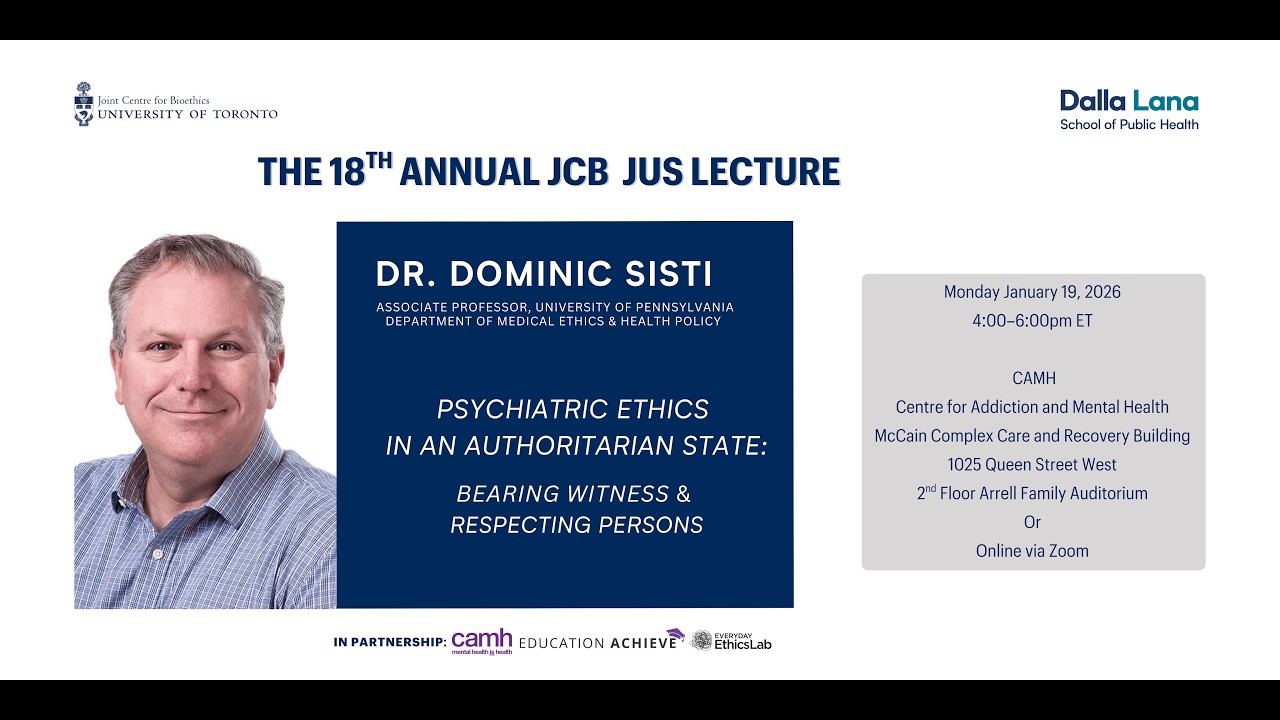
Psychiatric Ethics in an Authoritarian State | 18th Annual Jus Lecture – Dr. Dominic Sisti
Keywords
Summary
116 words
Critical Evaluation
Value of the Information & Strength of the Argument
The lecture provides valuable insights into the vulnerability of psychiatry to political co-optation, supported by well-documented historical and contemporary examples. Sisti’s argumentation is coherent and persuasive, building a case that psychiatric ethics must adapt to authoritarian threats. He effectively uses case studies to illustrate patterns of abuse and highlights the ethical responsibilities of clinicians. The discussion of the executive order is particularly timely and relevant, offering a critical analysis of policy implications.
Scientific Rigor, Source Quality, Title Accuracy
Sisti demonstrates scientific rigor by citing historical and contemporary sources, including works by Ruth Ben-Ghiat, Timothy Snyder, and Jonathan Moreno. He references specific studies and reports, such as the ‘protest psychosis’ paper and the Global Initiative on Psychiatry. The title accurately reflects the content, focusing on psychiatric ethics in authoritarian contexts. The lecture is well-structured and grounded in scholarly literature, though it is primarily an opinion piece rather than an empirical study.
159 words
Title / Content Match
The title accurately reflects the content, which focuses on the ethical challenges in psychiatry under authoritarian political conditions.
Quality & Reliability
8/10
The lecture is delivered by a recognized expert in psychiatric ethics, with references to historical and contemporary cases, and includes a balanced discussion of ethical principles. However, it is an opinion-based lecture with limited empirical data and relies on the speaker's interpretation of events.
Key Moments
Markers derived by PSI from the transcript: the creator did not define chapters.
- Introduction and acknowledgment of the land
- Overview of bioethics' foundational assumptions and their erosion
- Discussion of authoritarianism's impact on professions and epistemic degradation
- Introduction of the executive order on homelessness and its ethical implications
- Historical example: drapetomania and the pathologization of freedom
- Nazi psychiatry and the T4 program
- Soviet psychiatry and political abuse
- Racialized diagnoses: protest psychosis and excited delirium
- Analysis of the executive order and its ethical violations
- Call to action: bearing witness and upholding dignity
Cited Sources
- Absolutely Essential — Referenced as Jonathan Moreno's book on bioethics and authoritarianism
- The Protest Psychosis — Referenced as Jonathan Metzl's book on racialized schizophrenia diagnoses
- Global Initiative on Psychiatry — Mentioned as a resource tracking psychiatric abuses in Russia
- How Medicine Saved the Life of Ethics — Referenced as Stephen Toulmin's essay on applied ethics
- Ending Crime and Disorder on America's Streets — The executive order discussed in the lecture
Concurring Sources
- The Protest Psychosis — Supports the discussion on racialized schizophrenia diagnoses
- Absolutely Essential — Supports the argument about bioethics' dependence on liberal democratic conditions
Dissenting Sources
- Executive Order on Homelessness — The executive order's approach to homelessness is criticized in the lecture, representing a contrasting viewpoint.
Contribution & Novelties
The lecture offers a novel synthesis of historical and contemporary examples to argue that psychiatry is uniquely vulnerable to authoritarian co-optation. It provides a framework for clinicians to recognize and resist such pressures, emphasizing the importance of bearing witness and upholding dignity. The analysis of the 2025 executive order is timely and adds to the discourse on psychiatric ethics in political contexts.
Pour aller plus loin :
- Ruth Ben-Ghiat’s work on authoritarianism — Provides background on moral degradation under authoritarian regimes.
- The Nuremberg Code — Historical foundation for research ethics, relevant to the erosion of ethical standards.
- Housing First — Evidence-based approach to homelessness, contrasted with the executive order’s approach.
110 words
Radar Profile
The radar profile shows high scores in quantity and quality of information, with a moderate technical level. The lecture is well-researched and provides a comprehensive overview, but the technical depth is limited for a specialized audience.
💬 No comments were provided for analysis.