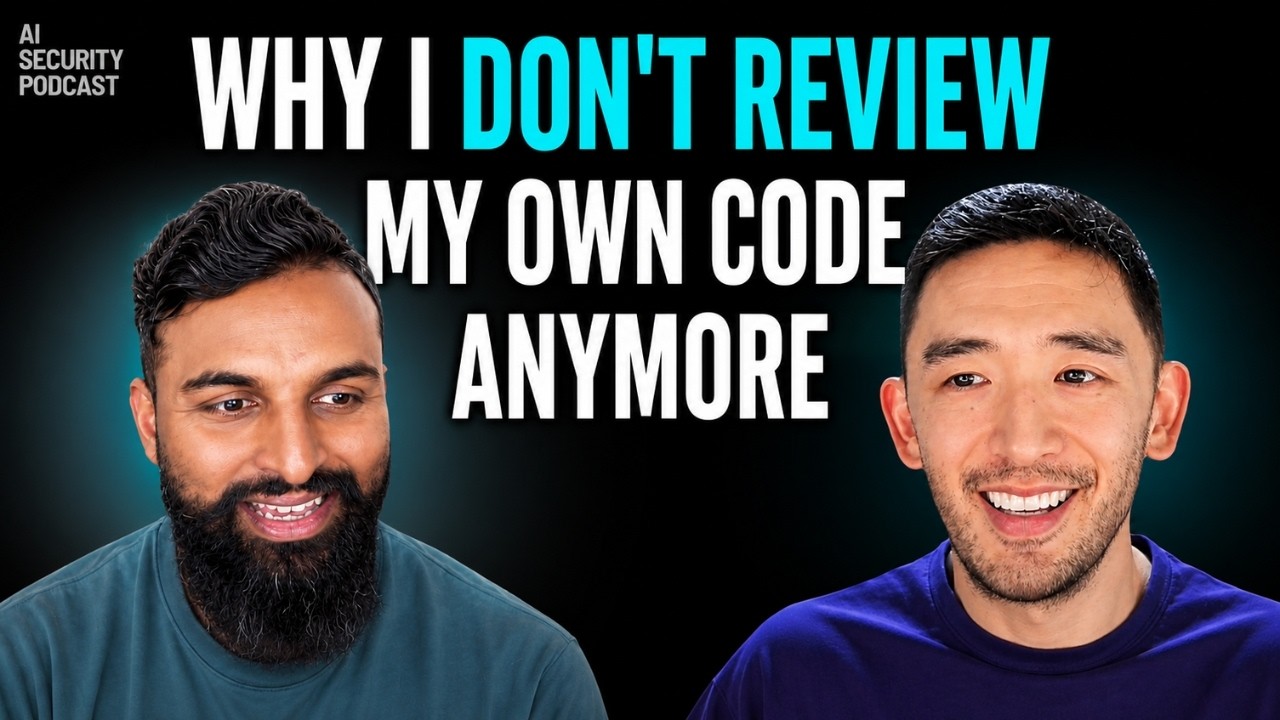
Why AI Agents Are Forcing a Redesign of Application Security?
Keywords
Summary
151 words
Critical Evaluation
Value of the Information & Strength of the Argument
The value of the information lies in the practical insights from a practitioner who has built software without reviewing code, and the discussion on the evolving role of security. The argumentation is coherent, with logical progression from the CEO’s claim to its implications for security. However, the arguments are largely anecdotal and lack empirical evidence. The hosts rely on personal experience and industry observations, which adds credibility but not scientific rigor. They effectively challenge the CEO’s claim by distinguishing coding from software engineering and highlighting the persistence of legacy systems and the need for verification. The discussion on the ‘forest fire’ and moats is insightful, though speculative.
Scientific Rigor, Source Quality, Title Accuracy
The scientific rigor is moderate; the podcast is an opinion-based discussion without formal citations. The sources mentioned are primarily the hosts’ experiences and references to industry events (e.g., Anthropic CEO’s statements, a survey of 81,000 Claude users). The title accurately reflects the content, focusing on the redesign of application security due to AI agents. The description provides links to the podcast’s website and newsletter, but no specific academic or technical references. The discussion is well-structured but lacks depth in technical details, making it more suitable for a general audience interested in cybersecurity trends.
215 words
Title / Content Match
The title accurately reflects the core discussion on how AI agents are reshaping application security, though the content is more of a conversational analysis than a technical deep dive.
Quality & Reliability
7/10
The podcast presents expert opinions and practical insights from practitioners, but lacks formal citations or empirical data. Claims are anecdotal and forward-looking, with no rigorous scientific backing.
Chapters
- Introduction
- The Anthropic CEO's Claim: Is Software Engineering Dead?
- Separating Coding from Software Engineering
- Managing Software Without Ever Looking at the Code
- Will AI Eliminate the AppSec Team?
- The Challenge of Legacy Code (COBOL on Mainframes)
- Shifting Focus: From Code Analysis to Agentic Execution
- The Coming "Forest Fire" in the Security Startup Landscape
- The "Build vs. Buy" Illusion: Prototyping vs. Production
- How to Build a Defensible Moat in AI Security
- Why Hardware and Red Tape Are the Ultimate Moats
- The AI Scaffolding Approach for Enterprises
- Automating SIEM Detections
Cited Sources
- AI Security Podcast Website — Official website of the podcast, providing additional resources and episodes.
- AI Cybersecurity Newsletter — Newsletter for AI cybersecurity updates, mentioned in the description.
- AI Security Podcast LinkedIn — LinkedIn page for the podcast, used for social media engagement.
Concurring Sources
- OWASP Top 10 for LLM Applications — Aligns with the discussion on security risks in AI-generated code and prompt injection.
Dissenting Sources
- Anthropic CEO's Claim — The podcast challenges the CEO's claim that software engineering will disappear, arguing that the need for security and human oversight will persist.
Contribution & Novelties
The podcast offers a unique perspective on how AI agents are forcing a redesign of application security, emphasizing the shift from code-centric security to agentic execution and the need for AI scaffolding. It provides practical insights from a builder who has deployed software without reviewing code, highlighting the new challenges of verification and auditing. The discussion on the ‘forest fire’ in the startup landscape and the importance of defensible moats is a fresh take on the market dynamics.
Pour aller plus loin :
- OWASP Top 10 for LLM Applications — Relevant for understanding security risks in AI applications.
- Prompt Injection Attacks — Directly related to the discussion on prompt injection as the next SQL injection.
- AI Security: A Comprehensive Guide — CISA’s guidance on AI security, providing a broader context for securing AI systems.
134 words
Radar Profile
The radar profile shows balanced scores across information quantity, quality, technical level, and reliability, with a slight emphasis on information quality and technical level. This indicates a well-rounded discussion with practical insights, though lacking in formal rigor.