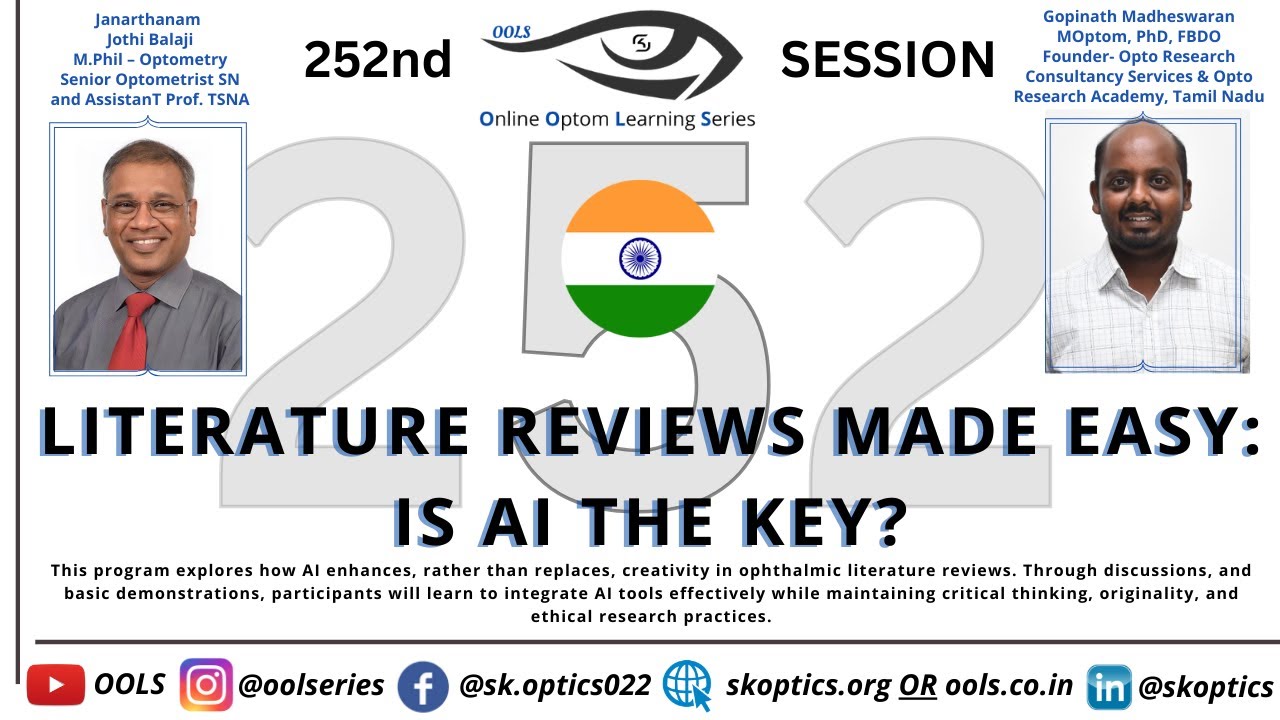
#LiteratureReviews Made Easy: Is #AI the Key? #artificialintelligence | OOLS | JJB and Dr. Gopinath
Keywords
Summary
171 words
Critical Evaluation
Value of the Information & Strength of the Argument
The session offers valuable practical insights into using AI for literature reviews, with a clear demonstration of Elicit’s capabilities. The argumentation is solid, emphasizing that AI enhances rather than replaces human judgment, and highlighting the need for critical evaluation. The speakers effectively address common challenges and provide actionable tips. However, the argumentation could be strengthened by including more diverse examples and discussing potential limitations of AI tools in greater depth.
Scientific Rigor, Source Quality, Title Accuracy
The session demonstrates a reasonable level of scientific rigor, with speakers emphasizing the importance of using reliable databases and maintaining ethical standards. However, specific sources are not cited within the video, and the demonstrations rely on a single example. The title accurately reflects the content, which focuses on using AI to simplify literature reviews. The session does not include a formal review of literature or meta-analysis, but it provides a practical tutorial that is relevant for researchers.
162 words
Title / Content Match
The title accurately reflects the content, which focuses on using AI to simplify literature reviews.
Quality & Reliability
7/10
The session provides practical guidance on using AI tools for literature review, with live demonstrations and emphasis on critical thinking. However, it lacks formal citations and rigorous validation of claims, and the demonstrations are based on a single example.
Key Moments
Markers derived by PSI from the transcript: the creator did not define chapters.
Cited Sources
- Nerdy Optometrist — Mentioned as media partner and podcast resource.
- OOLS Website — Official website of the Online Optom Learning Series.
- S.K. Optics Website — Organization managing OOLS.
Concurring Sources
Contribution & Novelties
The session provides a practical, step-by-step guide on integrating AI tools into literature review processes, specifically within the optometry field. It offers a live demonstration of Elicit, showcasing how AI can streamline paper discovery, summarization, and data extraction. The emphasis on maintaining human oversight and critical thinking is a valuable contribution to the discourse on AI in research.
Pour aller plus loin :
- Elicit — AI research assistant for literature review.
- PRISMA guidelines — Standard for systematic reviews.
- PubMed — Major biomedical database.
83 words
Radar Profile
The radar profile shows a balanced performance across all dimensions, with slightly higher scores in information quantity and quality, reflecting the session's practical content. The technical level is moderate, suitable for a broad audience, while reliability is adequate, though not heavily supported by formal citations.
💬 Sur les 0 commentaires analysés, aucune tendance n'est disponible.