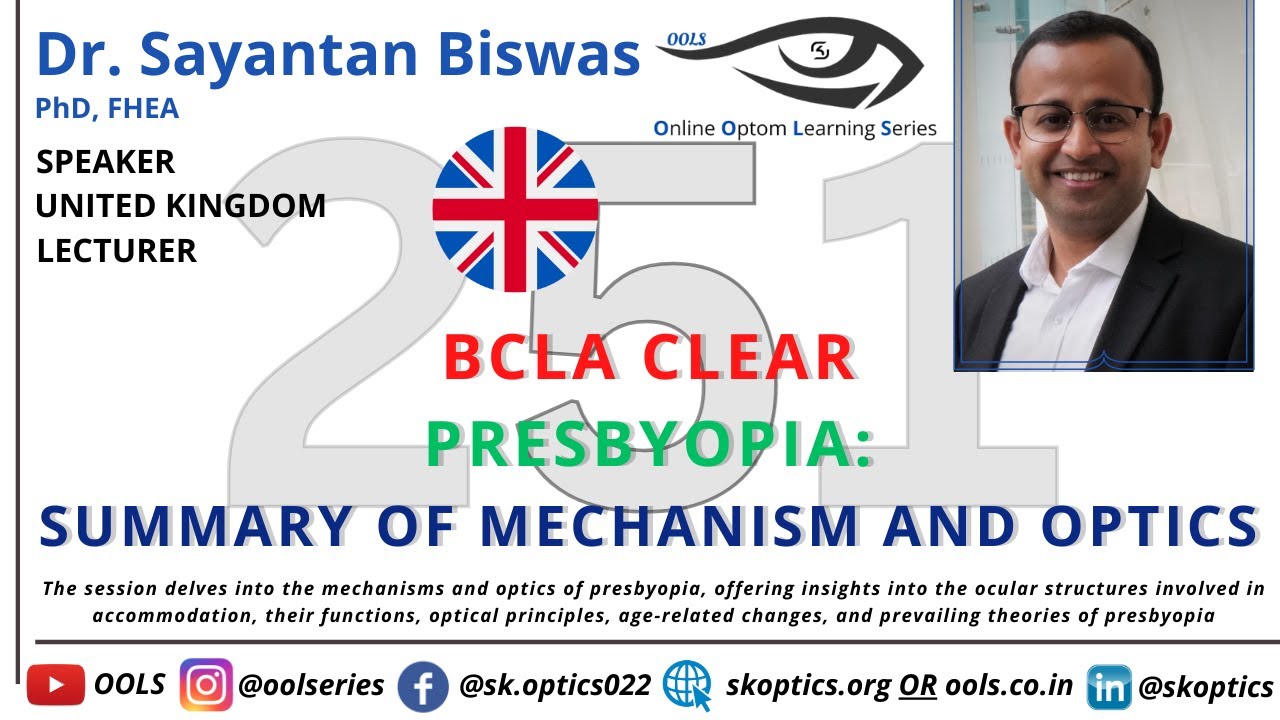
#BCLA Clear #Presbyopia: Summary of Mechanism and #Optics #Multifocal | OOLS | Dr Sayantan Biswas
Keywords
Summary
178 words
Critical Evaluation
Value of the Information & Strength of the Argument
The lecture provides a high-value synthesis of current scientific understanding of presbyopia mechanisms, consolidating evidence from multiple peer-reviewed studies. The argumentation is solid, systematically presenting evidence for each component of the accommodative system and evaluating competing theories. The speaker critically assesses the limitations of in vitro studies and emphasizes the importance of in vivo research. The discussion of lens stiffness, zonular changes, and ciliary muscle function is well-supported by specific studies, such as those by Glasser and Campbell, Hayes et al., and MRI-based investigations. The presentation effectively argues that presbyopia is multifactorial, avoiding oversimplification.
Scientific Rigor, Source Quality, Title Accuracy
The scientific rigor is high, as the content is based on the BCLA CLEAR Presbyopia reports, which are open-access, peer-reviewed publications. The speaker cites specific studies and authors, providing a traceable evidence base. The title accurately reflects the content, which is a summary of the mechanism and optics of presbyopia. The lecture is well-structured and adheres to scientific standards, with no apparent bias or unsupported claims. The inclusion of a Q&A session adds practical insights, though the speaker acknowledges limitations in certain areas, such as the mechanism of presbyopia eye drops.
200 words
Title / Content Match
The title accurately reflects the content, which summarizes the mechanism and optics of presbyopia based on the BCLA CLEAR reports.
Quality & Reliability
8/10
The presentation is based on the BCLA CLEAR Presbyopia reports, which are peer-reviewed and open access. The speaker is a lecturer at Aston University with a PhD and over 40 publications. The content is well-structured, citing multiple studies and theories. However, the video is a recorded lecture with limited interactive verification, and some statements are simplified for a clinical audience.
Key Moments
Markers derived by PSI from the transcript: the creator did not define chapters.
- Introduction and speaker background
- Definition and significance of presbyopia
- Mechanism of accommodation: Helmholtz theory
- Lens morphology changes during accommodation
- Age-related changes in lens stiffness and theories of presbyopia
- Ciliary muscle studies and in vivo evidence
- Summary of multifactorial nature of presbyopia
- Q&A on presbyopia management and eye drops
Cited Sources
- BCLA CLEAR Presbyopia reports — The lecture is based on these open-access reports published in Contact Lens and Anterior Eye.
- Online Optom Learning Series (OOLS) — The channel and platform hosting the lecture.
- S.K. Optics — The organization managing OOLS.
- Nerdy Optometrist — Media partner and podcast mentioned in the description.
Concurring Sources
- BCLA CLEAR Presbyopia reports — The lecture directly aligns with the content of these reports.
Contribution & Novelties
The lecture provides a clear and comprehensive summary of the current understanding of presbyopia mechanisms, synthesizing evidence from the BCLA CLEAR reports. It highlights the multifactorial nature of presbyopia, emphasizing that no single theory fully explains it. The presentation offers a balanced view of lenticular and extra-lenticular contributions, with a focus on in vivo evidence. It also clarifies misconceptions, such as the belief that ciliary muscle weakens with age. The Q&A adds practical insights into management options.
Pour aller plus loin :
- Helmholtz theory of accommodation — Provides background on the classical theory.
- Presbyopia — General overview and management.
- BCLA CLEAR Presbyopia — Official BCLA page for the CLEAR reports.
- Pilocarpine — Mechanism of action and use in presbyopia management.
120 words
Radar Profile
The radar profile shows high scores in information quantity, quality, and reliability, with a slightly lower technical level, indicating a well-balanced, evidence-based lecture suitable for a professional audience.