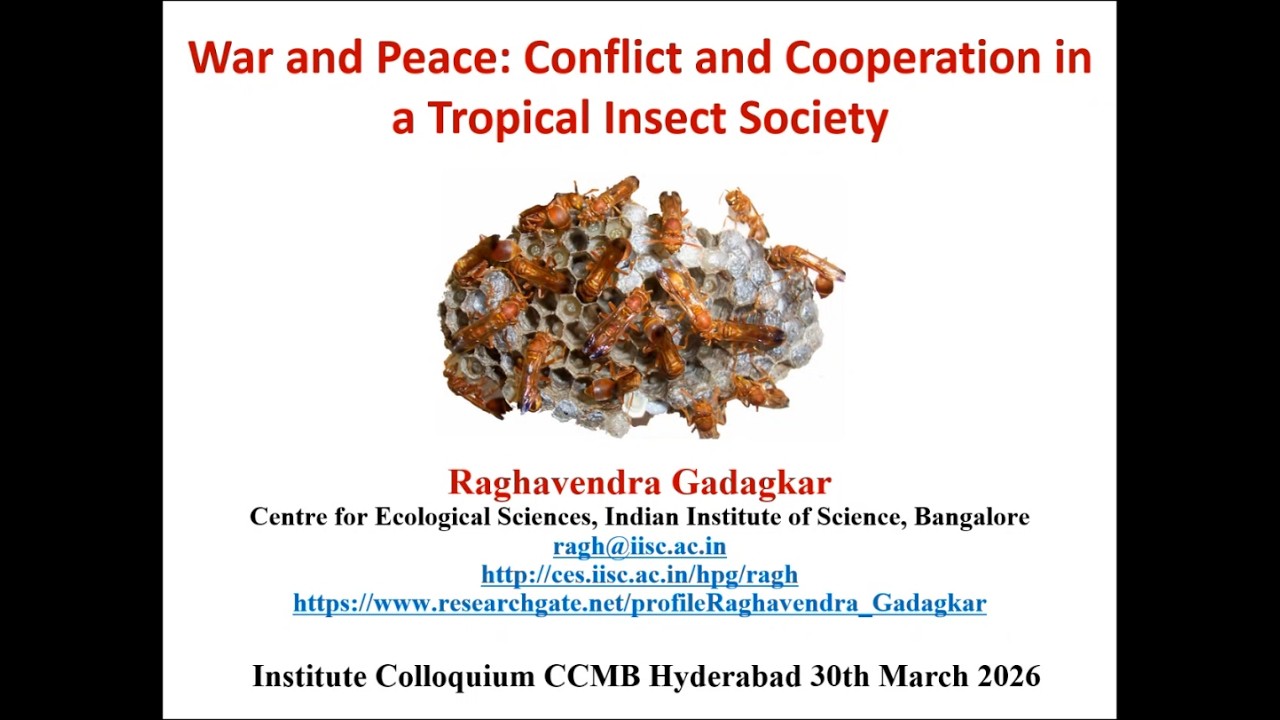
War and Peace: Conflict and Cooperation in a Tropical Insect Society
Keywords
Summary
150 words
Critical Evaluation
Value of the Information & Strength of the Argument
The lecture provides valuable insights into the social behavior of insects, particularly the Indian paper wasp. Prof. Gadagkar’s argumentation is clear and well-supported by his extensive observational data. He systematically presents his research process, from initial observations to hypothesis testing, which strengthens the credibility of his conclusions. He effectively contrasts the queen’s behavior with that of workers, showing that differences are quantitative rather than qualitative. The discussion of the importance of curiosity-driven research is compelling and well-argued. However, the talk is a general overview and does not delve into specific experimental details or statistical analyses, which limits its depth for a specialized audience.
Scientific Rigor, Source Quality, Title Accuracy
Prof. Gadagkar is a highly respected scientist, and his expertise lends credibility to the talk. He does not cite specific sources during the lecture, but he references his own research and that of colleagues. The title accurately reflects the content, which focuses on cooperation and conflict in insect societies. The talk is scientifically rigorous in its approach, with careful observations and logical reasoning. However, as a popular lecture, it lacks detailed citations and references, which would be expected in a formal scientific presentation. The adéquation between title and content is excellent.
209 words
Title / Content Match
The title accurately reflects the content, which focuses on cooperation and conflict within insect societies, particularly wasps.
Quality & Reliability
8/10
Lecture by a leading expert in insect sociobiology, based on decades of original research. The talk is well-structured, presents both process and product, and includes specific examples and data. However, it is a popular lecture without detailed citations or peer-reviewed references, and some claims are presented without direct evidence in the talk.
Key Moments
Markers derived by PSI from the transcript: the creator did not define chapters.
- Introduction to insect societies, honeybees as prime example.
- Discussion of ant societies, morphological differentiation, and weaver ants.
- Termites and their unique king-queen system.
- Introduction to paper wasps and their nests.
- Why study insect societies? Applications and curiosity-driven research.
- Introduction to the study species Ropalidia marginata and methods.
- The process of science and the importance of common sense.
- Behavioral observations of queens and workers, time-activity budgets.
- Quantitative differences in behavior between queens and workers.
Contribution & Novelties
This lecture provides a comprehensive overview of insect societies, with a focus on the speaker’s own research on Ropalidia marginata. It offers insights into the behavioral mechanisms underlying queen-worker differentiation and the importance of quantitative behavioral differences. The talk also emphasizes the value of curiosity-driven research and the process of science.
Pour aller plus loin :
- Eusociality — Provides background on the evolution of social behavior in insects.
- Ropalidia marginata — Information on the specific wasp species studied.
- Division of labour — Relevant to the discussion of task allocation in colonies.
- Queen pheromones — Related to chemical communication in social insects.
101 words
Radar Profile
The radar profile shows high scores in information quantity, quality, and reliability, with a moderate technical level. This indicates a well-balanced lecture that is informative and credible, but not overly technical, making it accessible to a broad audience.