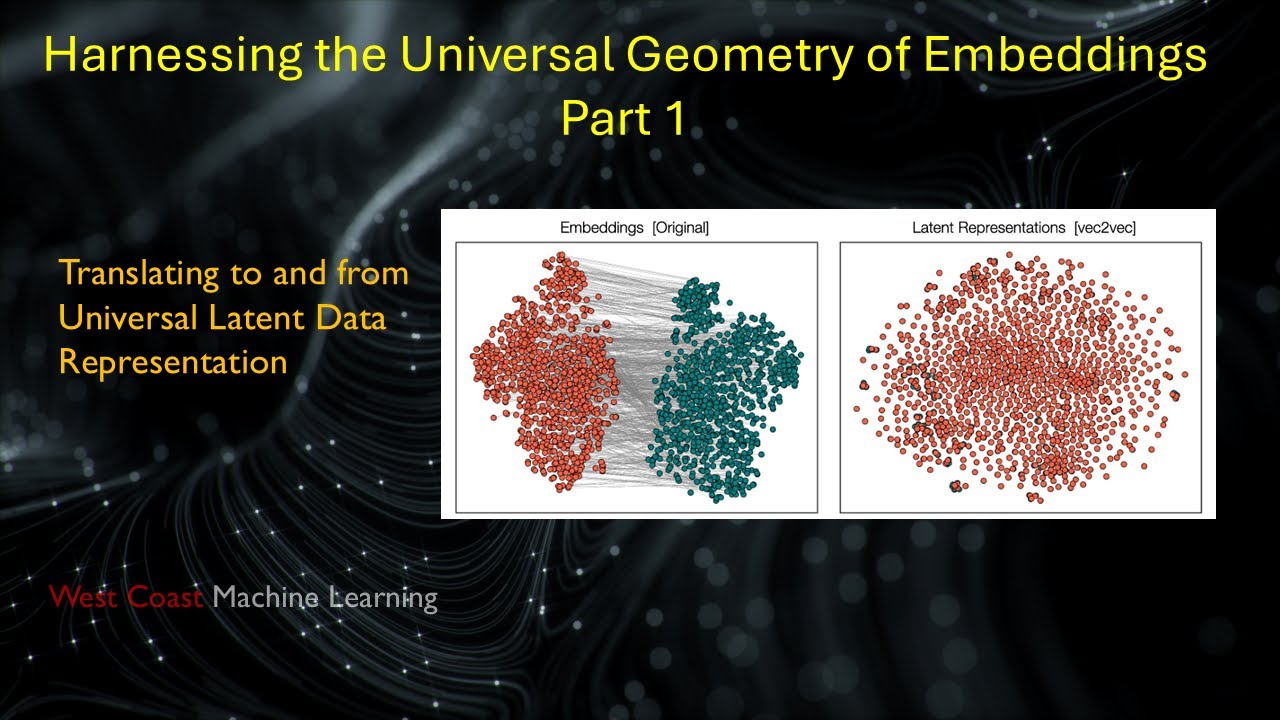
Harnessing the Universal Geometry of Embeddings - Part1
Keywords
Summary
119 words
Critical Evaluation
Value of the Information & Strength of the Argument
The video provides valuable insights into the paper’s methodology and implications. The speaker offers a clear explanation of the problem and the proposed solution, using analogies (e.g., English-Japanese translation) to make the concepts accessible. The argumentation is solid, with the speaker critically evaluating the paper’s claims and discussing potential limitations, such as the need for large datasets and the assumption of similar semantic coverage. The discussion with participants adds depth, exploring edge cases and practical considerations. However, the presentation is informal and lacks rigorous mathematical detail, which may limit its value for experts seeking a deep technical understanding.
Scientific Rigor, Source Quality, Title Accuracy
The video is based on a single research paper, which is cited in the description. The speaker does not provide additional sources or verify the paper’s claims independently. The title accurately reflects the content, which is a discussion of the paper’s approach to universal geometry of embeddings. The video does not include any external references beyond the paper and the meetup group, so the scientific rigor is limited to the paper’s own claims. The speaker’s analysis is thoughtful but not backed by additional evidence or replication.
199 words
Title / Content Match
The title accurately reflects the content, which focuses on the universal geometry of embeddings and the method presented in the paper.
Quality & Reliability
7/10
The video is a technical discussion of a specific research paper, providing detailed explanations and critical analysis. The speaker demonstrates a good understanding of the material and engages in thoughtful discussion. However, the presentation is informal and lacks rigorous verification of claims, and the video is not peer-reviewed.
Chapters
Cited Sources
- Harnessing the Universal Geometry of Embeddings — The paper discussed in the video, providing the theoretical basis and method.
- East Bay Tri-Valley Machine Learning Meetup — The meetup group where the discussion took place.
External References
Contribution & Novelties
The video provides a detailed walkthrough of the paper’s method, highlighting its novelty in achieving unsupervised embedding translation without paired data. It offers critical analysis and discussion of the method’s assumptions and limitations. The speaker’s analogies and Q&A session add practical insights.
Pour aller plus loin :
- Platonic Representation Hypothesis — The hypothesis that all sufficiently large models converge to a similar representation, which the paper builds upon.
- CycleGAN — A related technique using cycle consistency for unpaired image translation, which inspired the method.
- Adversarial Training — The GAN framework used for the adversarial loss in the method.
98 words
Radar Profile
The radar profile shows high scores in quantity of information and technical level, indicating a detailed and technical discussion. The quality of information and global reliability are moderate, reflecting the informal nature and reliance on a single source.