Muon - Part 1
Keywords
Summary
154 words
Critical Evaluation
Value of the Information & Strength of the Argument
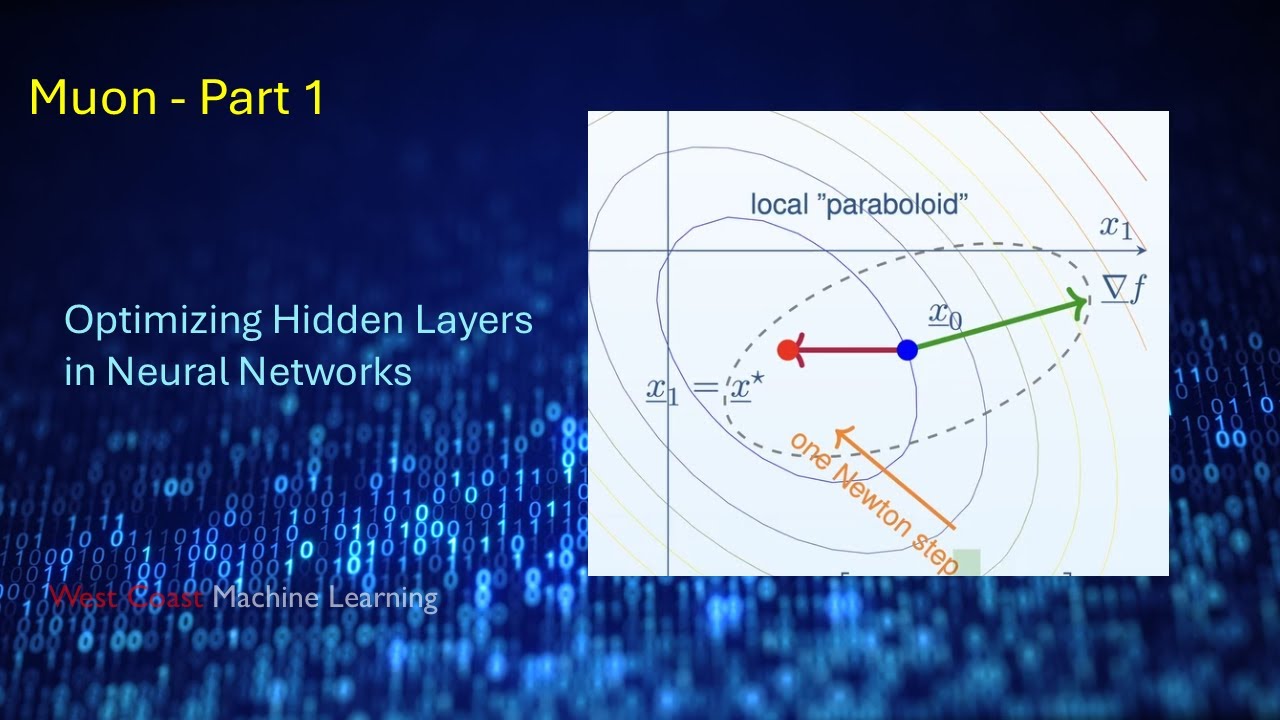
The video provides a clear and rigorous explanation of the mathematical foundations of optimization in machine learning. The speaker derives the perceptron update rule from a loss function, highlighting the intuition that gradients are proportional to data. He also explains the benefits and pitfalls of Newton’s method, such as quadratic convergence and instability with flat minima. The argumentation is logical and builds step by step, making complex concepts accessible. However, the talk is informal and includes some tangents and jokes, which may distract from the technical content. The speaker does not provide formal citations, but the mathematical derivations are standard and well-established.
Scientific Rigor, Source Quality, Title Accuracy
The scientific rigor is moderate: the speaker presents well-known mathematical concepts without formal references, but the derivations are accurate. The sources cited in the description are only meetup links, which are not scientific references. The title ‘Muon - Part 1’ is somewhat vague but accurately indicates the topic. The content is a tutorial, not a research presentation, so the lack of citations is expected. The speaker does mention historical figures like Marvin Minsky and Novikoff, but without specific references. Overall, the video is informative but not a rigorous academic source.
207 words
Title / Content Match
The title 'Muon - Part 1' is somewhat vague, but the content indeed focuses on the Muon optimizer, starting with the necessary background on optimization methods.
Quality & Reliability
7/10
The video provides a solid mathematical foundation for gradient descent and Newton's method, with clear derivations and intuitive explanations. However, it is a meetup talk without formal citations or peer review, and the presentation is somewhat informal with occasional tangents.
Chapters
Cited Sources
- East Bay Tri-Valley Machine Learning Meetup — The meetup group hosting the talk, mentioned in the description.
Concurring Sources
- Gradient descent — The video explains gradient descent, and this Wikipedia article provides a comprehensive overview.
- Newton's method in optimization — The video discusses Newton's method, and this article details its mathematical formulation.
- Perceptron — The video covers the perceptron, and this article provides historical and technical context.
External References
Contribution & Novelties
The video provides a pedagogical review of optimization methods, connecting the perceptron update to gradient descent and contrasting it with Newton’s method. It sets the stage for understanding the Muon optimizer, which normalizes gradients by their norm. The talk emphasizes the intuition that gradients are proportional to data, which is a useful perspective for understanding optimization.
Pour aller plus loin :
- Gradient descent — Wikipedia article on gradient descent, providing a comprehensive overview.
- Newton’s method in optimization — Wikipedia article on Newton’s method in optimization, detailing the mathematical formulation.
- Perceptron — Wikipedia article on the perceptron, including its history and convergence theorem.
- Adam optimizer — Original paper on the Adam optimizer, which is relevant to the discussion of gradient normalization.
- Muon optimizer — Paper on the Muon optimizer, providing the technical details of the algorithm discussed in the video.
139 words
Radar Profile
The radar profile shows high scores in quantitative information, technical level, and information quality, indicating a technically dense and informative talk. The lower score in global reliability reflects the informal nature and lack of formal citations. Overall, the video is a valuable educational resource for understanding optimization foundations.