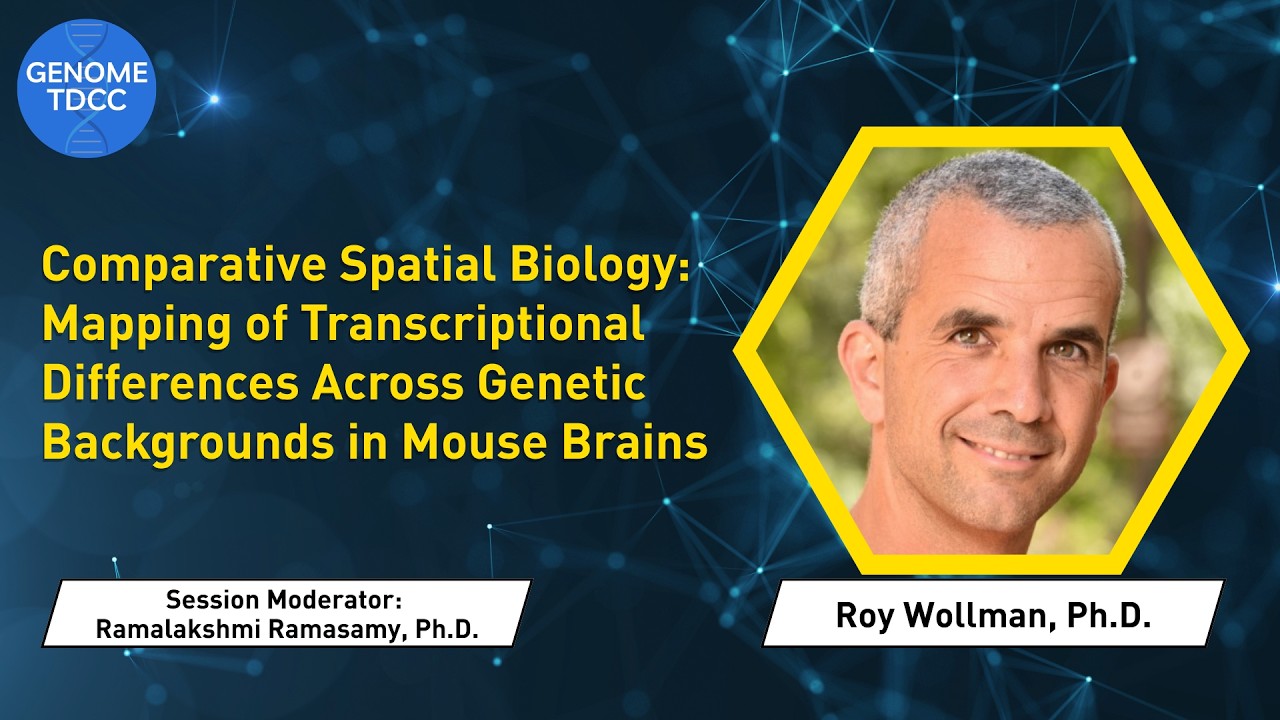
Scaling Spatial Transcriptomics with ATLAS: High-Throughput Tissue Mapping
Keywords
Summary
109 words
Critical Evaluation
Value of the Information & Strength of the Argument
The video presents a novel and significant methodological advance in spatial transcriptomics. The argumentation is strong: the speaker clearly explains the limitations of current methods (measuring only a fraction of the transcriptome) and how ATLAS addresses them by measuring aggregate signatures. The method is validated through extensive benchmarking against multiple existing technologies, showing comparable or better performance. The large-scale application (40 million cells) demonstrates the practical utility of the approach for comparative studies. The speaker also addresses potential concerns, such as the validity of imputation, with concrete examples. Overall, the information is valuable and well-argued, though some technical details are omitted for brevity.
Scientific Rigor, Source Quality, Title Accuracy
The scientific rigor is high: the method is based on established principles (NMF, integration with scRNA-seq) and validated against multiple independent datasets. The speaker cites relevant prior work (e.g., MERFISH, MERSCOPE) and provides a link to his lab’s website for further information. The title accurately reflects the content. The video is a seminar presentation, not a peer-reviewed publication, but the methodology appears sound. The inclusion of a Q&A session adds credibility by addressing potential limitations.
193 words
Title / Content Match
The title accurately reflects the content: the video presents ATLAS, a method for scaling spatial transcriptomics to high-throughput tissue mapping.
Quality & Reliability
8/10
Presentation of a novel method (ATLAS) with validation against multiple existing technologies and a large-scale comparative study. The speaker is a professor at UCLA with relevant expertise. The method is described in detail, and benchmarking shows comparable performance to established methods. However, the video is a seminar recording and not peer-reviewed; some technical details are omitted.
Chapters
- Introduction from Ramalakshmi Ramasamy
- Introduction to Scalable Spatial Transcriptomics
- Atlas-Based Encoding of Gene Expression
- Integrating Spatial Data with Single-Cell References
- Applications in Brain Mapping and Disease Research
- Questions and Answers with Ramalkshmi Ramasamy, Roy Wollman, and Fei Chen
Cited Sources
- Wollman Lab UCLA — Official lab website providing further information on the ATLAS method and related research.
Concurring Sources
- Wollman Lab UCLA — Lab website likely contains publications and details on ATLAS, consistent with the video's claims.
Contribution & Novelties
The video introduces ATLAS, a novel method that significantly increases the throughput of spatial transcriptomics by measuring aggregate transcriptional signatures instead of individual mRNA molecules. This enables organ-scale studies with tens of millions of cells, facilitating comparative analyses across conditions and genetic backgrounds. The method leverages existing single-cell reference atlases for decoding and imputation, making it a powerful tool for systems biology.
Pour aller plus loin :
- Spatial transcriptomics — Overview of the field and related technologies.
- Single-cell RNA sequencing — Background on scRNA-seq, which is integral to ATLAS.
- Non-negative matrix factorization — The mathematical technique used for dimensionality reduction in ATLAS.
102 words
Radar Profile
The radar profile shows high scores in information quantity, quality, and reliability, with a slightly lower technical level, reflecting the presentation's focus on conceptual understanding rather than deep technical details. The overall high scores indicate a scientifically robust and informative video.