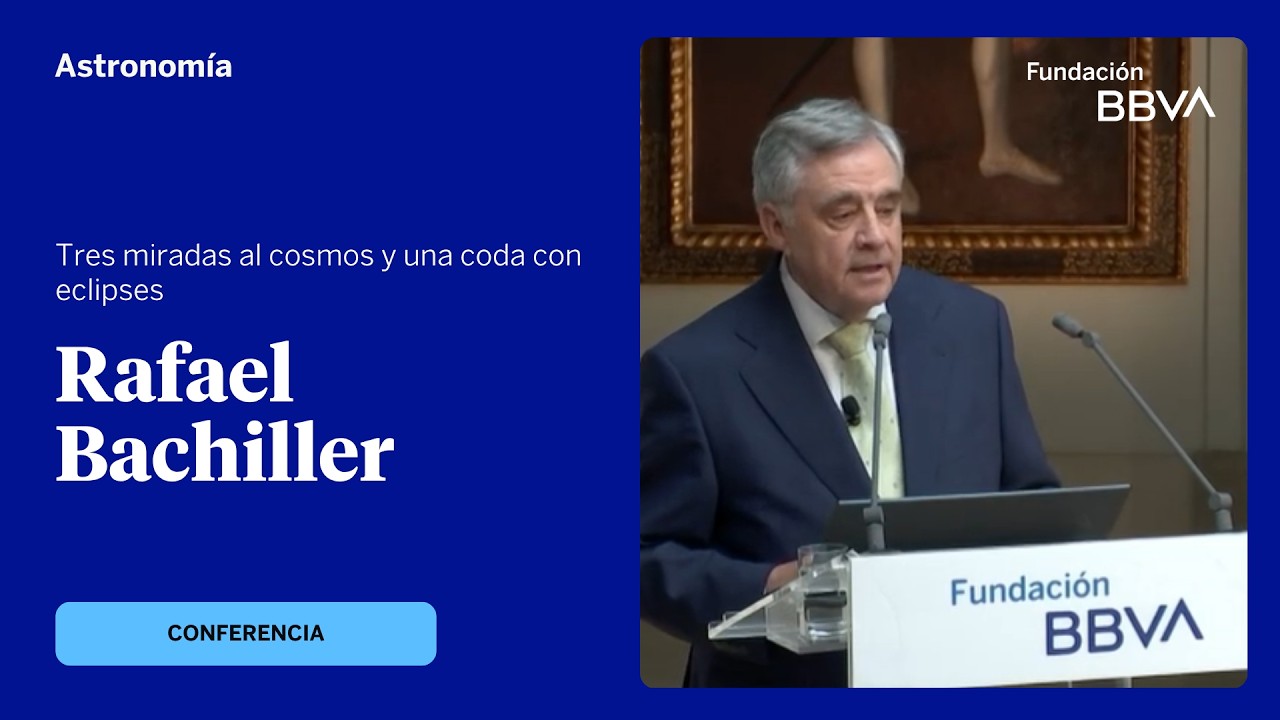
Ciclo de conferencias: "Astrofísica hoy: ciencia y fascinación", por Rafael Bachiller
Keywords
Summary
209 words
Critical Evaluation
The lecture provides a comprehensive and accessible overview of several key topics in modern astrophysics, delivered by a highly credible expert. The speaker’s authority is established by his position as director of the National Astronomical Observatory, and he presents information that is generally accurate and up-to-date. The discussion of dark matter and dark energy is well-structured, explaining the evidence and current hypotheses without oversimplifying. The mention of Vera Rubin’s pioneering work is particularly valuable, as it highlights the contributions of women in science. The section on exoplanets is also well-presented, covering the main detection methods and the significance of atmospheric studies. However, the lecture is primarily a popular science talk, so it lacks the depth and rigor of a formal scientific presentation. No specific sources are cited within the talk, and the speaker does not reference particular papers or data sets, which limits the ability to verify claims. The description provides a link to the BBVA Foundation’s page for more information, but this is not a direct scientific source. The content is largely qualitative, with few quantitative details, which may be appropriate for a general audience but reduces its value for those seeking in-depth knowledge. The structure is logical, moving from the large-scale composition of the universe to the specifics of exoplanets, and finally to broader questions about humanity’s place in the cosmos. The title accurately reflects the content, and the lecture successfully conveys both the scientific facts and the sense of wonder associated with astrophysics. Overall, the information is reliable and well-presented, but it is not a substitute for peer-reviewed literature.
262 words
Title / Content Match
The title accurately reflects the content, which is a lecture on current astrophysics topics, blending science and fascination.
Quality & Reliability
8/10
The speaker is a professional astronomer and director of the National Astronomical Observatory, providing credible expertise. The content is up-to-date and covers major topics in astrophysics, but it is a popular science lecture without detailed citations or peer-reviewed references.
Key Moments
Markers derived by PSI from the transcript: the creator did not define chapters.
- Introduction to the lecture and the cycle of conferences.
- Discussion of dark matter and its role in the universe.
- Vera Rubin's discovery of dark matter and her story.
- Dark energy and the accelerated expansion of the universe.
- Exoplanet detection methods: radial velocity and transits.
- Direct imaging and atmospheric studies of exoplanets.
- Gravitational waves and their significance.
- James Webb Space Telescope and early galaxies.
- The search for life beyond Earth.
- Conclusion and reflections on humanity's place in the cosmos.
Cited Sources
- Fundación BBVA - Ciclo Astrofísica — Official page for the lecture cycle, providing additional information and context.
- Fundación BBVA LinkedIn — Social media profile of the organizing institution.
Concurring Sources
- Wikipedia - Dark Matter — Provides a detailed scientific overview consistent with the lecture's claims.
- NASA - Exoplanet Exploration — NASA's official exoplanet page, supporting the information on detection methods and discoveries.
Dissenting Sources
- No discordant sources found — The lecture presents mainstream scientific consensus; no contradictory sources were identified.
Contribution & Novelties
The lecture provides a synthesis of current astrophysical research, emphasizing the most pressing questions and recent discoveries. It offers a clear explanation of dark matter and dark energy, and highlights the importance of exoplanet studies. The speaker’s personal anecdotes and historical context add value, making the content engaging.
Pour aller plus loin :
- Dark matter - Wikipedia — Comprehensive overview of dark matter, its evidence, and candidate particles.
- Exoplanet - Wikipedia — Detailed information on exoplanet detection methods and known systems.
- James Webb Space Telescope - NASA — Official NASA page for the JWST mission, with updates and scientific results.
- LIGO - Gravitational Waves — Official LIGO website explaining gravitational wave detection and discoveries.
- Euclid mission - ESA — ESA page for the Euclid mission, dedicated to studying dark energy and dark matter.
133 words
Radar Profile
The radar profile shows high scores in information quantity and quality, reflecting the lecture's comprehensive coverage and expert delivery. The technical level is moderate, suitable for a general audience, while reliability is high due to the speaker's credentials.
💬 No comments were provided for analysis.