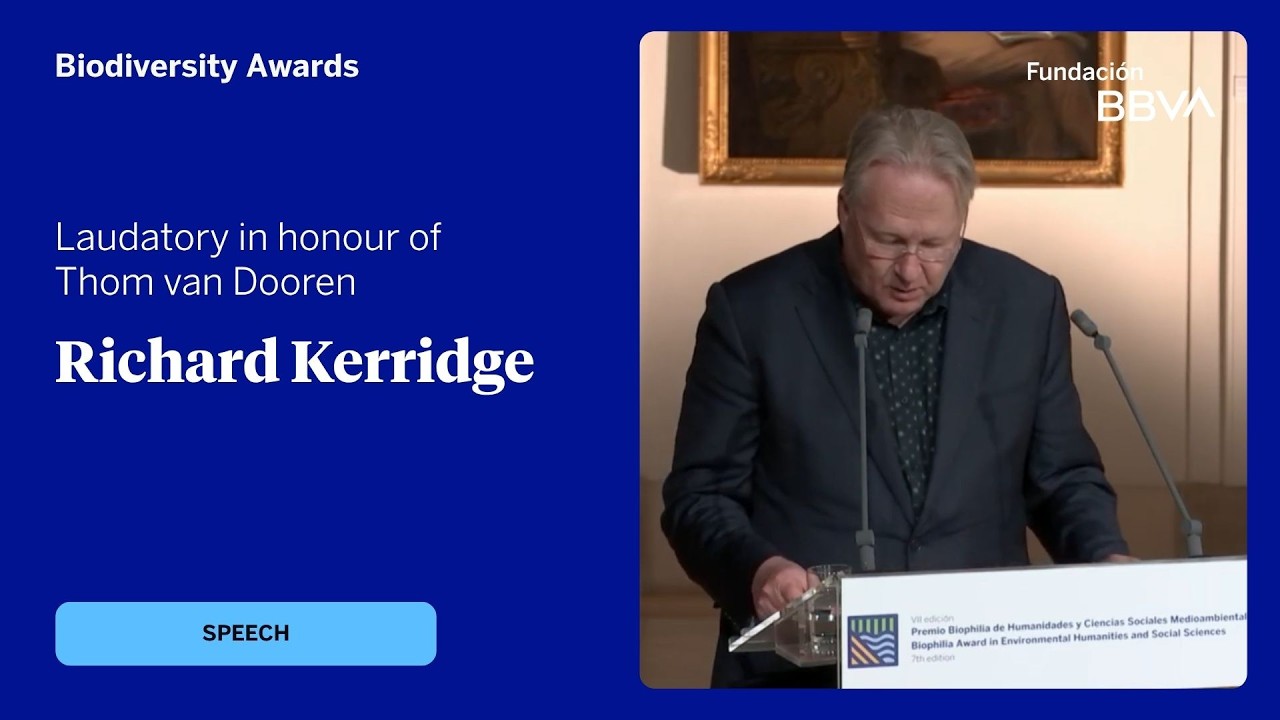
Laudatory speech by Prof. Richard Kerridge
Keywords
Summary
163 words
Critical Evaluation
The speech is a masterful example of academic laudation, blending biographical accuracy with a clear exposition of the laureate’s theoretical contributions. Kerridge effectively situates van Dooren’s work within the broader context of the environmental humanities, tracing its intellectual lineage from early ecology through post-structuralism. The argument is coherent and well-supported, with references to specific concepts such as the ‘metaphysics of presence’ and ‘Umwelt’, and to van Dooren’s publications. The speech’s strength lies in its ability to make complex theoretical ideas accessible without oversimplifying them, which mirrors van Dooren’s own approach. However, as a laudatory speech, it is inherently uncritical; it does not engage with potential critiques of van Dooren’s work, such as the risk of anthropomorphism or the practical limitations of applying post-structuralist theory to conservation. The sources cited are primarily van Dooren’s own books and a few theorists (Barad, Morton, von Uexküll), which are appropriate but not exhaustive. The speech’s rhetorical structure is effective, building a case for van Dooren’s significance while also conveying the urgency of extinction. The title accurately reflects the content, and the speech fulfills its purpose of honoring the laureate. Overall, it is a high-quality, informative, and engaging piece, though its uncritical nature and limited scope prevent it from being a comprehensive scholarly analysis.
209 words
Title / Content Match
The title accurately reflects the content: a laudatory speech introducing and praising the work of Thom van Dooren.
Quality & Reliability
7/10
The speech is a well-structured laudatory address by a senior academic, providing accurate biographical details and a coherent exposition of the laureate's theoretical contributions. It is grounded in established concepts (post-structuralism, Umwelt, entanglement) and references specific publications. However, it is an opinion piece, not peer-reviewed, and lacks critical engagement with potential limitations of the work.
Key Moments
Markers derived by PSI from the transcript: the creator did not define chapters.
- Introduction and announcement of Thom van Dooren as award recipient.
- Kerridge outlines van Dooren's academic positions and background.
- Discussion of van Dooren's three major books and their translations.
- Explanation of post-structuralist insight and its connection to ecology.
- Introduction of the concept of 'material-discursive' and its significance.
- Examples of entanglement: Hawaiian snails and vultures in India.
- Discussion of Umwelt and snail slime as a way of knowing.
- Conclusion: gratitude and emphasis on what we may still save.
Cited Sources
- Flightways: Life and Loss at the Edge of Extinction — Mentioned as one of van Dooren's highly cited books.
- The Wake of Crows: Living and Dying in Shared Worlds — Mentioned as one of van Dooren's highly cited books.
- A World in a Shell: Snail Stories for a Time of Extinctions — Mentioned as one of van Dooren's highly cited books.
Concurring Sources
- The Environmental Humanities: A Critical Introduction — Provides context on the field and its methods.
- Karen Barad's 'Meeting the Universe Halfway' — Relevant to the concept of material-discursive.
Dissenting Sources
- Critique of post-structuralist approaches in ecology — Some scholars argue that post-structuralist theory may overemphasize discourse at the expense of material reality, a potential critique not addressed in the speech.
Contribution & Novelties
The speech provides a clear synthesis of Thom van Dooren’s contributions to the environmental humanities, particularly his application of post-structuralist theory to extinction studies. It highlights the concept of ‘material-discursive’ and the importance of entanglement, offering a framework for understanding extinction as a slow unraveling of relationships. The speech also emphasizes the role of narrative in bridging academic and public understanding, which is a key innovation in van Dooren’s work.
Pour aller plus loin :
- Environmental humanities — Provides an overview of the interdisciplinary field.
- Post-structuralism — Explains the theoretical background of van Dooren’s approach.
- Umwelt — Concept introduced by Jakob von Uexküll, central to understanding species-specific experiences.
- Multispecies ethnography — Related methodology in anthropology.
- Extinction studies — Emerging field focusing on the cultural and philosophical aspects of extinction.
129 words
Radar Profile
The radar profile shows high scores in quality of information and reliability, reflecting the speech's solid academic grounding. The quantity of information is moderate, as it is a focused laudatory address rather than a comprehensive review. The technical level is moderate, making it accessible to a broad audience.
💬 No comments were provided for analysis.