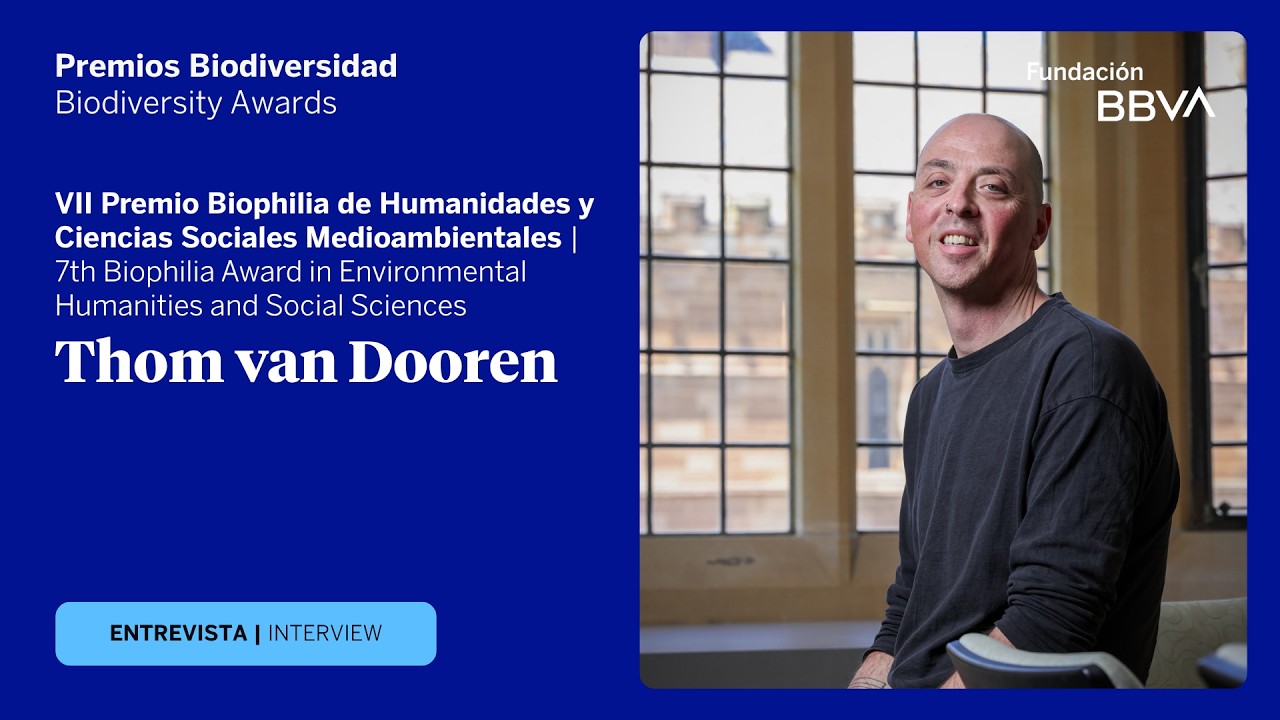
Thom van Dooren: “We must take into account the systems in which each extinction occurs”
Keywords
Summary
151 words
Critical Evaluation
The interview provides a compelling and articulate introduction to the environmental humanities and van Dooren’s particular approach to extinction studies. The value of the information lies in its conceptual clarity and the way it bridges philosophy, biology, and ethics. Van Dooren’s argument that extinction is not merely a biological event but a biocultural unraveling is well-supported with concrete examples, such as the chemosensory worlds of snails and the mourning behavior of crows. This grounds his philosophical claims in empirical detail, enhancing their credibility. The argumentation is solid: he systematically builds a case for a multispecies perspective, drawing on co-evolution, relationality, and the idea that human nature is an interspecies relationship. He acknowledges the influence of key thinkers like Plumwood, Haraway, and Rose, which situates his work within a broader scholarly tradition. The scientific rigor is high for an interview format; he avoids overgeneralization and emphasizes the need for situated, empirical case studies. The sources cited are primarily his own work and the award announcement, which is appropriate for an interview. The title accurately reflects the content, focusing on the systemic nature of extinction. The interview does not include any advertising. The public comments are not provided, so no analysis of audience reception is possible. Overall, the interview is a valuable resource for understanding the environmental humanities and offers a nuanced perspective on extinction, though it is not a peer-reviewed source and should be complemented with primary literature.
237 words
Title / Content Match
The title accurately reflects the core theme of the interview, which emphasizes the systemic and relational nature of extinction.
Quality & Reliability
8/10
The interview features a recognized scholar in environmental humanities, recipient of the Biophilia Award. The content is well-structured, grounded in academic concepts, and references established thinkers. However, it is an interview, not peer-reviewed research, and the claims are not empirically verified in the video.
Key Moments
Markers derived by PSI from the transcript: the creator did not define chapters.
Cited Sources
- Biophilia Award announcement — Official announcement of the award and lecture details.
- Fundación BBVA LinkedIn — Institutional page of the awarding foundation.
Concurring Sources
- Biophilia Award announcement — The award committee's description of van Dooren's work aligns with the interview's themes.
Contribution & Novelties
The interview offers a clear articulation of the environmental humanities as a generative, experimental field, and presents van Dooren’s distinctive concept of extinction as a biocultural unraveling. It emphasizes the need to attend to the relational and ethical dimensions of biodiversity loss, moving beyond simplistic narratives. The emphasis on ‘field philosophy’—grounding philosophical inquiry in empirical case studies—is a notable methodological contribution.
Pour aller plus loin :
- Environmental humanities (Wikipedia) — Overview of the field.
- Multispecies ethnography (Wikipedia) — Related approach in anthropology.
- Donna Haraway’s ‘Staying with the Trouble’ — Key text on multispecies ethics.
- Val Plumwood (Wikipedia) — Influential ecofeminist philosopher.
- Deborah Bird Rose (Wikipedia) — Anthropologist and environmental humanities scholar.
111 words
Radar Profile
The radar profile shows high scores in quality of information and reliability, reflecting the expert status of the interviewee and the coherent argumentation. The quantity of information is moderate, as it is a single interview, and the technical level is moderate, accessible to a general audience. The overall balance indicates a valuable but not exhaustive resource.