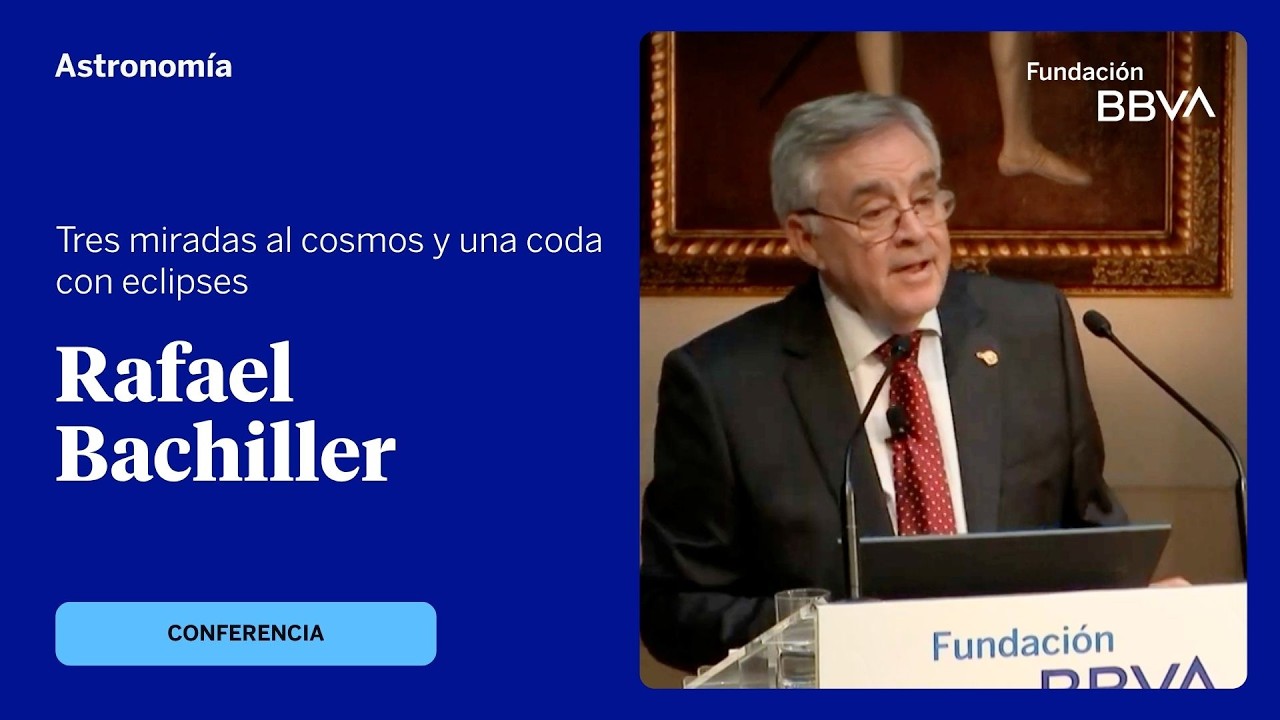
Conferencia: "Los eclipses solares en la ciencia, la historia y el arte", por Rafael Bachiller
Keywords
Summary
178 words
Critical Evaluation
The conference is a masterful blend of scientific accuracy and cultural history, delivered by an expert with deep knowledge and authority. Bachiller’s explanations are clear and accessible, making complex astronomical concepts understandable without oversimplifying. He effectively uses historical anecdotes to illustrate the evolution of human understanding of eclipses, from superstition to scientific inquiry. The scientific content is rigorous, with accurate descriptions of the mechanics of eclipses, the solar corona, and the role of eclipses in confirming general relativity. The artistic examples are well-chosen and thoughtfully analyzed, showing how eclipses have inspired artists across centuries. The talk is well-structured, progressing logically from the upcoming events to historical context, artistic representations, and scientific importance. The speaker’s credibility is impeccable, and the information is reliable. The only minor criticism is that the talk is primarily a general overview rather than a deep dive into any single aspect, but this is appropriate for a public lecture. The title accurately reflects the content, and the talk successfully achieves its goal of educating and inspiring the audience about the upcoming eclipses.
175 words
Title / Content Match
The title accurately reflects the content, which covers solar eclipses from scientific, historical, and artistic perspectives.
Quality & Reliability
9/10
The speaker is a renowned astronomer and director of the National Astronomical Observatory, providing authoritative and accurate information. The content is well-structured, historically grounded, and scientifically rigorous.
Key Moments
Markers derived by PSI from the transcript: the creator did not define chapters.
- Introduction to the upcoming trio of eclipses in Spain (2026, 2027, 2028) and the role of the Royal Observatory in calculating ephemerides.
- Historical examples of eclipses influencing battles and history, such as the Battle of Simancas and Christopher Columbus's lunar eclipse.
- Discussion of artistic representations of eclipses, from religious paintings to modern art, including works by José de Ribera and Roy Lichtenstein.
- Scientific observations of eclipses, including early descriptions of the corona by Plutarch and detailed drawings by Antonio de Ulloa.
- The role of eclipses in confirming Einstein's theory of general relativity, with the 1919 expedition.
- Modern scientific uses of eclipses, including studies of the solar corona and the importance of the upcoming eclipses for research.
- Conclusion emphasizing the unique opportunity for observation and public engagement with the upcoming eclipses.
Cited Sources
- Fundación BBVA — Organizer of the conference and source of information about the event.
Concurring Sources
- NASA - Solar Eclipses — NASA provides authoritative information on solar eclipses, including their science and history.
Contribution & Novelties
The conference provides a comprehensive and engaging synthesis of solar eclipses, combining scientific, historical, and artistic perspectives. It highlights the upcoming trio of eclipses visible from Spain, offering a unique opportunity for observation and public engagement. The talk emphasizes the importance of eclipses in scientific discovery, such as confirming general relativity, and their cultural significance throughout history.
Pour aller plus loin :
- Solar eclipse - Wikipedia — General overview of solar eclipses, their types, and mechanics.
- Corona - Wikipedia — Detailed information about the Sun’s corona, a key focus of eclipse observations.
- Eddington experiment - Wikipedia — The 1919 expedition that confirmed general relativity using a solar eclipse.
108 words
Radar Profile
The radar profile shows high scores across all dimensions, indicating a well-balanced and reliable presentation. The content is rich in information, technically sound, and highly credible, with a strong emphasis on scientific accuracy and historical context.