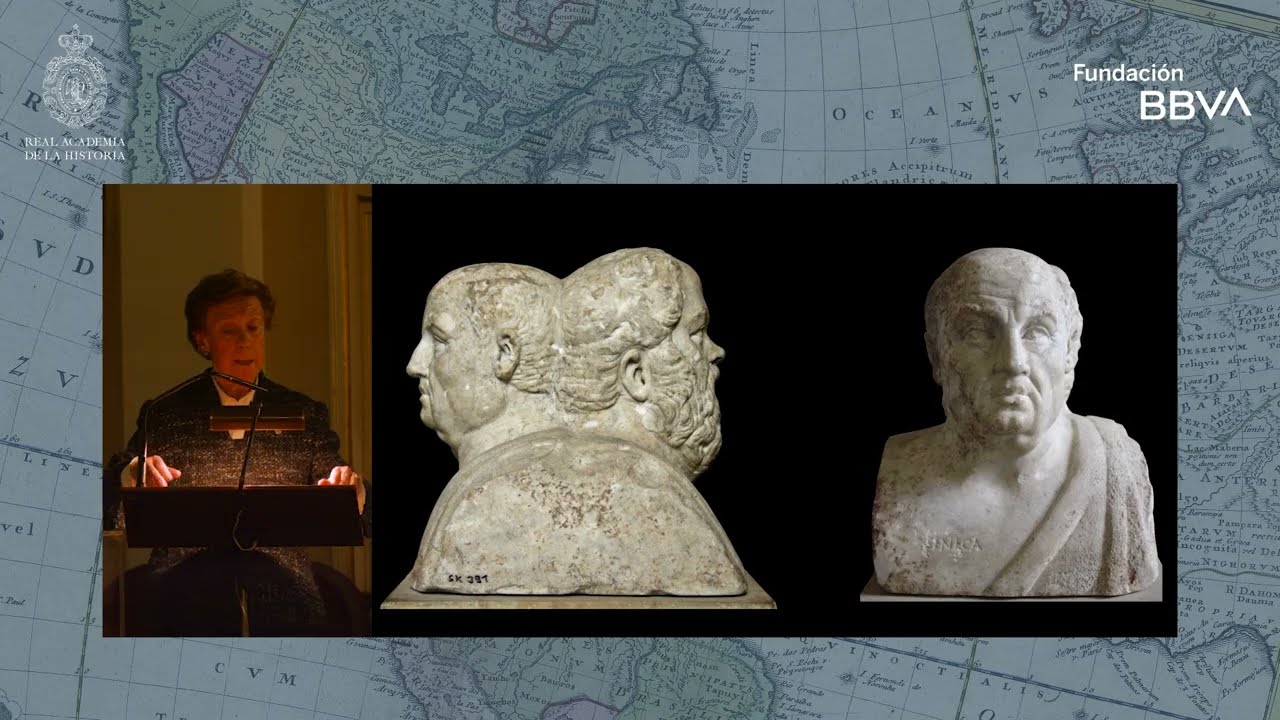
Pilar León-Castro Alonso: "Hispanos en Roma: el fulgor de la provincia en la metrópoli"
Keywords
Summary
159 words
Critical Evaluation
The lecture by Professor Pilar León-Castro Alonso offers a compelling and erudite overview of the role of Hispanic elites in the Roman Empire. The speaker demonstrates deep knowledge of the subject, drawing on a wide range of historical sources, including Cicero’s speeches, inscriptions, and literary works. The argumentation is solid, presenting a clear thesis that the success of Hispanics was due to a combination of ambition, financial capability, and exceptional education. The lecture is well-structured, moving chronologically from the late Republic to the early Empire, and highlights key figures such as the Balbi and the Annaei. The use of specific examples, like the trial of Balbus and Seneca’s role as Nero’s advisor, adds credibility and depth. However, the lecture is primarily a synthesis of existing scholarship rather than presenting new research, which is typical for a conference aimed at a general audience. The speaker occasionally makes speculative statements, such as the possibility that Balbus reached the Niger, but she acknowledges the uncertainty. The sources cited are not explicitly listed, but the speaker references primary texts and inscriptions, which are reliable. The title accurately reflects the content, and the lecture fulfills its promise of exploring the impact of Hispanics in Rome. Overall, this is a high-quality presentation that is both informative and engaging, though it may lack the rigor of a peer-reviewed article. The lecture’s strength lies in its narrative flow and the speaker’s ability to connect historical events to broader themes of power, culture, and identity.
246 words
Title / Content Match
The title accurately reflects the content, which focuses on the influence of Hispanics in Rome, as the lecture covers prominent figures from Hispania and their impact on the Roman Empire.
Quality & Reliability
8/10
The lecture is delivered by a university professor (catedrática) specializing in ancient history, providing a well-structured narrative based on historical sources and inscriptions. The content is scholarly, but as a conference, it lacks peer review and detailed citations, though it references primary sources like Cicero's Pro Balbo and inscriptions.
Key Moments
Markers derived by PSI from the transcript: the creator did not define chapters.
- Introduction to the topic and the Balbus family from Gades.
- Discussion of Balbus the Elder's rise to power under Caesar and his trial.
- Balbus the Younger's achievements, including his campaign in Africa and patronage.
- Introduction of the Annaeus family and Seneca the Elder's historical work.
- Seneca the Younger's role as philosopher and advisor to Nero.
- Seneca's downfall and suicide, and the impact on his family.
- Conclusion summarizing the influence of Hispanic elites on Rome.
Cited Sources
- Cicero, Pro Balbo — Mentioned as the speech defending Balbus the Elder.
- Inscription from Delphi — Referenced to attest the activities of Gallio as proconsul of Achaea.
Concurring Sources
- Cambridge Ancient History — General scholarly work on Roman history that supports the narrative of provincial elites.
Dissenting Sources
- Some scholars argue that Seneca's influence was exaggerated — Alternative interpretations exist regarding the extent of Seneca's political power.
Contribution & Novelties
The lecture provides a comprehensive synthesis of the role of Hispanic elites in Rome, emphasizing their financial and educational advantages. It offers a nuanced view of figures like Seneca, acknowledging both his achievements and his political failures. The speaker’s expertise adds depth to the narrative, making it a valuable resource for understanding the integration of provincial elites into the Roman power structure.
Pour aller plus loin :
- Seneca the Younger — Overview of his life and works.
- Trajan — Roman emperor from Hispania, his reign and achievements.
- Hispania — Historical overview of the Roman province.
95 words
Radar Profile
The radar profile shows high scores in quantity and quality of information, with a moderate level of technical depth, reflecting a lecture that is informative and reliable but not highly specialized. The overall reliability is strong, indicating a trustworthy presentation.