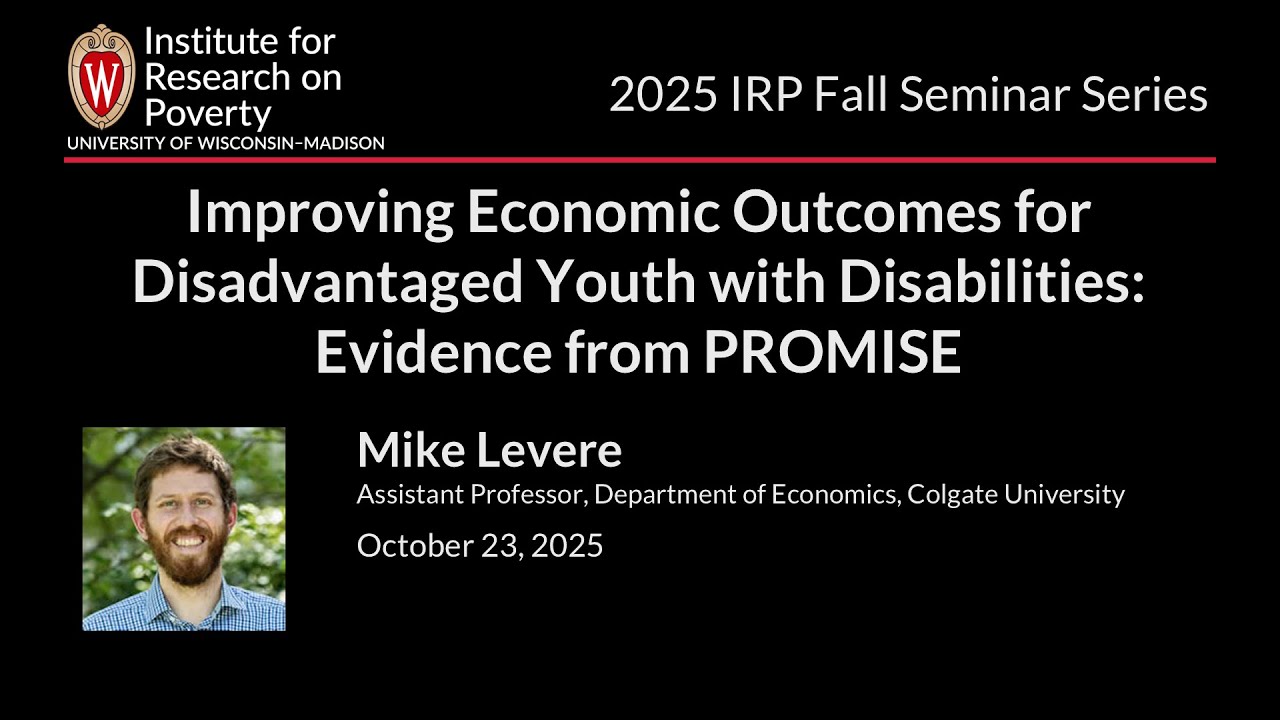
Improving Economic Outcomes for Disadvantaged Youth with Disabilities: Evidence from PROMISE
Keywords
Summary
170 words
Critical Evaluation
Value of the Information & Strength of the Argument
The presentation provides valuable evidence from a large-scale RCT, which is rare in this policy area. The use of administrative data and high survey response rates strengthens the credibility of the findings. The speaker carefully discusses limitations, such as the fading of employment effects and the negative net benefit, and appropriately cautions against overinterpreting the reduction in healthcare expenditures. The argumentation is solid, with clear explanations of the program design, data sources, and empirical strategy.
Scientific Rigor, Source Quality, Title Accuracy
The speaker cites relevant research on the safety net and disability programs, and the study itself is rigorous. The title accurately reflects the content. The presentation is based on a peer-reviewed study conducted with Mathematica, a reputable research organization. The speaker acknowledges the cost-benefit analysis and the potential for long-term benefits, showing scientific caution.
144 words
Title / Content Match
The title accurately reflects the content, which focuses on the PROMISE program's impact on economic outcomes for disadvantaged youth with disabilities.
Quality & Reliability
8/10
Presentation of a large-scale randomized controlled trial with 12,000 participants, using administrative data from SSA, CMS, and IRS, and high survey response rates. The speaker is an academic economist, and the study is conducted by Mathematica, a reputable research organization. Limitations are acknowledged, including cost-benefit analysis and fading effects.
Key Moments
Markers derived by PSI from the transcript: the creator did not define chapters.
- Introduction to the motivation: safety net programs help children, but evidence for kids with disabilities is lacking.
- Overview of SSI program and the double disadvantage of poverty and disability.
- Description of PROMISE program: services offered, implementation across 11 states, and RCT design.
- Data sources: administrative data from SSA, CMS, IRS, and surveys.
- Baseline characteristics and balance between treatment and control groups.
- Main findings: increased service uptake, employment, and earnings, but fading effects.
- Reduction in healthcare expenditures and discussion of potential health improvements.
- Mediation analysis: early paid employment as key driver.
- Cost-benefit analysis: negative net benefit in short term, but potential long-term gains.
- Discussion of age-18 redetermination and challenges for youth with disabilities.
Cited Sources
- PROMISE program evaluation — The study was conducted by Mathematica, and the presentation references their evaluation.
- Social Security Administration — The SSA implemented the PROMISE program and provided administrative data.
- Centers for Medicare & Medicaid Services — CMS provided Medicaid expenditure data.
Concurring Sources
- Mathematica's PROMISE evaluation — The study is based on Mathematica's evaluation, which likely has similar findings.
Contribution & Novelties
This study provides novel evidence from a large-scale RCT on a hard-to-serve population, showing that intensive services can improve employment and reduce healthcare expenditures, with early paid employment as a key mechanism. It also highlights the cost-effectiveness challenges.
Pour aller plus loin :
- Supplemental Security Income (SSI) — Overview of the SSI program.
- Transition to Adulthood for Youth with Disabilities — Research on transition challenges.
- Mediation Analysis in Social Science — Explanation of mediation analysis used in the study.
79 words
Radar Profile
The radar profile shows high scores in information quantity, quality, and reliability, with a slightly lower technical level, indicating a presentation that is rigorous and accessible to a broad audience.
💬 No comments were provided for this video.