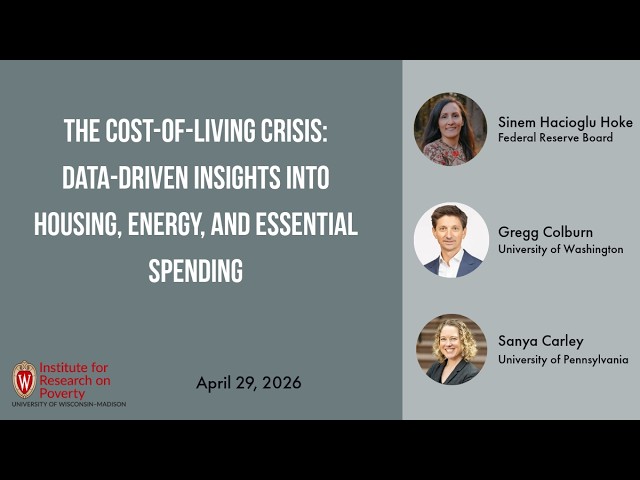
The Cost-of-Living Crisis: Data-Driven Insights into Housing, Energy, and Essential Spending
Keywords
Summary
169 words
Critical Evaluation
Value of the Information & Strength of the Argument
The value of the information is high, as each speaker brings unique data and rigorous analysis. Dr. Hok uses a novel dataset (Numerator) to show that low-income households experience higher inflation and are more affected by tariffs, with clear evidence and methodology. Dr. Colburn uses longitudinal data (PSID) to demonstrate long-term trends in housing cost burden, providing a compelling argument for policy inadequacy. Dr. Carley’s work on energy insecurity is well-supported by existing literature. The argumentation is solid, with each speaker presenting data, acknowledging limitations, and drawing policy-relevant conclusions. The webinar effectively synthesizes multiple perspectives to explain the cost-of-living crisis.
Scientific Rigor, Source Quality, Title Accuracy
The scientific rigor is high: the speakers are established researchers, and they reference their own peer-reviewed publications and well-known datasets. The sources cited are credible (e.g., Federal Reserve, Census Bureau, PSID). The title accurately reflects the content, which is data-driven and covers housing, energy, and essential spending. The webinar is well-structured, with clear methodology and appropriate caveats. However, as a webinar, it lacks the formal peer-review process, and some findings are preliminary. The adequacy between title and content is excellent.
195 words
Title / Content Match
The title accurately reflects the content, which covers housing, energy, and essential spending through a data-driven lens.
Quality & Reliability
8/10
The webinar features three academic researchers presenting data-driven analyses based on established datasets (e.g., Numerator, PSID) and peer-reviewed work. The content is rigorous, with clear methodology and appropriate caveats. However, the format is a webinar, not a peer-reviewed publication, and some claims rely on unpublished or preliminary research.
Key Moments
Markers derived by PSI from the transcript: the creator did not define chapters.
- Introduction by host Holly Lynn Hart, outlining the webinar structure and speakers.
- Dr. Sinem Hacaloglu Hok begins her presentation on consumer spending and prices, introducing the Numerator dataset.
- Dr. Hok presents findings on consumer sentiment and spending by income, showing divergence post-2023.
- Dr. Hok discusses inflation disparities across income levels, with low-income households facing higher cumulative inflation.
- Dr. Hok concludes with analysis of tariff impacts, showing regressive pass-through and welfare costs.
- Dr. Gregg Colburn begins his presentation on housing affordability, outlining three key arguments.
- Dr. Colburn presents data on income stagnation and rising rents for renters over 50 years.
- Dr. Colburn discusses housing cost burden spell duration and its spread up the income distribution.
- Dr. Sanya Carley begins her presentation on energy affordability and insecurity.
- Dr. Carley presents data on energy burden and its impact on low-income households.
- Q&A session begins, with speakers addressing audience questions.
Cited Sources
- Numerator data — Dr. Hok uses Numerator's consumer panel data for her analysis.
- Panel Study of Income Dynamics (PSID) — Dr. Colburn references PSID data for housing cost burden analysis.
- U.S. Census Bureau — Dr. Hok compares her data to Census retail sales and price indices.
- Federal Reserve Board — Dr. Hok is affiliated with the Federal Reserve Board.
Concurring Sources
- U.S. Census Bureau — Official statistics on income, poverty, and spending align with the webinar's data.
- Bureau of Labor Statistics — CPI and consumer spending data corroborate the inflation disparities discussed.
Dissenting Sources
- No discordant sources identified — The webinar's findings are consistent with existing literature and official data.
Contribution & Novelties
The webinar provides a comprehensive, data-driven overview of the cost-of-living crisis, integrating insights from consumer spending, housing, and energy. It highlights the disproportionate burden on low-income households and offers policy-relevant findings. The use of high-frequency retail data (Numerator) and longitudinal housing data (PSID) adds novel empirical evidence.
Pour aller plus loin :
- Consumer Expenditure Survey — Official data on household spending patterns.
- Housing Cost Burden — Definition and context.
- Energy Insecurity — U.S. Department of Energy resources on energy insecurity.
80 words
Radar Profile
The radar profile shows high scores in information quantity, quality, and reliability, with a slightly lower technical level, reflecting the webinar's accessibility. The balanced profile indicates a well-rounded presentation suitable for a broad audience.
💬 No comments were provided for analysis.