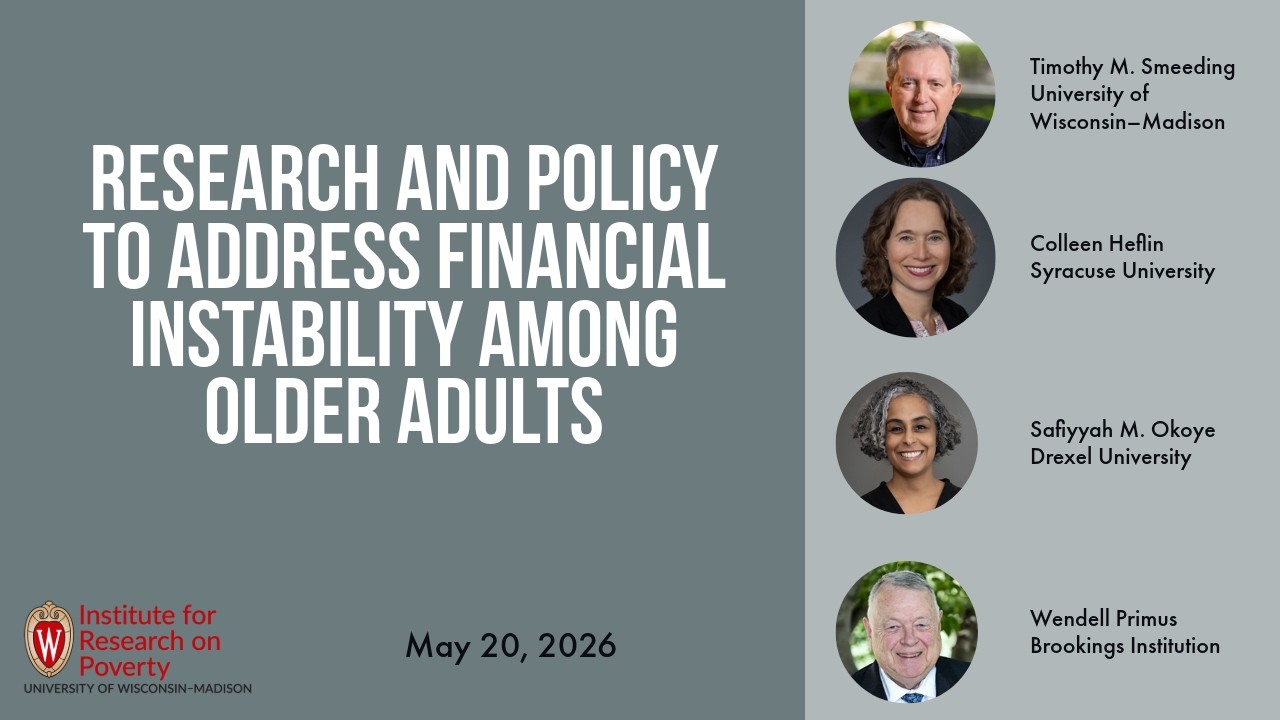
Webinar: Research and Policy to Address Financial Instability Among Older Adults
Keywords
Summary
152 words
Critical Evaluation
Value of the Information & Strength of the Argument
The webinar provides valuable insights into the multifaceted challenges of financial instability among older adults, supported by data from official sources and qualitative interviews. The argumentation is solid, with each speaker presenting evidence for their claims. Smeeding uses Census Bureau data to show poverty trends, Heflin cites USDA statistics and AARP surveys, and Akwaii draws on a peer-reviewed study. The policy recommendations are grounded in research and practical considerations. However, the webinar is primarily an expert opinion forum rather than a presentation of new original research, and the speakers advocate for specific policy changes without extensive counterarguments.
Scientific Rigor, Source Quality, Title Accuracy
The webinar demonstrates scientific rigor through the use of reputable sources, including Census Bureau data, USDA reports, and peer-reviewed studies. The speakers are experts from respected institutions, and the content is well-referenced. The title accurately reflects the content, which covers both research and policy aspects. The webinar does not include a formal literature review but provides a comprehensive overview of the current landscape. The Q&A session at the end allows for clarification and further discussion, enhancing the overall quality.
191 words
Title / Content Match
The title accurately reflects the webinar's content, which covers research and policy options to address financial instability among older adults.
Quality & Reliability
8/10
The webinar features four experts from reputable institutions (University of Wisconsin-Madison, Syracuse University, Drexel University, Brookings Institution) presenting data from official sources (Census Bureau, USDA, AARP) and peer-reviewed research. The content is well-structured and evidence-based, though it represents expert opinion and policy advocacy rather than new original research.
Key Moments
Markers derived by PSI from the transcript: the creator did not define chapters.
- Introduction by host Holly Leinweber, outlining the webinar structure and speakers.
- Dr. Timothy Smeeding presents poverty trends among older adults, using Census Bureau data and discussing the supplemental poverty measure.
- Dr. Colleen Heflin discusses food insecurity among older adults, citing USDA statistics and AARP surveys, and highlights barriers to SNAP participation.
- Dr. Sophia Ann Akwaii presents research on housing instability, using data from the National Health and Aging Trends Study, and discusses the impact on older adults with disabilities.
- Dr. Wendell Primus proposes policy options to reduce elderly poverty, including expanding SSI and improving program participation.
Cited Sources
- Census Bureau Poverty Data — Used by Dr. Smeeding to show poverty trends and measures.
- USDA Food Security Reports — Cited by Dr. Heflin for food insecurity statistics.
- AARP Survey on Food Access — Referenced by Dr. Heflin for survey data on food access barriers.
- National Health and Aging Trends Study (NHATS) — Used by Dr. Akwaii for housing characteristics research.
- Brookings Institution — Affiliation of Dr. Wendell Primus, who presented policy options.
Concurring Sources
- Census Bureau Poverty Data — Data on poverty rates among older adults align with the webinar's presentation.
- USDA Food Security Reports — Statistics on food insecurity among older adults match the webinar's claims.
- AARP Survey on Food Access — Survey findings on food access barriers are consistent with the webinar's discussion.
Contribution & Novelties
The webinar synthesizes current research and policy perspectives on financial instability among older adults, highlighting the interconnectedness of poverty, food insecurity, and housing instability. It provides a comprehensive overview of the challenges and potential policy solutions, drawing on expert insights and recent data. The discussion of SNAP participation barriers and the impact of medical out-of-pocket costs adds depth to the understanding of elderly poverty.
Pour aller plus loin :
- Social Security Administration — Official information on Social Security benefits and programs.
- Supplemental Nutrition Assistance Program (SNAP) — USDA page on SNAP eligibility and benefits.
- Housing and Urban Development (HUD) — Federal agency addressing housing instability and homelessness.
- Meals on Wheels America — Organization providing home-delivered meals to older adults.
- National Council on Aging — Advocacy and resources for older adults’ financial security.
132 words
Radar Profile
The radar profile shows high scores in information quantity, quality, and reliability, with a moderate technical level. This indicates a well-researched and informative webinar that is accessible to a broad audience, though it may not delve into highly technical methodologies.
💬 Sur les 0 commentaires analysés, aucune tendance n'est disponible.