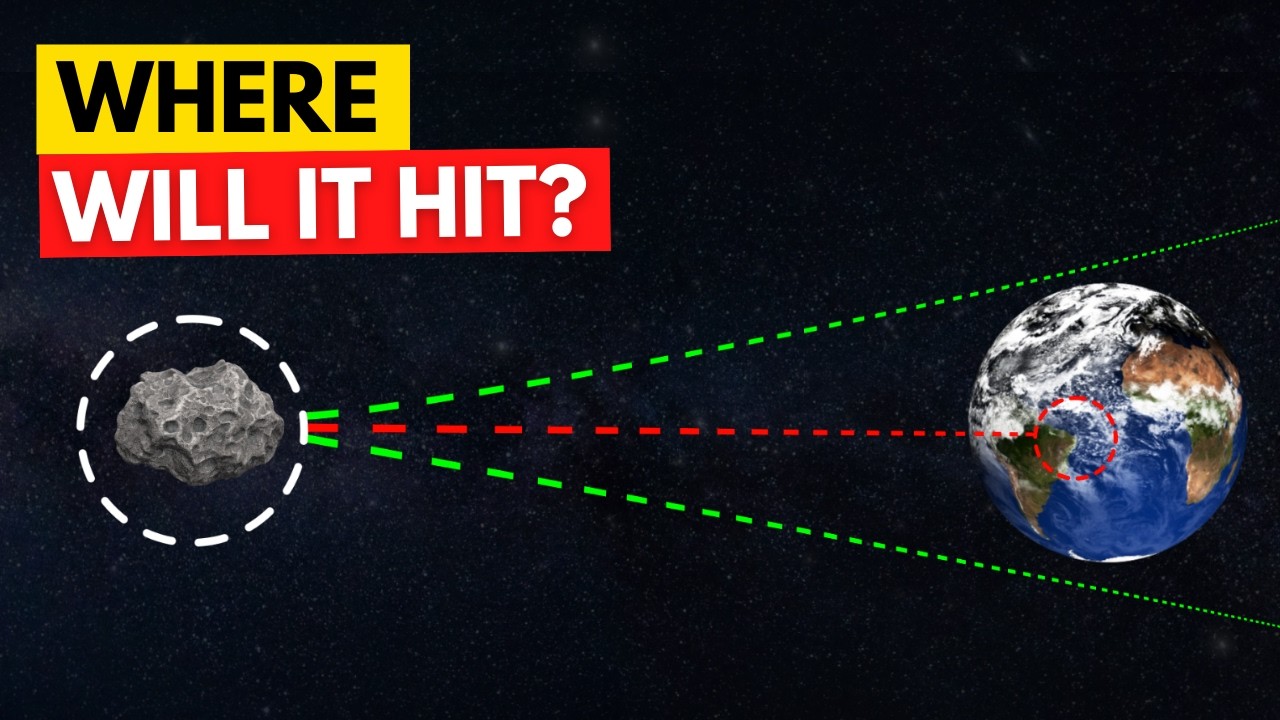
Scientists Warn Asteroid YR4 May Impact Earth - What We Know So far
Keywords
Summary
188 words
Critical Evaluation
Value of the Information & Strength of the Argument
The video provides substantial value by synthesizing current data and historical context to explain the scientific and practical aspects of the YR4 threat. It effectively argues that while the probability is low, the potential consequences are severe, justifying the activation of planetary defense procedures. The argumentation is solid, using concrete examples like the DART mission and the Gauss method to support its points. The presenter also addresses common misconceptions, such as the effectiveness of nuclear weapons in space, and emphasizes the uncertainties involved in asteroid trajectory prediction. The inclusion of worst-case casualty estimates, while alarming, is presented as a realistic assessment rather than fear-mongering, and is balanced by the reminder that the probability of impact is very low.
Scientific Rigor, Source Quality, Title Accuracy
The video demonstrates strong scientific rigor by referencing established scientific concepts and missions. It correctly explains the method of least squares, albedo, the Yarkovsky effect, and the Torino scale. It cites NASA’s DART mission and its results, and mentions the James Webb Space Telescope’s upcoming observations. The sources are not explicitly cited in the video, but the information aligns with publicly available scientific data. The title accurately reflects the content, and the video’s structure with chapters helps viewers navigate the information. The presenter’s background as a scientist adds credibility, and the content is presented in a balanced manner, acknowledging uncertainties and different perspectives.
236 words
Title / Content Match
The title accurately reflects the content: the video discusses the asteroid YR4, its potential impact, and the current state of knowledge.
Quality & Reliability
8/10
The video provides a well-structured and scientifically accurate overview of asteroid 2024 YR4, covering detection history, orbital mechanics, impact probability, potential damage, and mitigation strategies. It cites specific missions (DART) and historical events (Ceres discovery) and correctly explains concepts like albedo, Yarkovsky effect, and the Torino scale. The content is up-to-date as of the publication date and includes appropriate caveats about uncertainties. Minor inaccuracies (e.g., 'one in 42 chance' vs. 2.3% is close, but the phrasing 'one in 42' is slightly off; also '500 times Hiroshima' is an overestimate for 8 megatons vs. 15 kilotons) slightly reduce the score.
Chapters
Cited Sources
- Rockstar Scientist Merch — Merchandise store associated with the channel, mentioned in the description.
- Shure SM7B Microphone Video — Affiliate link to a video about the microphone used, listed in the description.
Concurring Sources
- NASA's DART Mission — NASA's official page on the DART mission, which the video cites as a demonstration of kinetic impactor technology.
Contribution & Novelties
The video provides a timely and accessible synthesis of the 2024 YR4 situation, explaining the scientific principles behind asteroid detection and deflection in a clear and engaging manner. It adds value by connecting historical discoveries (Ceres, Gauss) to current events, and by discussing the political and ethical dimensions of planetary defense. The presenter’s personal perspective on humanity’s ‘age of folly’ offers a unique philosophical angle.
Pour aller plus loin :
- Asteroid impact avoidance — Wikipedia article covering various deflection methods, including kinetic impactors and nuclear options.
- Torino scale — Wikipedia article explaining the Torino scale used to categorize impact hazards.
- Yarkovsky effect — Wikipedia article on the thermal force that can alter an asteroid’s orbit, as mentioned in the video.
- DART mission — Wikipedia article on NASA’s Double Asteroid Redirection Test, a successful kinetic impactor mission.
136 words
Radar Profile
The radar profile shows high scores in quantity and quality of information, with a slightly lower but still solid technical level and reliability. This indicates a well-balanced video that is both informative and credible, suitable for a general audience interested in astronomy and planetary defense.
💬 Positif. Sur les 30 commentaires analysés, le climat est très positif, avec des réactions humoristiques et des éloges pour la clarté et le caractère informatif de la vidéo. Plusieurs commentaires expriment une confiance dans la science et une appréciation de l'équilibre entre humour et sérieux.