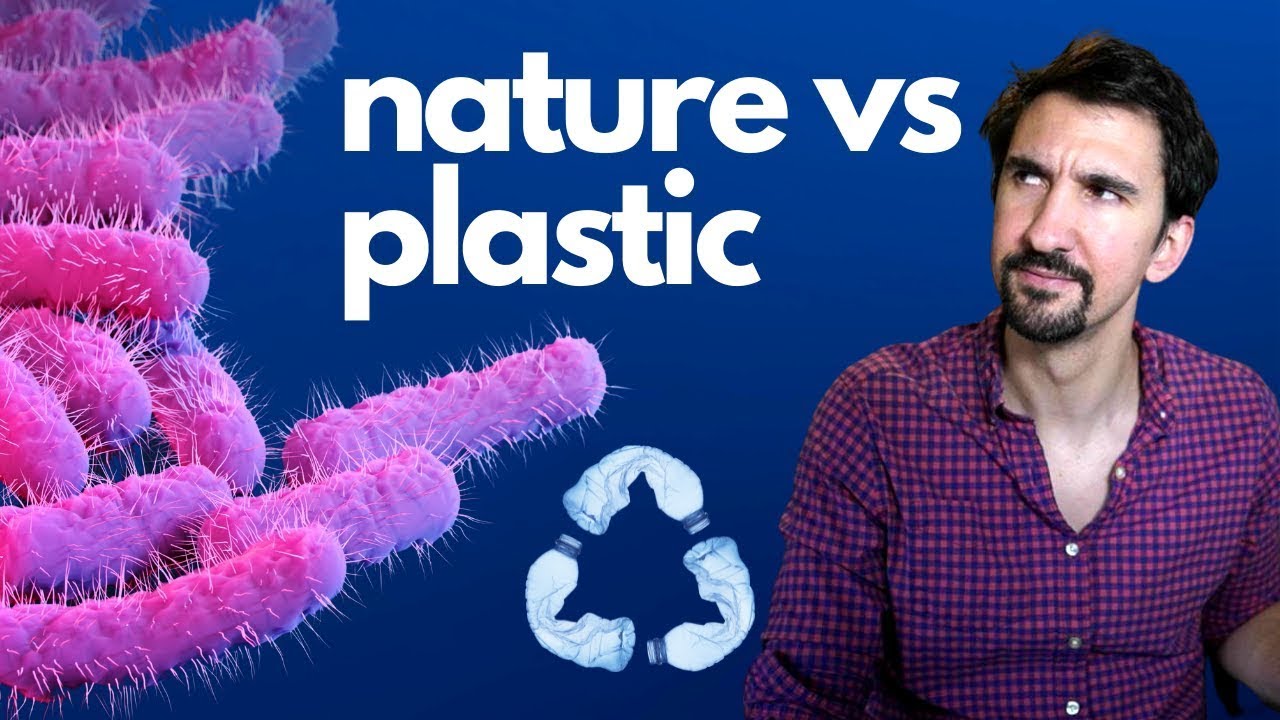
How Close are We to Plastic-Eating Bacteria?
Keywords
Summary
146 words
Critical Evaluation
Value of the Information & Strength of the Argument
The video provides valuable information by bridging the gap between a scientific discovery and its industrial application. It clearly explains the science behind PET degradation and the limitations of the wild-type bacterium, then transitions to the engineering and commercial efforts to overcome these limitations. The argumentation is solid, presenting both the potential and the challenges, such as the slow degradation rate and the economic cost. The discussion of Carbios’ business model and partnerships adds practical insight. However, the video could have provided more depth on the scientific details of enzyme optimization and the environmental impact assessment.
Scientific Rigor, Source Quality, Title Accuracy
The video demonstrates scientific rigor by referencing a specific 2016 paper from the Kyoto Institute of Technology and providing data on PET production and recycling rates. It also mentions the UN report on recycling rates. However, some claims, such as the GHG emission reduction estimates, are not directly sourced. The title accurately reflects the content, and the video does not overstate the current capabilities, clearly stating that the technology is not yet a plug-and-play solution. The video also includes a brief discussion of the economic and policy aspects, which adds to its credibility.
204 words
Title / Content Match
The title accurately reflects the content, which explores the current state and potential of plastic-eating bacteria and enzymes.
Quality & Reliability
7/10
The video presents a balanced overview of enzymatic plastic recycling, citing specific studies (2016 Kyoto Institute of Technology paper) and company data (Carbios). However, it lacks direct citations for some claims (e.g., GHG reduction estimates) and relies on general knowledge. The scientific content is accurate but simplified, with a clear distinction between lab results and industrial scalability.
Key Moments
Markers derived by PSI from the transcript: the creator did not define chapters.
- Introduction to the plastic problem and the discovery of Ideonella sakaiensis.
- Explanation of PET and its recycling challenges.
- Details on Ideonella sakaiensis and its enzymes PETase and MHETase.
- Discussion of the limitations of the wild-type bacterium.
- Introduction to Carbios and their optimized enzymatic process.
- Economic challenges and potential policy solutions.
Cited Sources
- 2016 paper from Kyoto Institute of Technology — Reported the discovery of Ideonella sakaiensis and its ability to degrade PET.
- UN report 2019 — Cited for the statistic that only 15% of plastics are collected for recycling.
- Carbios disclosure information — Mentioned for details on Carbios' plans for licensing and enzyme sales.
Concurring Sources
- Ideonella sakaiensis — Confirms the discovery and characteristics of the bacterium.
- PETase — Provides details on the enzyme and its function.
Contribution & Novelties
The video provides an accessible synthesis of the state of enzymatic plastic recycling, highlighting the transition from a scientific discovery to an industrial solution. It uniquely combines scientific explanation with a business perspective, discussing Carbios’ commercial strategy and the economic barriers. The video also emphasizes the need for policy intervention to level the playing field.
Pour aller plus loin :
- Ideonella sakaiensis — Wikipedia article on the bacterium.
- PETase — Wikipedia article on the enzyme.
- Carbios — Official website of Carbios, the company featured in the video.
- Circular economy — Concept of circular economy relevant to the discussion.
98 words
Radar Profile
The radar profile shows balanced scores across all dimensions, with slightly lower scores in technical depth and quantity of information, reflecting the video's focus on accessibility rather than exhaustive detail. The high reliability score indicates a trustworthy presentation of the topic.