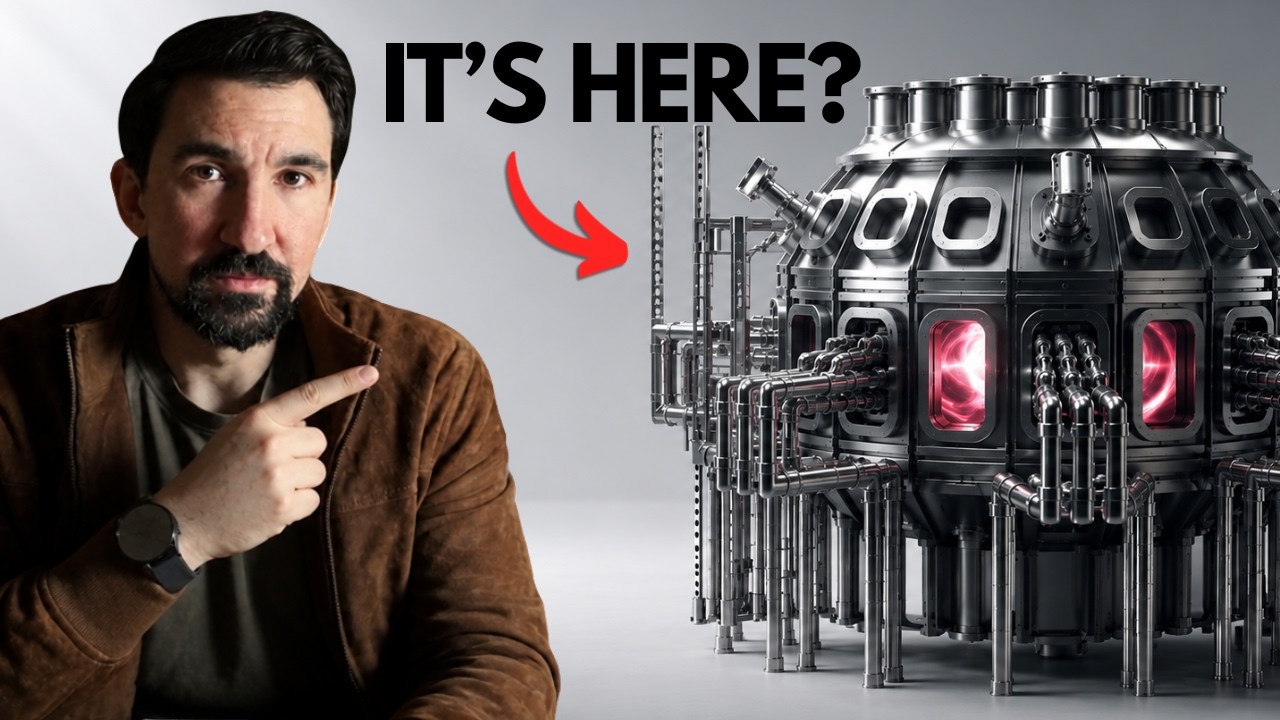
It's Happening - World's First Fusion Plant Applies to Join the Grid
Keywords
Summary
149 words
Critical Evaluation
Value of the Information & Strength of the Argument
The video provides valuable insights into the current state of fusion energy, particularly the significance of the grid application and the technological advancements in magnets. The argumentation is well-structured, presenting both the potential and the challenges. The presenter balances optimism with critical analysis, acknowledging the ambitious timeline and the historical pattern of fusion being ‘20 years away’. The interview with the CFS co-founder adds credibility, though it also reflects the company’s optimistic perspective. The video effectively explains complex physics in an accessible manner, making it informative for a general audience.
Scientific Rigor, Source Quality, Title Accuracy
The video demonstrates scientific rigor by referencing key milestones like the 2021 magnet test and the DOE validation. It also mentions the Lawson triple product and the NIF results, providing a solid foundation. The sources cited are primarily the company’s claims and the presenter’s own expertise, with limited external references. The title accurately reflects the content, focusing on the grid application. The video includes a promotional segment for Shortform, which is clearly disclosed. Overall, the content is reliable, though it relies heavily on the company’s narrative.
191 words
Title / Content Match
The title accurately reflects the video's focus on the first fusion plant grid application, though the content also covers broader fusion history and technology.
Quality & Reliability
8/10
The video presents a balanced analysis of the recent fusion grid application, backed by interviews with a Commonwealth Fusion Systems co-founder and references to key scientific milestones. The content is technically accurate, though it includes promotional segments and some optimistic projections from the company.
Chapters
- The World's First Fusion Grid Connect
- Why is Fusion So Hard to Get Right?
- Ad Break
- Fusion's Net Energy Gain Problem
- Why Fusion Reactors Have to Be So Big
- The Magnet Breakthrough That Changed Everything
- The Timeline to Fusion
- The First Ever Fusion Grid Application
- What Are Commonwealth Saying About Fusion?
- Conclusion: The Nature of Mythical Technologies
Cited Sources
- Dr Ben Miles Newsletter — Mentioned as a resource for further content and updates.
- Rockstar Scientist Merch — Mentioned as a merchandise link.
- Shortform — Sponsor of the video, offering a book summary service.
Concurring Sources
- Commonwealth Fusion Systems — The company behind the grid application, providing official information on their projects.
Dissenting Sources
- Critics of fusion timeline — Some commenters and experts remain skeptical about the feasibility of the proposed timeline, citing historical delays in fusion projects.
Contribution & Novelties
The video provides a timely analysis of the first fusion grid application, offering a balanced perspective on the technological and regulatory milestones. It introduces the concept of ‘mythic tech’ to categorize technologies with unknowable timelines, and argues that fusion is transitioning to ‘deep tech’ with a more defined path. The interview with a CFS co-founder provides insider insights into the company’s strategy and confidence.
Pour aller plus loin :
- ITER — The international fusion project, providing context on the scale and challenges of fusion reactors.
- Lawson criterion — The fundamental condition for fusion, explained in the video.
- High-temperature superconductors — The technology behind the REBCO magnets, key to the breakthrough.
110 words
Radar Profile
The radar profile shows high scores in information quantity and quality, with a slightly lower technical level, indicating the video is informative and reliable but not overly technical. The global reliability is strong, reflecting the balanced approach and credible sources.
💬 Positif. Sur les 30 commentaires analysés, la majorité exprime un optimisme prudent, saluant les progrès tout en rappelant les défis historiques. Quelques commentaires ironiques sur le 'toujours 20 ans' et des doutes sur les motivations financières, mais dans l'ensemble, le climat est encourageant.