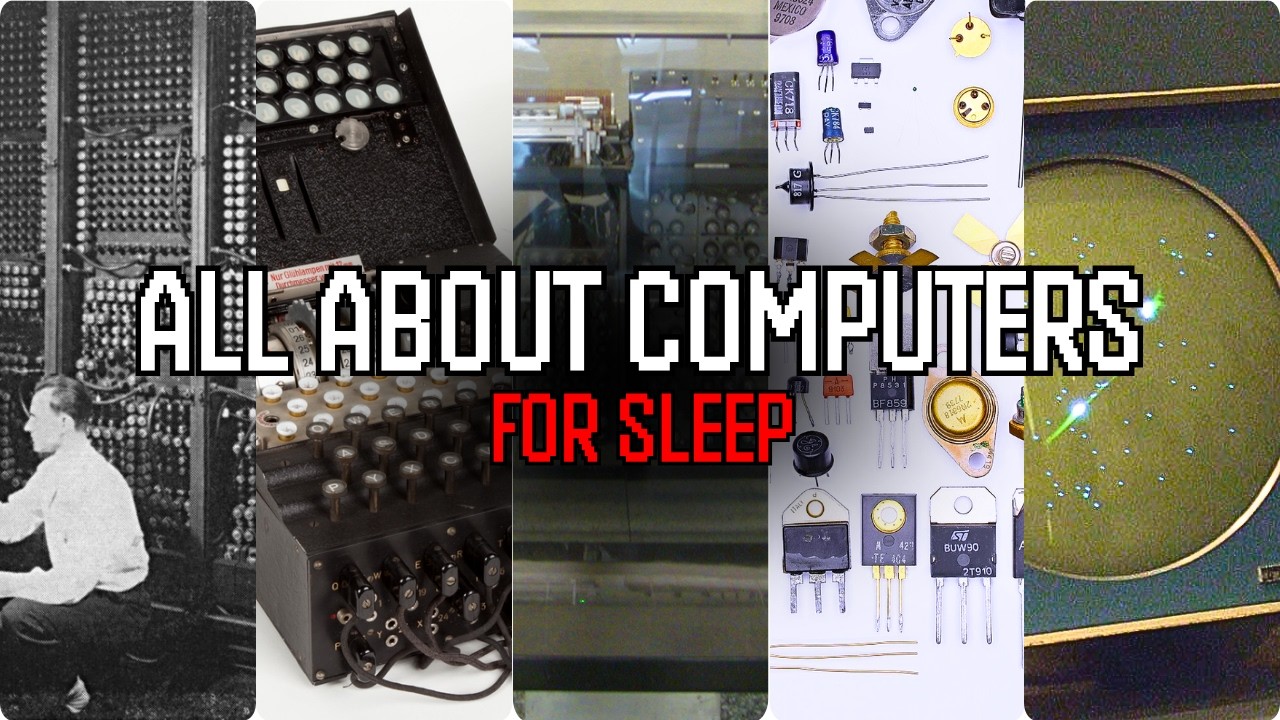
The Entire History Of Computers (Slowly)
Keywords
Summary
140 words
Critical Evaluation
The video offers a comprehensive and engaging overview of the history of computers, spanning from ancient counting tools to modern digital devices. Its strength lies in its clear narrative structure, which connects disparate inventions into a coherent story of conceptual evolution. The emphasis on key ideas such as programmability, binary logic, and the separation of hardware and software is well-executed and accessible to a broad audience. The video correctly highlights the contributions of Charles Babbage and Ada Lovelace, and it effectively explains the significance of George Boole’s logical algebra. However, there are some simplifications and omissions. For instance, the transition from mechanical to electronic computing is covered, but the role of early electromechanical devices like the Harvard Mark I is only briefly mentioned. Additionally, the video glosses over the contributions of other pioneers such as Alan Turing and John von Neumann, whose work on theoretical computation and stored-program architecture is crucial. The visual sources are cited in a linked document, but the video itself does not provide direct references, which limits the ability to verify specific claims. The production quality is high, with clear narration and helpful visuals, but the pacing is slow, as indicated by the title, which may not suit all viewers. Overall, the video is a valuable educational resource, but it should be supplemented with more detailed sources for a deeper understanding.
225 words
Title / Content Match
The title accurately reflects the content, as the video indeed covers the entire history of computers in a slow, detailed manner.
Quality & Reliability
8/10
The video provides a comprehensive historical overview of computing, covering key inventions and figures with reasonable accuracy. It cites visual sources in a linked document, though specific references are not directly shown. The narrative is engaging and generally well-researched, but some simplifications and omissions may occur for brevity.
Key Moments
Markers derived by PSI from the transcript: the creator did not define chapters.
- Introduction to the concept of computers and the importance of following instructions.
- Discussion of early counting tools and the abacus.
- Pascal's mechanical calculator and the concept of automatic carry.
- Leibniz's stepped reckoner and his work on binary numbers.
- Jacquard's punched-card loom and the idea of external programming.
- Charles Babbage's difference engine and analytical engine.
- Ada Lovelace's notes and the first computer program.
- George Boole's laws of thought and Boolean logic.
- Herman Hollerith's punched-card tabulating machines and the founding of IBM.
- Transition to electronic computers and the ENIAC.
Cited Sources
- Visual Sources Document — The video description provides a link to a document listing visual sources used in the video.
Concurring Sources
- Visual Sources Document — The linked document likely contains references to historical sources that align with the video's content.
Contribution & Novelties
The video provides a comprehensive and accessible narrative of the history of computing, emphasizing the conceptual evolution from mechanical calculators to modern computers. It highlights the importance of programmability and binary logic, and it connects disparate inventions into a coherent story. The video’s strength lies in its clear explanations of complex ideas, such as Babbage’s analytical engine and Boole’s logic, making them understandable to a general audience.
Pour aller plus loin :
- Analytical engine — Detailed article on Babbage’s design and its components.
- Ada Lovelace — Biography and her contributions to computing.
- Boolean algebra — Overview of the logical system that underpins digital circuits.
- Punched card — History and use of punched cards in computing.
- History of computing hardware — Broader context on the development of computing machines.
128 words
Radar Profile
The radar profile shows high scores in quantity and quality of information, with a moderate technical level. This indicates a comprehensive and reliable overview, but with limited depth in technical details, suitable for a general audience.