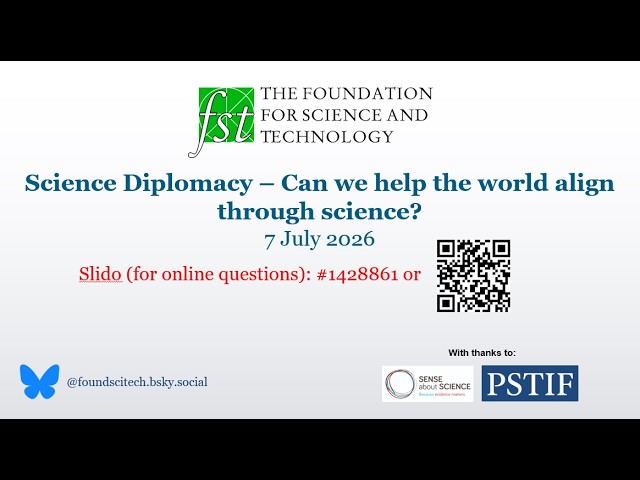
FST - Science Diplomacy: Can we help the world align through science?
Keywords
Summary
160 words
Critical Evaluation
Value of the Information & Strength of the Argument
The video provides valuable insights from high-level experts with direct experience in UK science policy and diplomacy. The arguments are well-structured, with each speaker offering distinct perspectives: Chi Onwurah focuses on the committee’s report, George Freeman emphasizes the urgency of the global race and the need for strategic alliances, Emily Darlington highlights the importance of soft power and standards, and Peter Knight provides data on scientific output and economic trends. The discussion is coherent and addresses both opportunities and challenges. However, the arguments are largely based on personal experience and opinion rather than rigorous evidence, and some claims lack specific references. The panel does not engage deeply with counterarguments, but the overall reasoning is sound and persuasive.
Scientific Rigor, Source Quality, Title Accuracy
The video is a panel discussion rather than a formal scientific presentation, so it does not cite specific sources in the traditional sense. However, the speakers reference the SITSC inquiry and its report, which is a credible source. The title accurately reflects the content. The discussion is grounded in the speakers’ expertise and institutional roles, lending credibility. The audio quality is poor for the first 14 minutes, which may affect comprehension. No comments were provided for analysis.
209 words
Title / Content Match
The title accurately reflects the content, which is a panel discussion on how science can facilitate international alignment and diplomacy.
Quality & Reliability
7/10
The video features high-level experts including MPs and academics, providing credible insights into UK science diplomacy. However, the audio quality is poor for the first 14 minutes, and the discussion is largely opinion-based rather than data-driven, with limited references to specific studies or reports.
Key Moments
Markers derived by PSI from the transcript: the creator did not define chapters.
- Introduction by David, setting the context of the event and introducing the speakers.
- Chi Onwurah presents the key findings of the SITSC inquiry on science diplomacy.
- George Freeman discusses the intensifying global race for technological sovereignty and the need for strategic alliances.
- Emily Darlington emphasizes the importance of soft power and standards in science diplomacy.
- Peter Knight provides data on scientific output and economic trends, highlighting the UK's strengths and challenges.
- Panel discussion on the role of multilateral vs. bilateral partnerships in science diplomacy.
- Discussion on specific areas like quantum technology and life sciences as examples of science diplomacy.
- Q&A session with the audience, addressing questions on implementation and future directions.
Cited Sources
- Science, Innovation and Technology Select Committee (SITSC) inquiry on science diplomacy — The inquiry report is the central focus of the discussion, with speakers referencing its recommendations.
Concurring Sources
- UK Science and Technology Framework — The framework aligns with the discussion on strategic priorities for science diplomacy.
Contribution & Novelties
The video offers a unique perspective by bringing together policymakers and scientists to discuss science diplomacy, providing practical insights into how the UK can leverage its scientific strengths for international influence. It highlights the need for a strategic framework and better coordination across government departments. The discussion also touches on emerging areas like quantum technology and biosecurity, offering forward-looking recommendations.
Pour aller plus loin :
- Science diplomacy — Overview of the concept and its applications.
- UK Science and Technology Framework — Official UK policy document on science and technology strategy.
- Horizon Europe — EU research funding program, relevant to the discussion on multilateral partnerships.
104 words
Radar Profile
The radar profile shows moderate to high scores across all dimensions, with particularly strong performance in information quantity and quality, reflecting the expertise of the speakers. The lower score in technical level indicates that the content is accessible to a general audience, while the high reliability score is justified by the authoritative sources and institutional backing.